


26 Ago «Do players really keep running strong until the final whistle?»
The scenario every coach knows
You’re 60 minutes into a match. Your midfield anchor starts covering less ground. A winger who was explosive in the first half now struggles to sprint back. The question is immediate: do I wait and trust his pacing strategy, or do I bring on a substitute to change the rhythm?
For years, coaches have relied on intuition, video impressions, and post-match reports. But what if we could measure—minute by minute—how running performance evolves, and how substitutions really impact the game?
That’s exactly what our latest research at the Football Intelligence & Performance Department of LALIGA set out to do.
Why short intervals matter
Most football research looks at physical performance across entire halves or full matches. That gives a big picture but often misses the real turning points—the moments when performance starts to drop.
By breaking the match into 5-minute intervals, we uncovered a more precise story: how players who complete the full game, those who get replaced, and those who enter as substitutes differ in their physical outputs.
This matters because matches are often decided in windows of just a few minutes. Recognizing when fatigue builds—and how substitutes shift the balance—can turn science into points on the table.
How we measured it
- Sample: 820 matches from LaLiga’s First and Second Divisions, season 2022/23.
- Players: 1,251 outfield professionals, over 381,000 individual observations.
- Technology: TRACAB optical tracking + Mediacoach integration, recording every movement at 25Hz.
- Metrics:
- Total Distance (TD)
- Very High-Speed Running (VHSR, 21–24 km/h)
- Sprinting (>24 km/h)
- Groups:
- Entire Match Players (EMP)
- Replaced Players (RP)
- Substitutes (SP)
The focus was not just on “how much” players ran, but on when their performance shifted across 5-minute windows.
Key findings every coach should know
1. Decline starts around the 55th–60th minute
Running performance generally decreases as the match goes on, with sharper drops after the 55th minute. This is the moment where fatigue becomes visible in data—not just in the eyes of the coaching staff.
- Coaching takeaway: Pay close attention to players’ intensity between minutes 55 and 70. It’s often the tipping point for substitutions.
2. Replaced players burn brighter early—but fade faster
Players who are later substituted (RP) showed higher activity in the first half (more distance, more sprints). But from the 55th minute onwards, their metrics decline sharply, falling below those who complete the match.
- Coaching takeaway: Some players may give maximum intensity knowing they won’t last the full 90. Plan their substitutions proactively rather than reactively.
3. Substitutes are impact players
Fresh substitutes (SP) consistently recorded more high-speed and sprint distances than both starters and replaced players during their time on the pitch. They inject intensity, even if they don’t always cover the same total distance.
- Coaching takeaway: Substitutions are not just replacements—they are weapons of disruption. Use them strategically to lift team intensity and change match dynamics.
How this connects with broader football science
- Past studies (e.g., Bradley & Noakes, 2013; Mohr et al., 2003) showed performance declines of 10–45% in the last 15 minutes of matches.
- More recent analyses confirm that substitutes consistently produce more high-intensity runs relative to their time played (Carling et al., 2010; López-Valenciano et al., 2023).
- Our study goes further by showing that these dynamics appear in short, 5-minute windows—right where coaches make real-time decisions.
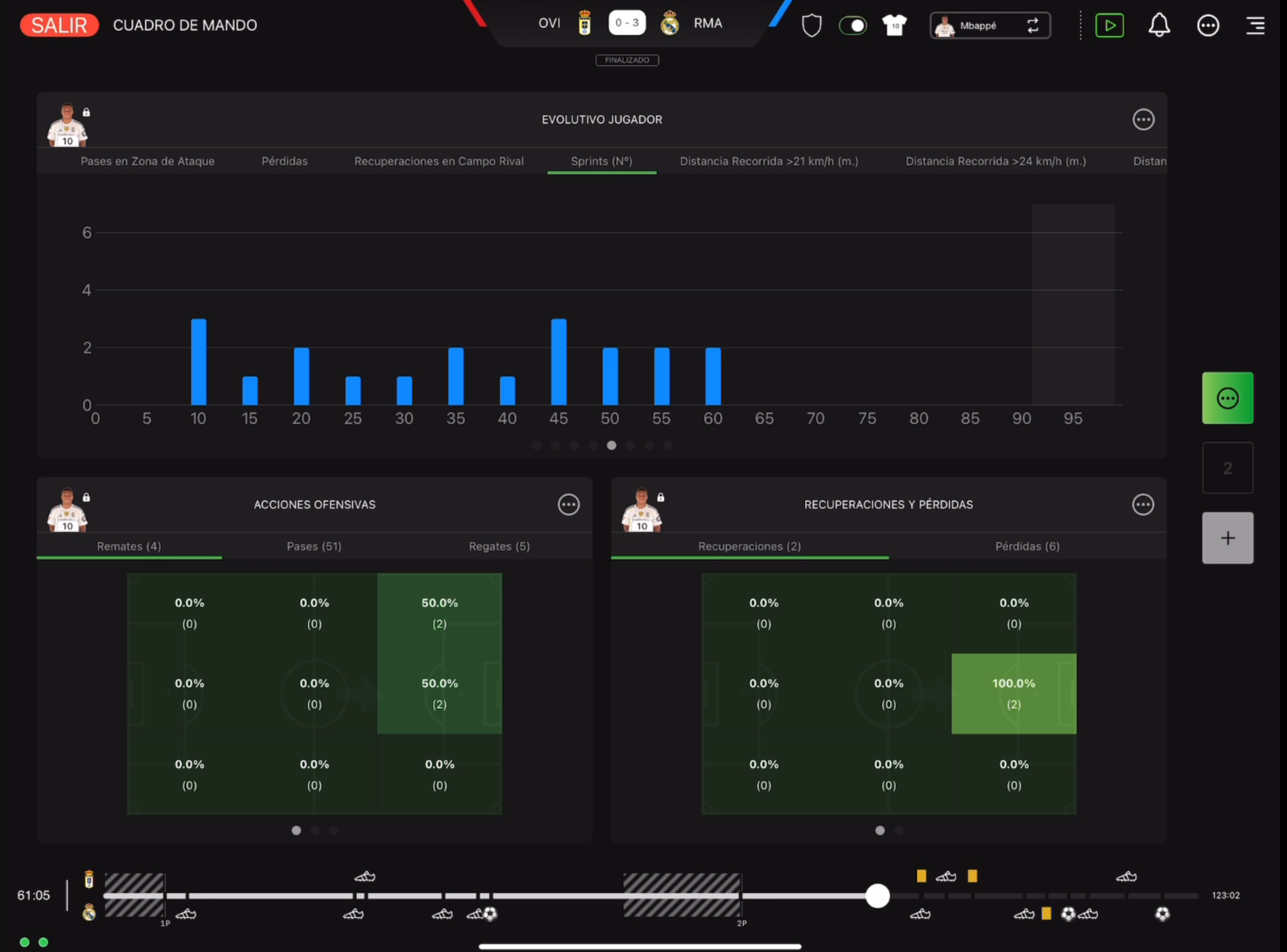
And with tools like Sportian Performance Live Pro (formerly Mediacoach Live Pro), coaches already have access to these data in real time. Alerts can flag when a player’s intensity drops without tactical justification—giving evidence to support (or challenge) the gut feeling of a substitution.
What this means for your work
- Plan pacing strategies: Key players who play the full 90 need load management in training to sustain intensity across matches.
- Optimize substitutions: Don’t just wait for visible fatigue—data shows the decline starts around the 55th minute.
- Use substitutes as tactical tools: Their physical edge can swing momentum, especially late in games.
- Leverage real-time data: Match analysis technology can confirm what your eyes suspect and help anticipate the drop before it costs you.
Limitations and next steps
This research covered one season and did not include internal load (heart rate, RPE). Future studies will integrate positional differences, contextual factors (match status, tactical interruptions), and comparisons across leagues. Still, the evidence is strong: roles and timing shape running performance, and coaches can act on it.
Keep learning
- Read the full scientific article: https://doi.org/10.5114/biolsport.2025.151645