


10 Jul Comparative Analysis of Physical Effort between Starters and Substitutes in Professional Football: A Study of LALIGA EA Sports 2022/23 Season

Introduction
Analyzing physical performance in professional football provides critical insights into the differences in effort between starters and substitutes. This study compares distances covered at various intensities, both in offensive and defensive phases, between starters and substitutes, while also considering differences in minutes played and positional variations. The data used are from LaLiga EA Sports, corresponding to the 2022/23 season.
Methodology
A database was used that collects physical performance data of players in matches from LaLiga EA Sports during the 2022/23 season. The analyzed metrics include:
- Total distance covered per minute (volume)
- Distance covered at more than 21 km/h per minute (high intensity)
- Distance covered at more than 24 km/h per minute (very high intensity)
Distances covered in the offensive phase (with possession) and defensive phase (without possession) were differentiated. Additionally, substitutes with less than 10 minutes played were excluded to avoid biases.
Results
Minutes Played
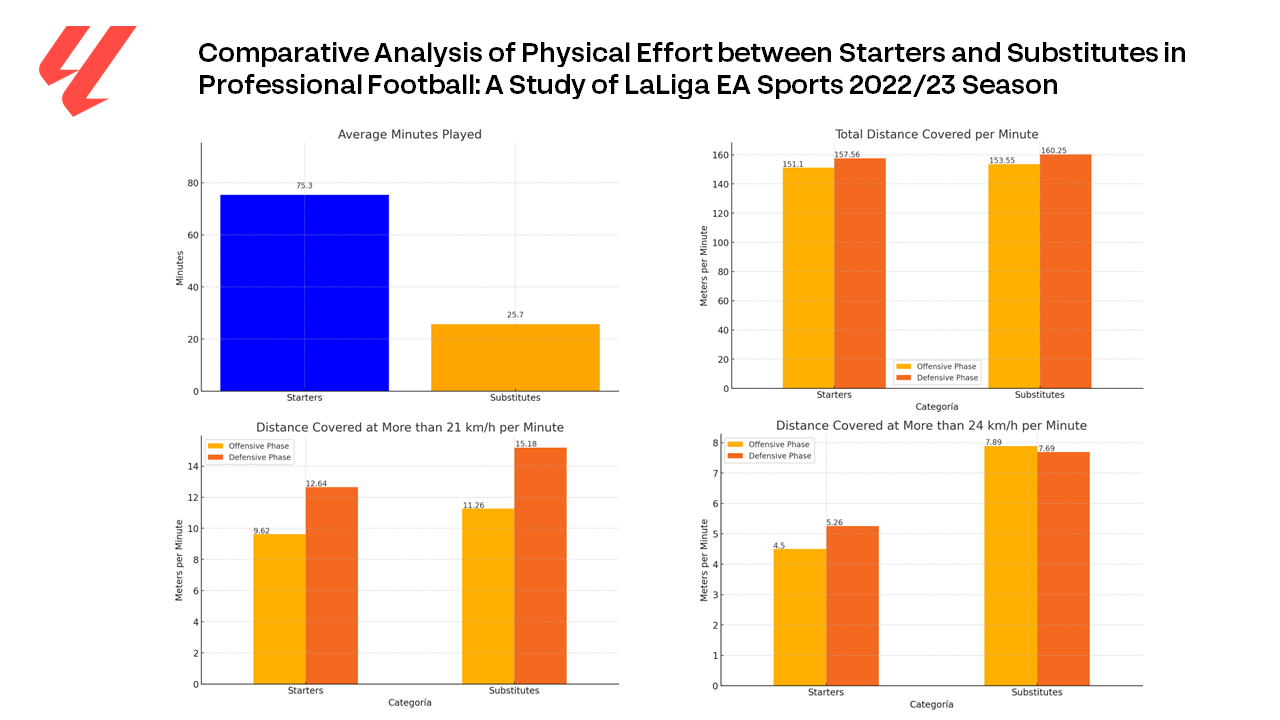
- Average minutes played by starters: 75.3 minutes
- Average minutes played by substitutes: 25.7 minutes
- Percentage difference: Starters play on average 193% more minutes than substitutes.
Distances Covered
Offensive Phase
- Total distance covered per minute with possession:
- Starters: 151.10 m/min
- Substitutes: 153.55 m/min
- Distance covered at more than 21 km/h per minute with possession:
- Starters: 9.62 m/min
- Substitutes: 11.26 m/min
- Distance covered at more than 24 km/h per minute with possession:
- Starters: 4.50 m/min
- Substitutes: 7.89 m/min
Defensive Phase
- Total distance covered per minute without possession:
- Starters: 157.56 m/min
- Substitutes: 160.25 m/min
- Distance covered at more than 21 km/h per minute without possession:
- Starters: 12.64 m/min
- Substitutes: 15.18 m/min
- Distance covered at more than 24 km/h per minute without possession:
- Starters: 5.26 m/min
- Substitutes: 7.69 m/min
Comparison between Phases
- Players cover more distance in the defensive phase than in the offensive phase.
- High and very high intensity (distances at more than 21 km/h and 24 km/h) are greater in the defensive phase, reflecting the additional effort needed to recover the ball and defend.
Positional Analysis
Data were grouped by position, considering the positions with the highest and lowest average values.
Starters
- Position with the highest offensive effort:
- Right Center Forward:
- Total distance with possession: 170.5 m/min
- Distance at more than 21 km/h with possession: 20.5 m/min
- Distance at more than 24 km/h with possession: 12.2 m/min
- Right Center Forward:
- Position with the lowest offensive effort:
- Left Double Pivot Midfielder:
- Total distance with possession: 130.2 m/min
- Distance at more than 21 km/h with possession: 3.7 m/min
- Distance at more than 24 km/h with possession: 1.8 m/min
- Left Double Pivot Midfielder:
Substitutes
- Position with the highest offensive effort:
- Right Center Forward:
- Total distance with possession: 175.3 m/min
- Distance at more than 21 km/h with possession: 23.4 m/min
- Distance at more than 24 km/h with possession: 15.0 m/min
- Right Center Forward:
- Position with the lowest offensive effort:
- Left Double Pivot Midfielder:
- Total distance with possession: 140.6 m/min
- Distance at more than 21 km/h with possession: 4.5 m/min
- Distance at more than 24 km/h with possession: 2.9 m/min
- Left Double Pivot Midfielder:
Discussion
The results confirm the hypothesis that substitutes, when entering the field, show greater physical effort compared to starters, both in the offensive and defensive phases. This is likely due to their fresher physical state and motivation to change their status from substitute to starter.
Furthermore, the defensive phase demands greater physical effort, reflected in the higher distances covered at high and very high intensity. Forward positions exhibit the highest effort values, while defensive midfielders (double pivot) show the lowest values, highlighting the different physical demands according to position.
Conclusion
This study underscores the importance of considering both the status of being a starter or substitute, as well as the phase of the game and positional demands to fully understand the physical requirements in professional football. Coaches and physical trainers should take these differences into account to optimize performance and manage players’ workload.