


28 Jun Physical Performance Analysis of LALIGA EA Sports Players

Introduction
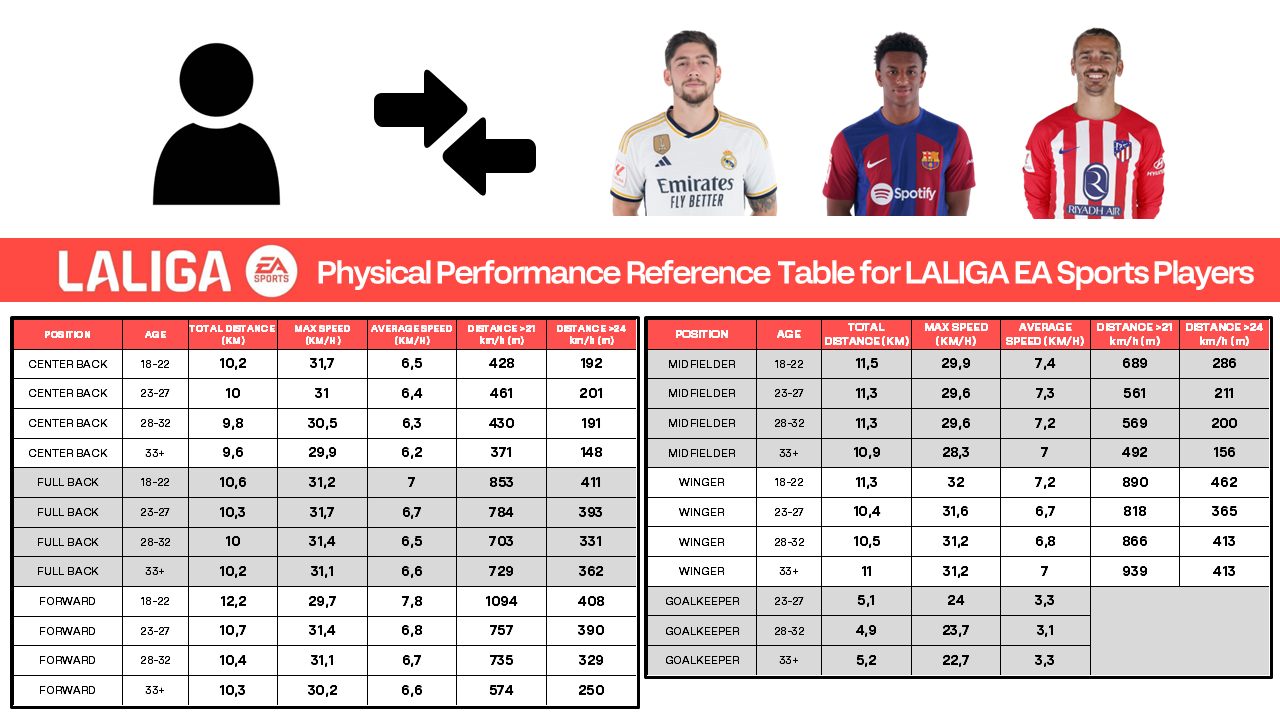
Physical performance in professional football is a crucial aspect for sporting success. This study analyzes physical performance data of LALIGA EA Sports players during the 2023/24 season, providing a comparative reference for different positions and age groups. The results allow for an evaluation of how different positions perform in terms of distance covered, maximum speed, average speed, and high-intensity distances.
Methodology
Data from players who have played more than 900 minutes in the 2023/24 season were analyzed. The performance metrics include:
- Total distance covered (km)
- Maximum speed (km/h)
- Average speed (km/h)
- Distance at more than 21 km/h (m)
- Distance at more than 24 km/h (m)
Players were classified into six positions: center back, full-back, forward, midfielder, winger, and goalkeeper. Age groups were defined as 18-22, 23-27, 28-32, and 33+ years.
Results
1. Total Distance Covered Data indicates that full-backs are the players who cover the greatest total distance, with an average of 10.6 km per match for the 18-22 age group. On the other hand, goalkeepers cover the least distance, with an average of 9.7 km for the 33+ age group.
2. Maximum Speed Forwards register the highest maximum speeds, reaching up to 31.7 km/h in the 18-22 age group. Goalkeepers show the lowest maximum speeds, with an average of 29.7 km/h in the 33+ age group.
3. Average Speed The average speed is highest among midfielders and full-backs, with values around 7.0 km/h in the 18-22 age group. Goalkeepers, as expected, have the lowest average speed, around 5.5 km/h.
4. High-Intensity Distance (>21 km/h) Full-backs again lead in this metric, with an average distance of 853 meters per match for the 18-22 age group. Wingers and forwards also show high values in this metric.
5. High-Intensity Distance (>24 km/h) Full-backs and forwards dominate this category, with average distances of 411 meters and 192 meters, respectively, for the 18-22 age group.
Discussion
General Trends The results show that full-backs and midfielders tend to cover greater distances and maintain higher average speeds, reflecting their dynamic roles on the field. Forwards excel in maximum speed, which is critical for fast offensive plays and counterattacks.
Differences by Age Comparisons between age groups indicate that while maximum speed may slightly decrease with age, older players maintain their performance through experience and tactical positioning. This is evident in positions that do not rely heavily on explosive speed.
Differences by Position Full-backs require high levels of endurance and sustained speed, while forwards need explosiveness. Midfielders balance endurance and speed, being essential in both defense and attack. Goalkeepers, although covering less distance, must be prepared for quick and explosive movements.
Conclusions
This study provides a valuable reference for evaluating the physical performance of football players in different positions and age groups. The findings can be used to design specific training programs and improve players’ physical preparation.