


09 Sep The Revolution of Football Analysis: Transition Metric Based on Convex Hull
In modern football, data analysis has become an essential tool for coaches and technical teams. From traditional metrics like ball possession to advanced models like xT (Expected Threat), technology is redefining the way we understand the sport. One of the most exciting concepts being explored is the use of Convex Hull to measure the quality of transitions in football, a metric that promises to revolutionize tactical analysis.
What is Convex Hull in Football?
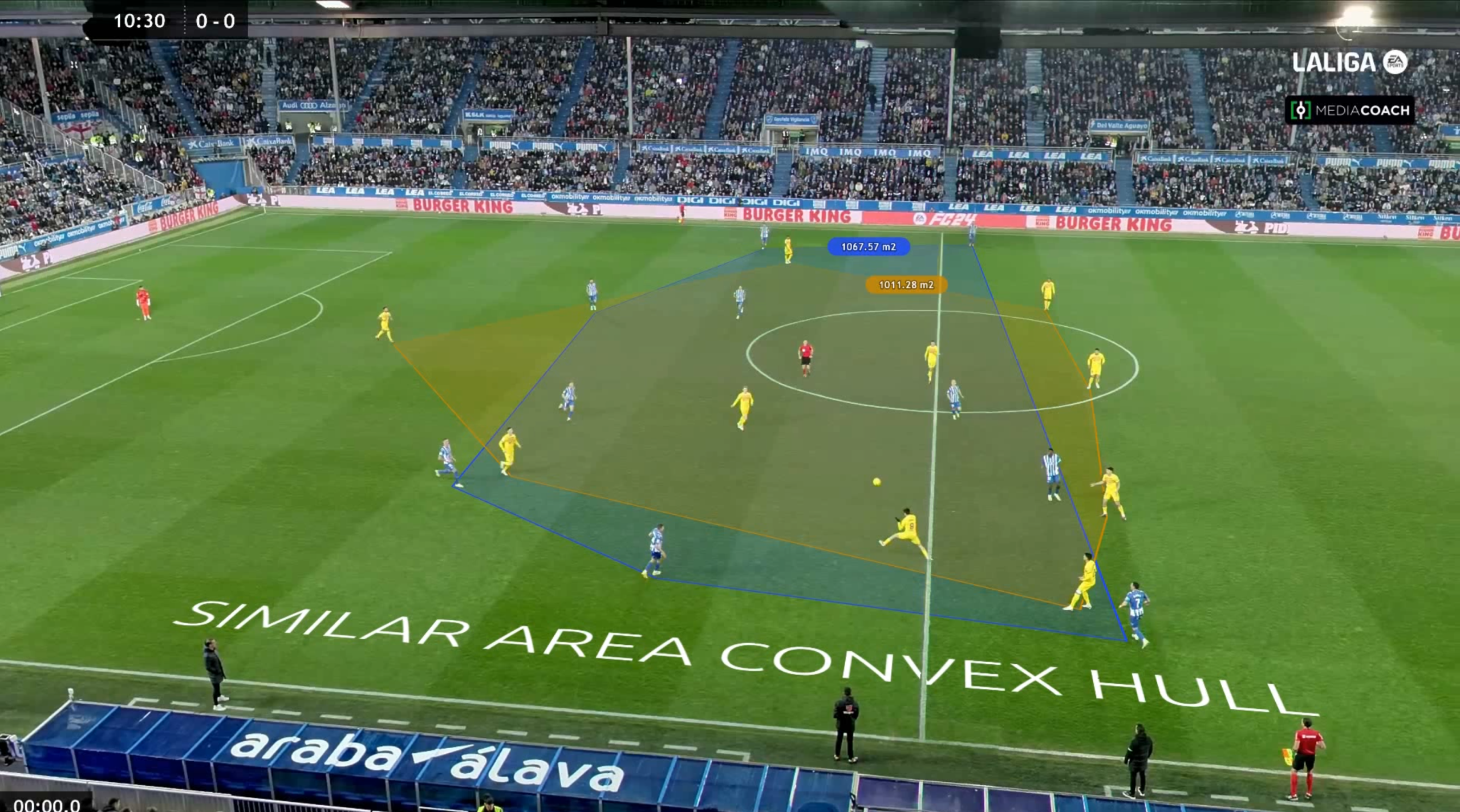
The Convex Hull, in geometric terms, is the smallest convex boundary that contains a set of points. Applied to football, these points are the players’ positions on the field. In an attacking phase, a team tends to occupy more space, which is reflected in a larger Convex Hull. In defense, the team aims to compact, reducing the area of its Convex Hull to protect the goal and close down spaces.
This geometric tool provides a quantitative way to measure how teams occupy and manage space on the field during different phases of the game. Traditionally, Convex Hull has been used in static studies, measuring the space a team occupies at specific moments, whether attacking or defending. However, the new metric we are proposing takes this analysis a step further.
Transition Metric: Speed and Quality in Convex Hull Adjustment
Transitions are crucial moments in football. The shift from attack to defense (or vice versa) in an instant can define the success or failure of a play. The metric we are developing measures the speed and quality with which a team adjusts its Convex Hull in a transition, whether expanding to attack or shrinking to defend after losing or recovering the ball.
The key to this metric is measuring the time it takes for a team to adjust the area of its Convex Hull after a transition during open play (without interruptions). The shorter the adjustment time, the more efficient the team is at adapting to the new phase of play. This has applications both in defense, where teams need to close down spaces quickly, and in attack, where maximizing space is crucial to creating chances.
Real-Time Application of the Metric
The application of this metric goes beyond post-match analysis. The idea is to integrate it into real-time analysis tools, providing coaches with a clear, dynamic view of how their team adjusts after key transitions. By visualizing this adjustment in real-time via video overlay on the match itself, technical staff will be able to make more informed decisions about their team’s tactics and organization in critical moments.
Being able to see the area of Convex Hull live after a ball loss or recovery gives coaches a competitive advantage. It allows them to observe how quickly their players regroup to defend or how they spread out to exploit a counterattack, and adjust their tactical instructions accordingly.
Competitive Edge in Transitions
Teams that adjust their Convex Hull more quickly after a transition have a significant advantage. In defense, a team that compacts quickly can reduce the opponent’s opportunities, closing down dangerous spaces and limiting passing options. In attack, a team’s ability to expand quickly creates more offensive options and opens up space in the opponent’s defense, maximizing their potential to create danger.
This metric will also allow us to analyze the differences between teams’ playing styles. Some teams prioritize quick defensive compactness after losing possession, while others maintain a broader structure throughout to facilitate quick transitions into attack. The new metric will enable coaches to better understand these dynamics and adapt their strategies to optimize team performance.
The Future of Tactical Analysis in Football
This metric is just one of many innovations emerging in the world of tactical analysis. Real-time data tools, like those being developed for professional environments, allow for deeper, more detailed analysis of every aspect of the game. From spatial usage to individual player decisions, football is becoming a sport increasingly studied and optimized from a tactical perspective.
With the implementation of this Convex Hull-based metric, a new avenue opens for analyzing transitions in football. Teams will be able to measure not just how they play in attack or defense, but how they respond and adapt to possession changes, which is vital in modern football. This metric gives coaches a new tool to understand and improve their teams’ performance in the most decisive moments of the game.