


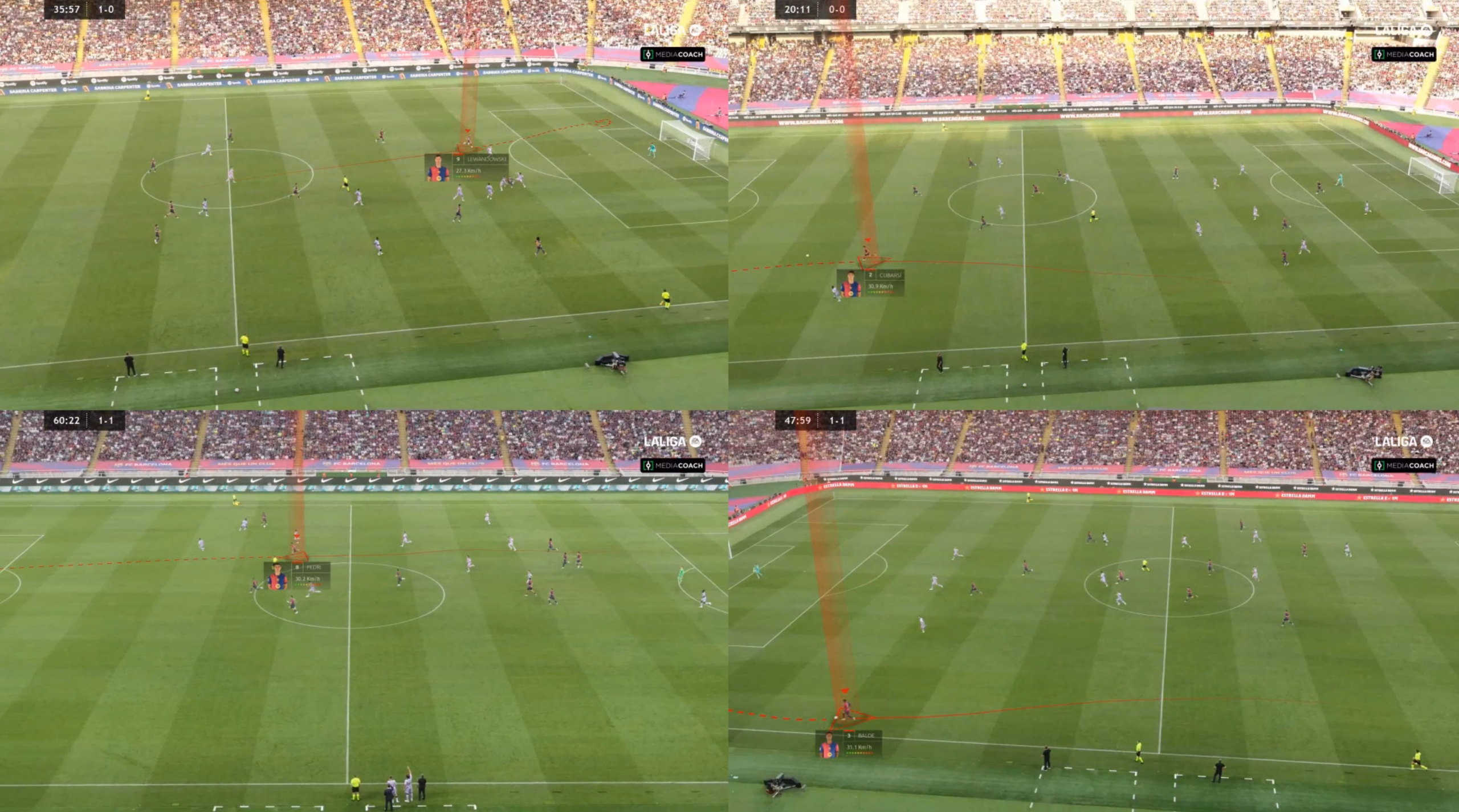
30 Sep How and When Players Sprint Based on Their Position: Key Insights for Training Sessions That Simulate Real Match Scenarios
Football: A Sport of Intermittent and Unpredictable Efforts
Football is characterized by a series of intermittent efforts of unpredictable duration and variable recovery times. Throughout a match, players experience pauses in activity followed by explosive actions that demand maximum physical performance. These high-intensity moments, such as maximal sprints, often coincide with key situations in the game, both in attack and defense.
Given the unpredictable nature of these efforts and the variability in recovery times, coaches must simulate these conditions in training. Preparing players for these scenarios is essential for them to handle moments of high physical demand more efficiently and with less risk of injury. The more accustomed players are to training under these conditions, the better they will perform during those decisive moments in the match.
When and How Do Maximal Intensity Sprints Occur?
The study, available at: https://doi.org/10.1080/24733938.2022.2100462, reveals that the fastest sprints in LaLiga happen primarily at the beginning (0′-15′) and end (75′-90′) of the match. This means coaches must ensure their players are prepared for high-intensity sprints right from the warm-up and under fatigue conditions at the end of the game.
Additionally, most of these sprints occur without ball possession and in non-linear trajectories, highlighting the importance of training situations that mimic these scenarios. Incorporating directional changes, sprints without the ball, and exercises that reproduce match conditions is key to adequately preparing players.
Sprints by Position: Tactical Keys
Each position on the field presents specific sprint demands:
- Center Backs (CB): Focus on defensive sprints to intercept balls and cover defensive spaces.
- Full Backs (FB): Alternate between offensive sprints to exploit space on the wings and defensive sprints to recover their position.
- Midfielders (MF): Primarily engage in sprints to recover possession and press opponents.
- Wingers and Forwards (WMF and FW): Perform more offensive sprints to break defensive lines, create chances, and enter the opponent’s penalty area.
By parameterizing these high-demand moments by position, coaches can design training sessions that precisely simulate the physical demands of each role during a match.
Predicting Key Moments: A Data-Based Model
Building on this research, a predictive model could be developed that analyzes both the opponent’s and one’s own team’s efforts, predicting when and in what tactical contexts maximal sprints will occur. This would allow coaches to prepare their teams for these efforts with greater certainty, improving performance in critical scenarios and reducing the risk of overload injuries.
Sprint Characteristics
Sprints last between 4.9 and 9 seconds, cover distances ranging from 30 to 55 meters, and reach speeds of 30 to 32 km/h. Training long sprints and simulating match contexts is essential to replicate these demands.
Conclusion
Simulating real match situations, especially those that coincide with moments of maximum physical demand, is key to preparing players. By parameterizing these efforts by position and using predictive data, coaches can optimize performance in critical match situations and reduce injury risk.