


18 Nov Does More Effective Playing Time Ensure More Excitement?

When it comes to enhancing the game, many coaches tend to think that more effective playing time might mean more spectacle, more goals, and ultimately more excitement for fans. But what is the reality? At LaLiga, we have deeply analyzed how effective playing time influences match outcomes, and the results are more revealing than you might imagine. Here, we explain how you can apply these findings to optimize your training sessions and strategies.
Methodology and Research Context
The study was conducted using data from LaLiga EA Sports for the 2023/24 season. Our analysis focused on exploring the relationship between effective playing time (the period when the ball is actively in play) and various match outcomes, such as the number of goals and the level of competitiveness in the score.
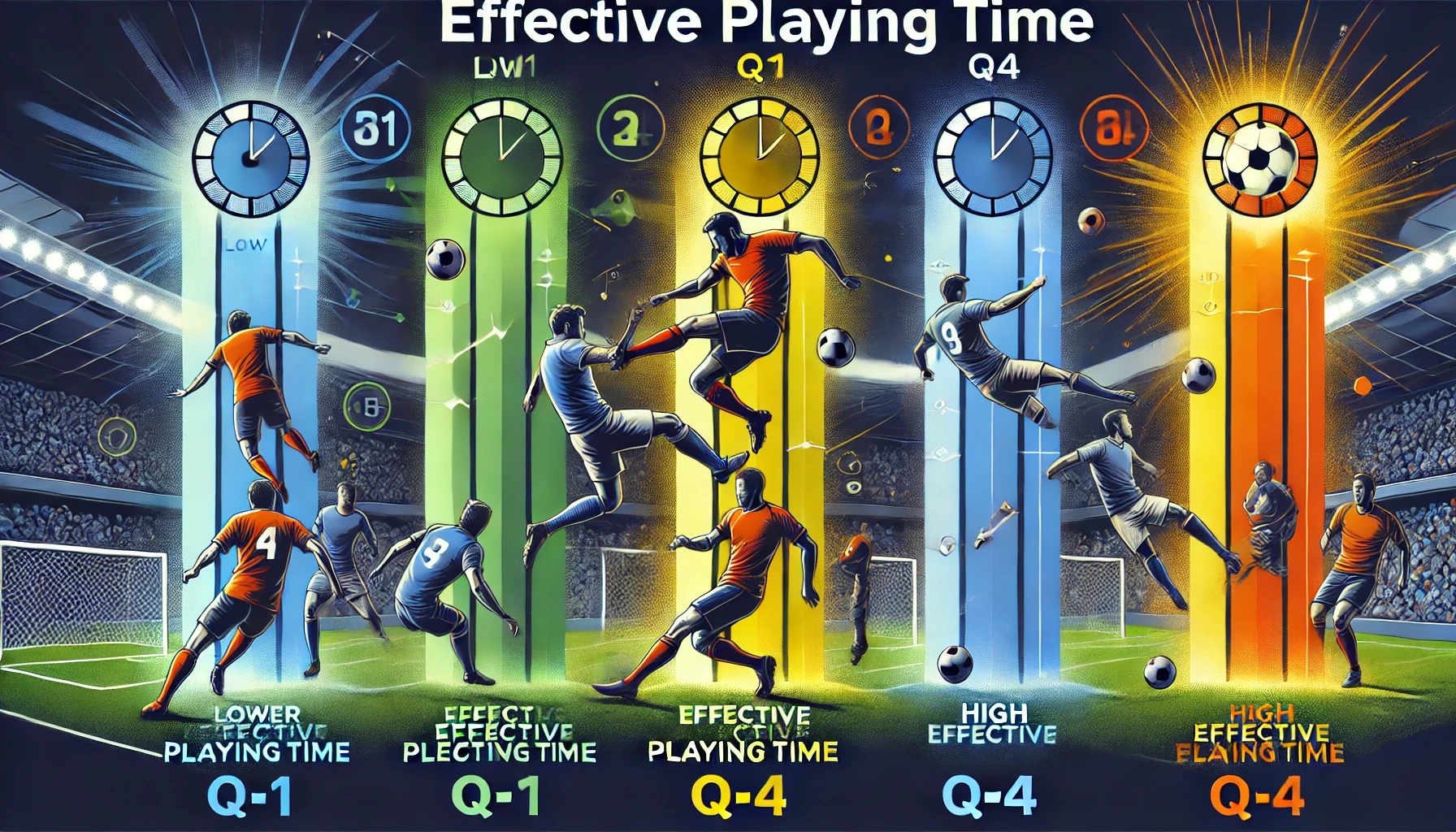
To conduct the analysis, we divided matches into four quartiles based on effective playing time, from Q1 (lowest effective time) to Q4 (highest effective time), allowing us to observe differences and trends across these groups. We also established categories based on the number of goals and score equality:
- High number of goals (3 or more) and Low number of goals (0-2).
- Regarding equality, we defined equal matches as those with a difference of one goal or none (including draws) and unequal matches as those with greater differences. This approach enabled us to identify how match dynamics change depending on effective playing time.
Less Effective Playing Time, More Equality
The data makes one thing clear: matches with less effective playing time tend to be more balanced. In matches with little effective time (Q1), we observed a high proportion of closely contested matches, whether with many or few goals. In other words, the final score showed much greater competitiveness. This suggests that if we want a close, tightly contested match, increasing effective playing time is not always necessary.
How can you apply this?
In training sessions, it may be more effective to focus on maintaining high intensity during shorter periods of active play, recreating high-competitiveness scenarios within limited time frames. This can help your players adapt better to maintaining control and parity when pressure is high and time is limited.
More Effective Playing Time Does Not Guarantee More Goals or Competitiveness
One of the most interesting findings was that more effective playing time does not necessarily lead to more goals. Matches with a high level of effective playing time (Q4) did not produce significantly more goals than those with less effective time. Additionally, when comparing matches with a high number of goals, we found that those with more effective playing time tended to be less balanced. In other words, a larger gap in the score was more common, reducing overall competitiveness.
How can you apply this?
This may change the way you prepare matches. Rather than focusing solely on increasing effective playing time, it may be more useful to focus on strategies that ensure competitiveness and a balanced score. Practicing scenarios of minimal advantage or disadvantage can be key to maintaining match control, especially when effective time increases.
Parity Matters More Than Time
Matches with less effective playing time not only displayed greater equality in terms of goals but also had a higher percentage of low-scoring tight matches. In contrast, high effective playing time was associated with more lopsided matches, even when there were many goals. This suggests that how you play within the available time is more important than merely extending the play duration.
How can you apply this?
As a coach, you can focus your strategies on maintaining score parity, using techniques to wear down the opponent or playing efficiently during critical phases of the game. Quick transitions, possession management at key moments, and mental preparation to play under time constraints are areas you can work on.
Takeaway Conclusions for the Field
LaLiga’s analysis leads to an intriguing conclusion: more effective playing time can lead to less balanced matches, while a more limited timeframe tends to maintain competitiveness. This implies that keeping matches engaging and exciting does not always depend on extending play time but rather on how that time is utilized. Focus on maintaining high intensity during brief periods, train your team to stay focused in tight situations, and use strategies to ensure score parity.