


15 Ene It’s Not Just About Running More, but Running Smarter and Making More Actions with Less Effort
In professional football, the smallest details make a big difference. In a recent internal study conducted by the Football Intelligence & Performance Area of LALIGA, «action rate» and «high-intensity distance rate» were analyzed in professional players over an entire season. The results shed light on a key aspect of performance: the efficiency of players in high-demand physical situations. But what does this mean for coaches? Here, we explain it in a clear and practical way.
Research Context
The study divided the teams into four groups based on their league performance (Q1: teams with the most points, Q4: teams with the fewest points) and evaluated the players using two main indicators:
- Action rate: the number of actions a player performs per effective minute of play, divided into:
- Offensive action rate
- Defensive action rate
- Total action rate
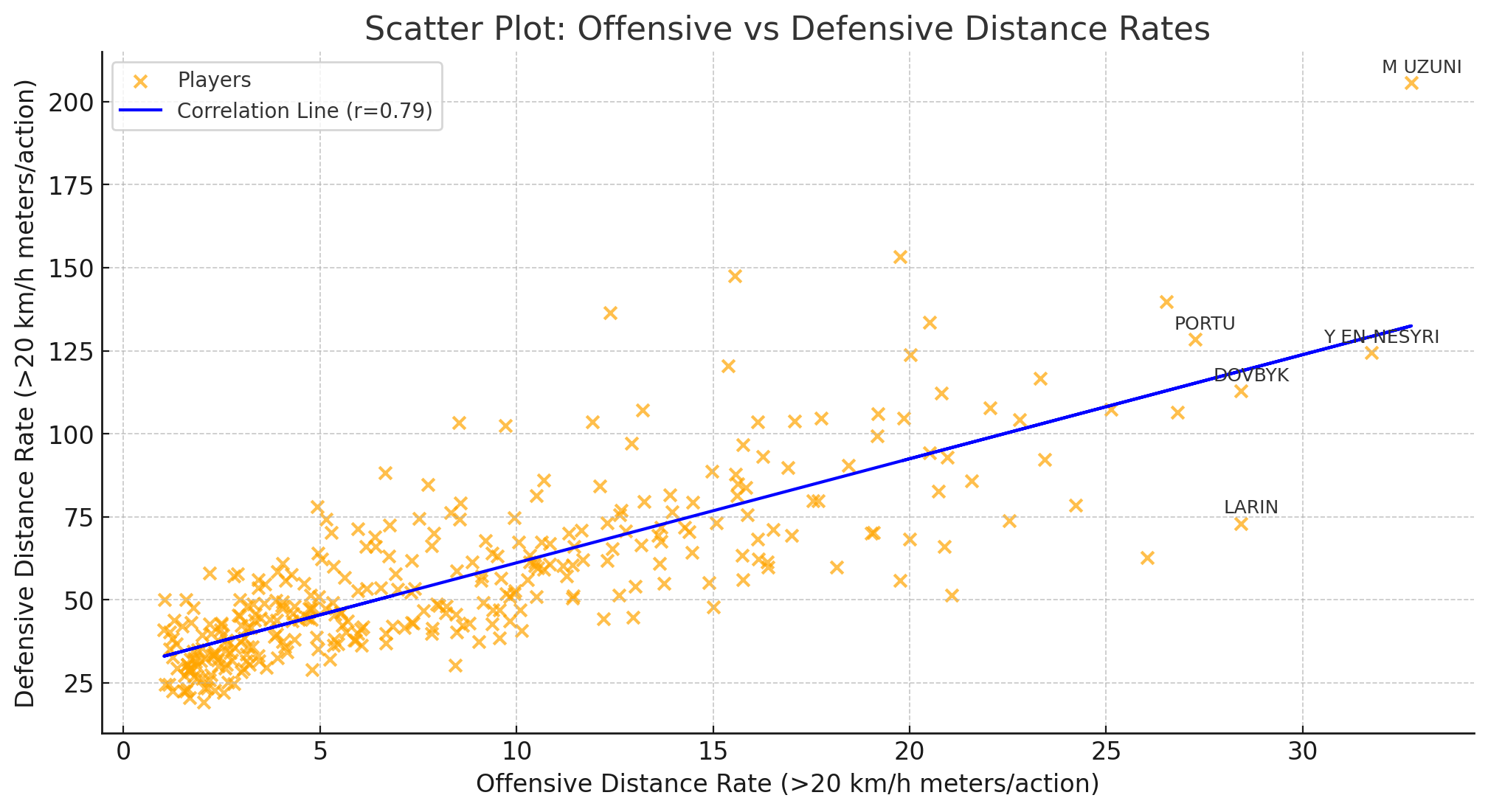
- High-intensity distance rate per action: the meters covered by a player at more than 20 km/h per action performed, divided into:
- Total high-intensity distance rate per action
- Offensive high-intensity distance rate per action
- Defensive high-intensity distance rate per action
The methodology involved collecting data from players throughout the season, classifying teams into quartiles based on their points, and conducting statistical comparisons between Q1 and Q4.
Top 5 Action and Distance Rates
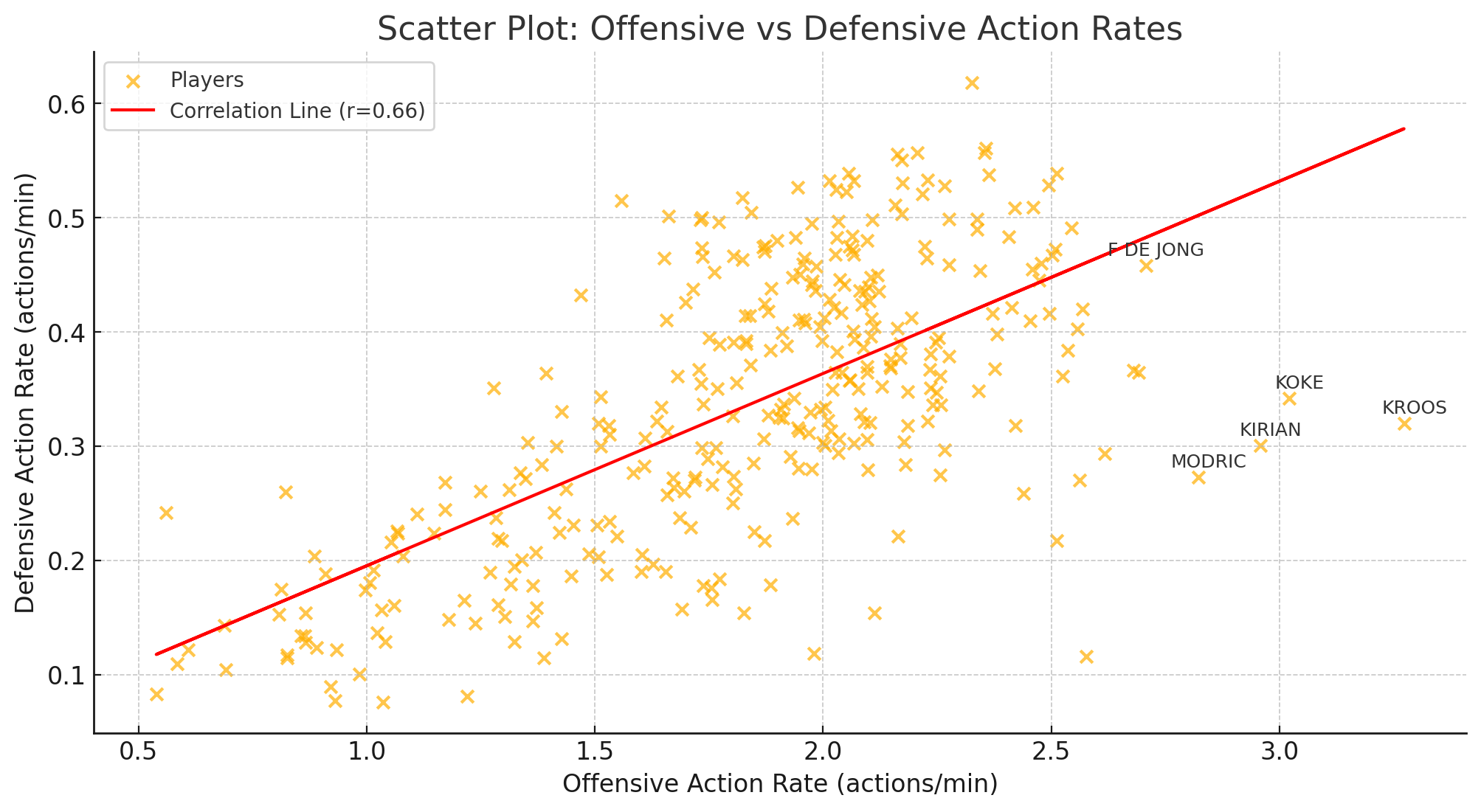
Offensive Action Rate (from highest to lowest value):
- Kroos (Real Madrid) – 3.27 actions/min
- Koke (Atlético de Madrid) – 3.02 actions/min
- Kirian (UD Las Palmas) – 2.96 actions/min
- Modric (Real Madrid) – 2.82 actions/min
- Frenkie de Jong (FC Barcelona) – 2.71 actions/min
Defensive Action Rate (from highest to lowest value):
- Zubeldia (Real Sociedad) – 0.62 actions/min
- Le Normand (Real Sociedad) – 0.56 actions/min
- Sergi Cardona (UD Las Palmas) – 0.56 actions/min
- Kike Salas (Sevilla FC) – 0.56 actions/min
- Bade (Sevilla FC) – 0.56 actions/min
Total Action Rate (from highest to lowest value):
- Kroos (Real Madrid) – 2.03 actions/min
- Frenkie de Jong (FC Barcelona) – 1.89 actions/min
- Kirian (UD Las Palmas) – 1.81 actions/min
- Cubarsi (FC Barcelona) – 1.79 actions/min
- Modric (Real Madrid) – 1.76 actions/min
Total High-Intensity Distance Rate per Action (from lowest to highest value):
- Kroos (Real Madrid) – 4.48 m/action
- Blind (Girona FC) – 6.02 m/action
- Parejo (Villarreal CF) – 6.38 m/action
- Frenkie de Jong (FC Barcelona) – 6.45 m/action
- David López (Girona FC) – 6.46 m/action
Offensive High-Intensity Distance Rate per Action (from lowest to highest value):
- Romeu (FC Barcelona) – 1.03 m/action
- Parejo (Villarreal CF) – 1.05 m/action
- Sokratis (Real Betis) – 1.05 m/action
- Pezzella (Real Betis) – 1.16 m/action
- I. Martínez (FC Barcelona) – 1.17 m/action
Defensive High-Intensity Distance Rate per Action (from lowest to highest value):
- Sergio Ramos (Sevilla FC) – 19.14 m/action
- Nastasić (RCD Mallorca) – 20.44 m/action
- A. Raíllo (RCD Mallorca) – 22.01 m/action
- Aridane (Rayo Vallecano) – 22.40 m/action
- David García (CA Osasuna) – 22.40 m/action
Analysis by Position and Key Rates
The detailed analysis of rates by player position revealed interesting differences that can be useful for coaches when planning specific training sessions based on each player’s role on the field.
1. Defenders
- Total action rate: Defenders tend to have a lower action rate compared to midfielders, reflecting their more containment-oriented role with fewer constant actions.
- Total high-intensity distance rate per action: They stand out for covering relatively short distances at high intensity, indicating efficient work in their zone with limited movement to critical actions.
2. Midfielders
- Total action rate: Midfielders lead in action rate, especially in the offensive phase, highlighting their key role in transition and play creation.
- Offensive high-intensity distance rate per action: They cover fewer meters per offensive action compared to forwards, reflecting a more positional game and continuous support.
3. Forwards
- Offensive action rate: Although their action rate is lower than that of midfielders, their contribution is vital in decisive game actions.
- Offensive high-intensity distance rate per action: They have a higher offensive distance rate, indicating the need for constant sprints and runs at high intensity.
Conclusion by Position
This analysis shows that the training approach should vary depending on the position:
- For defenders, it is key to work on efficiency in movements and decisive actions.
- For midfielders, tasks should be designed to increase action density and improve quick decision-making.
- For forwards, training should focus on execution speed and high-intensity runs.
Key Results and Practical Applications
1. Teams with More Points Perform More Actions per Minute (Total Action Rate)
- Result: Q1 teams had a significantly higher total action rate than Q4 teams (1.17 vs. 1.01 actions per effective minute, p < 0.05).
- Application: This data suggests that higher-performing teams are more active and participate more in the game, both in the offensive and defensive phases. Coaches can use this information to increase action density in their training sessions by designing tasks with fewer pauses and more transitions.Use Case: Design exercises where players must chain actions (passes, controls, off-the-ball movements) in a reduced space, simulating real game situations. This will enhance players’ ability to maintain a high action rate during the game.
2. Teams with More Points Cover Less High-Intensity Distance per Action
- Result: Q1 teams had a lower total high-intensity distance rate per action than Q4 teams (14.7 meters vs. 18.4 meters per action, p < 0.05).
- Application: This finding reveals that higher-performing teams are more efficient in their movements, managing to perform more actions with less high-intensity distance covered. Coaches can work on this efficiency through small-sided games where decision-making and positioning are key.Use Case: Training sessions aimed at improving positioning and game reading, reducing unnecessary movements, and optimizing actions. Drills such as high-intensity rondos or outnumbered situations help players make quick and efficient decisions.
3. You Don’t Always Need to Cover Great Distances to Be Effective
- Result: Players with better action rate results tend to cover less high-intensity distance per action, demonstrating that the key is not just running a lot, but knowing how and when to run.
- Application: Train players to be smarter in their movements and improve their game perception. The focus should not only be on the volume of running but also on the quality of each action.Use Case: Introduce active pauses in training where the player must identify the right moment to run at high intensity, fostering the development of tactical intelligence.
Key Conclusions for Coaches
- The most successful teams not only perform more actions per minute but are also more efficient in their high-intensity movements.
- Increasing action density in training and working on movement efficiency can be key to improving performance.
- Designing exercises that encourage quick decision-making, proper positioning, and intelligent use of high-intensity runs is essential to maximize players’ efficiency.
This study leaves us with a clear lesson: it’s not just about running more, but running smarter and making more actions with less effort. Applying these principles in daily training can make a difference in a team’s performance.