


17 Ene Beware of Average Age Statistics in Football! What Really Matters
In professional football, data is fundamental to understanding teams and planning strategies. However, the most commonly used statistics can sometimes be misleading if not analyzed correctly. One such case is the average age of squads. While it may seem like a straightforward metric, it can be deceiving if we don’t consider key factors like the effective playing time of players.
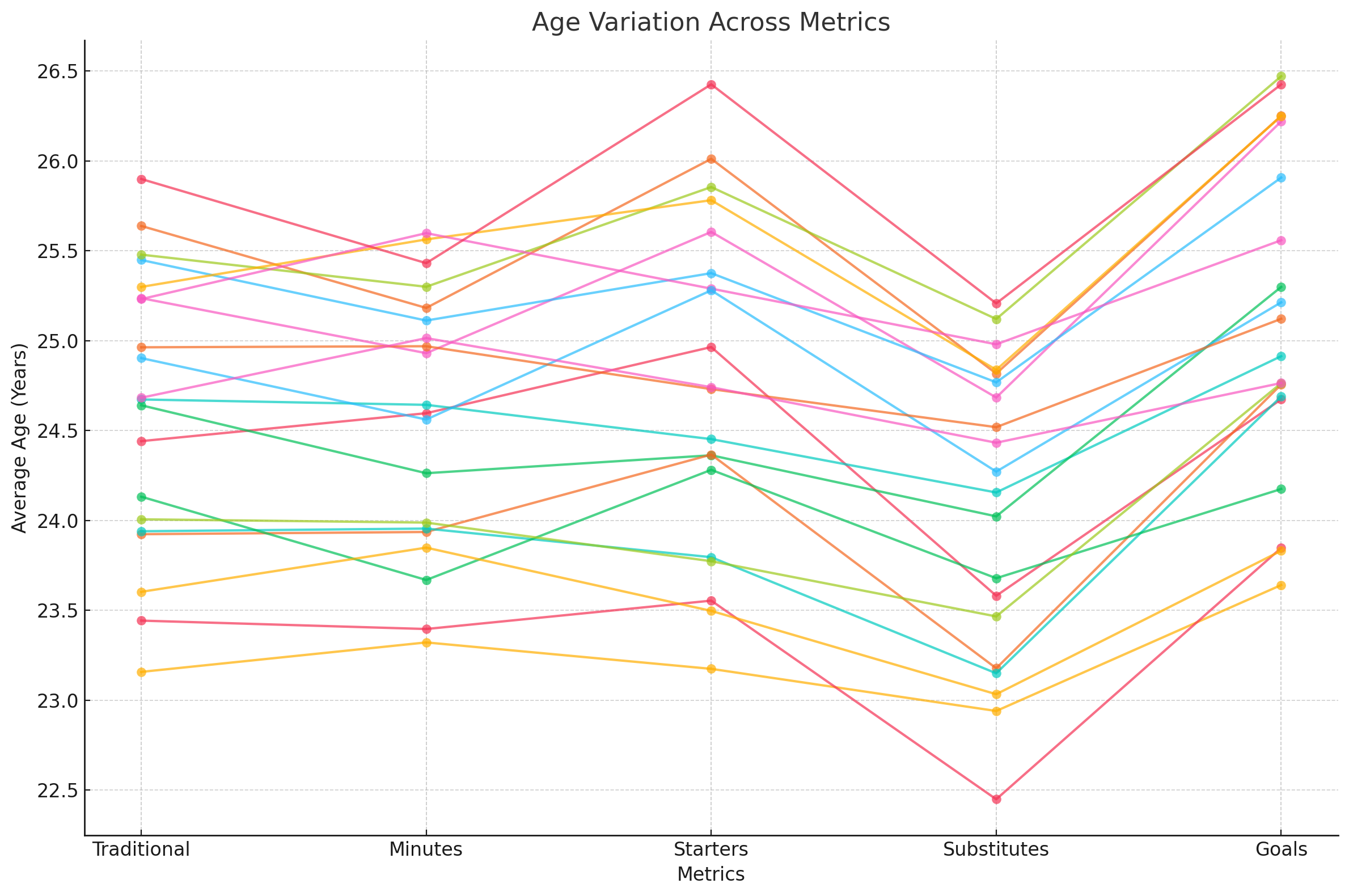
From LaLiga’s Football Intelligence & Performance Area, we conducted a comprehensive study using data from LaLiga EA Sports 2024/25, first half of the season (19 matchdays), which demonstrates how traditional average age can offer an incomplete view. A more detailed and tailored analysis can help coaches make better decisions in training and competition.
Why is traditional average age not enough?
The traditional average age assigns the same weight to all players on the squad, regardless of how many minutes they play. This creates situations where teams with many young players (who barely participate) appear «younger» than they actually are on the field. For example:
- Getafe CF, traditionally considered one of the youngest teams with an average age of 25.27 years, reveals a different reality when weighted by minutes played. In this case, the average age rises to 27.27 years, an increase of 7.91%. This shows that older players are the ones truly leading the workload on the pitch.
How does weighting by different metrics affect results?
Our research analyzed the impact of weighting age by various key indicators:
- Minutes played as starters:
- The average age also slightly increases when focusing on players who start matches. Overall, this global increase was 2.59% compared to the traditional age.
- Real Valladolid CF stood out in this category, with a significant increase in average age.
- Minutes played as substitutes:
- When weighted by minutes played as substitutes, the average age decreases by 0.72%, showing that substitutes tend to be younger players.
- RCD Mallorca led in this category, with a notable decrease compared to the traditional average.
- Offensive and defensive actions:
- When weighted by offensive actions, the global average age increases by 2.71%, while defensive actions raise it by 2.38%.
- In offensive actions, RCD Espanyol stood out with a significant increase of 8.25%.
- In defensive actions, Valencia CF stood out with a 5.19% increase in this metric.
- Goals scored:
- The average age weighted by goals scored is 2.93% higher than the traditional average.
- The most notable case was FC Barcelona, where the average age rose from 23.60 years to 27.86 years (+18.05%), reflecting that goal scorers tend to be older players.
- However, it’s also worth highlighting Real Madrid, which ranks third in this metric with an average age of 24.81 years, reflecting an interesting reliance on younger goal scorers.
Top 5 teams by average age across different metrics
Traditional:
- FC Barcelona: 23.60 years.
- Valencia CF: 23.82 years.
- Real Sociedad: 24.88 years.
- Real Valladolid CF: 24.93 years.
- Getafe CF: 25.27 years.
Minutes played:
- Valencia CF: 23.90 years.
- FC Barcelona: 24.57 years.
- Real Valladolid CF: 25.23 years.
- Real Sociedad: 25.29 years.
- RCD Espanyol: 25.45 years.
Minutes played as starters:
- Valencia CF: 23.79 years.
- FC Barcelona: 24.80 years.
- Real Valladolid CF: 25.14 years.
- RCD Espanyol: 25.31 years.
- Real Sociedad: 25.52 years.
Minutes played as substitutes:
- FC Barcelona: 22.68 years.
- Real Sociedad: 23.58 years.
- Getafe CF: 23.69 years.
- Valencia CF: 24.68 years.
- RC Celta: 24.86 years.
Goals scored:
- Valencia CF: 24.00 years.
- Real Sociedad: 24.69 years.
- Real Madrid: 24.81 years.
- UD Las Palmas: 25.55 years.
- Sevilla FC: 25.78 years.
Practical applications for coaches
The results of this research have direct implications for coaches, who can use these findings to:
- Plan training better: Knowing that veteran players concentrate certain key actions (goals, offensive or defensive actions) can help adjust workloads and prevent injuries.
- Make better decisions during competition: If substitutes are typically younger, these players can be utilized to bring freshness at key moments in the game.
- Manage generational transitions effectively: Understanding which player profiles lead in minutes and actions helps identify where to incorporate young talent and how to integrate them progressively.
Conclusion
The traditional average age of squads can be misleading. Weighting by key metrics such as minutes played, actions on the field, or goals provides a more realistic and useful perspective for coaches’ day-to-day work. At LaLiga, we continue to work on translating this research into the language of coaches, making it accessible and applicable to their real-world needs.