


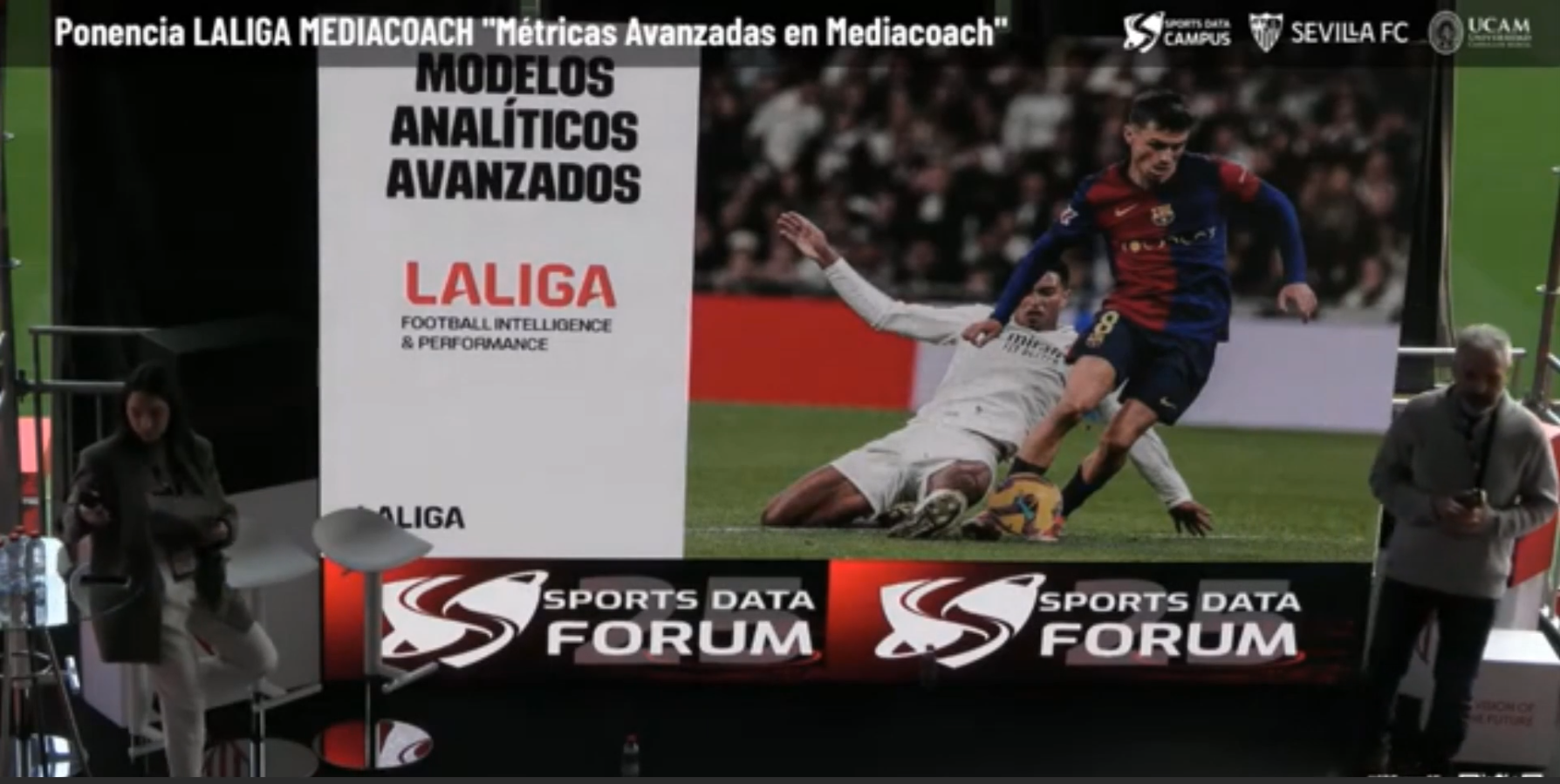
04 Abr Optimization in Football Data Analysis: Innovations and New Tools for Decision-Making
Football, like many other sports, has evolved beyond being merely a game of physical skill. Today, data plays a crucial role in decision-making, both on and off the pitch. However, there is still a significant gap between traditional analysis based on statistics and the use of advanced technologies such as player tracking, space analysis, and artificial intelligence.
At LALIGA’s Football Intelligence & Performance Area, we address this challenge by integrating data-driven solutions into the technical processes of clubs. These analyses are supported by cutting-edge technology providers like Sportian and Footovision, and rely on high-quality data sources such as OPTA and Tracab.
In this article, we will explore how Mediacoach and other advanced analytical models have transformed the way coaches and analysts understand and optimize team performance, leveraging new technologies to improve both strategy and on-field execution. Over the past few years, I’ve had the opportunity to work directly with professional clubs, and I want to share some of the key lessons I’ve learned during this journey.
The Challenge of Measuring the Immediate: The Importance of Ball Tracking
One of the biggest challenges in modern football analysis is ball tracking. This task becomes even more complex when dealing with high balls, where tracking can be affected by factors like the crowd or lighting conditions. While many performance analysis systems focus on aspects such as acceleration, speed, or number of touches, the reality is that the ball is the central element of the game. Yet, conventional tools are not always able to capture this variable accurately.
In football, ball tracking is essential not only to measure distance but also to understand how plays develop and how players interact with the ball. This type of analysis might seem secondary at first glance, but upon deeper inspection, it proves to be one of the most critical elements for predicting game dynamics.
In fact, ball tracking represents the most technically demanding part of tracking data. When the ball rises above player height, it easily blends into the stands, even if it’s colored yellow or white. This creates false positives and requires hours of post-processing and correction. It’s time-consuming and expensive — but necessary. As we often say internally, at LALIGA we aim for El Bulli-level precision. And like in the famous restaurant, the raw material must be of the highest quality.
The Magnet Effect: How the Ball Attracts Players and Changes Tactical Dynamics
One of the most intriguing discoveries in football data analysis is the magnet effect the ball has on players, especially in defensive contexts. When a team has the ball, the player distribution is directly influenced by its position, speed, and decisions. This phenomenon is key to understanding how spaces are created, closed, and exploited throughout a match.
The magnet effect also has tactical implications. Coaches must be aware of how their players group and shift toward the ball, as this can create imbalances in the opponent’s defense. For instance, teams playing with a low defensive block tend to cluster more around the ball, potentially opening up space on the flanks or midfield. Detecting and exploiting those spaces becomes crucial in designing offensive plays that can break through the opposing defense.
Optimizing Space Occupation: Beyond Tracking
A critical aspect of tactical analysis in football is space occupation. This is a key concept to evaluate how a team positions itself both defensively and offensively. However, space occupation cannot be measured solely by player positioning; it must also account for individual speed and acceleration.
In modern football, top speed and acceleration are determining factors for creating tactical advantages. Yet, measuring these variables isn’t simple. Advanced tracking tools, like those found in Mediacoach, allow for the analysis of not just player movements, but also their interactions with the ball in dynamic situations, providing a much more complete view of individual performance.
Another key insight: acceleration tends to have more tactical weight than top speed. Maximum speed requires space to build up — something rare in elite football, where most actions happen in tight spaces. Thus, being able to accelerate quickly is more critical than being the fastest over 30 meters.
Adapting to Context: Flexibility and Contextual Data
It’s important to remember that analytical models must be flexible. In football, there is no one-size-fits-all formula, as match circumstances vary widely. As the game progresses, team strategies can change depending on the scoreline, the type of defensive block used (high, mid, or low), or even the coach’s mentality.
For example, a team may start pressing high but switch to a low block to protect a lead. This tactical shift affects space occupation and the way players interact with each other and the ball, making it essential to adjust the analysis model in real time.
Real-Time Analysis Evolution: Tools for Immediate Decision-Making
As technology advances, the ability to perform real-time analysis has become a key factor for coaches. Tools like Mediacoach not only allow for post-match review, but also offer real-time data that can influence tactical decisions during the game.
For instance, if a player reaches a certain physical load threshold, automatic alerts can be generated so that the coaching staff considers substituting them before overexertion. These real-time insights, combined with pre-match analysis and deep knowledge of the opponent, can change the course of a game by enabling immediate tactical adjustments.
Here’s where we return to a powerful idea: in order to be useful to the coach, the information must be given in a language they understand. At LALIGA’s Football Intelligence & Performance Area, we don’t aim to replace the coach. We aim to assist them. And this starts by speaking their language — not figuratively, but literally. If a coach is speaking «German» and you show up with a great model in «Chinese,» no matter how good it is, it won’t resonate. But if you deliver insights in their language — through video, examples, and practical clips — that’s when the dialogue begins.
Conclusion: The Future of Football Analysis Lies in Technology Integration
Football is a sport where split-second decisions can make all the difference. By using advanced analysis tools like Mediacoach and other AI-powered solutions, it’s possible to optimize not only individual player performance but also enhance tactical and strategic decisions made by coaches.
As technology continues to evolve, we will increasingly see real-time data and predictive modeling deeply integrated into match preparation and execution. This represents an incredible opportunity for coaches and analysts to refine their approach, improve team efficiency, and make more informed decisions on the field.
Final Thought: A Data-Driven Future
In short, football data analysis is not just a trend; it’s the future of the sport. With every technological advancement, teams gain more tools to secure a competitive edge, completely transforming how football is played and analyzed. The key lies in how strategically these data insights are leveraged to create tangible on-field impact.