


17 Jun Same player, same team, different league… will performance change?
A change in league changes everything. What if performance is also a matter of context?
The context shifts. Do you?
Picture this: the season ends, your team gets promoted or relegated, but most of the squad remains. That feels like an advantage. Continuity brings stability. But in reality, nothing stays the same. Rivals are different. Tempo changes. Spaces shrink or open up. And if all of that shifts… shouldn’t you reconsider how your players will perform?
At the Football Intelligence Department of LALIGA, we set out to explore a simple but crucial question:
When a team changes division but the player stays, does their performance remain the same?
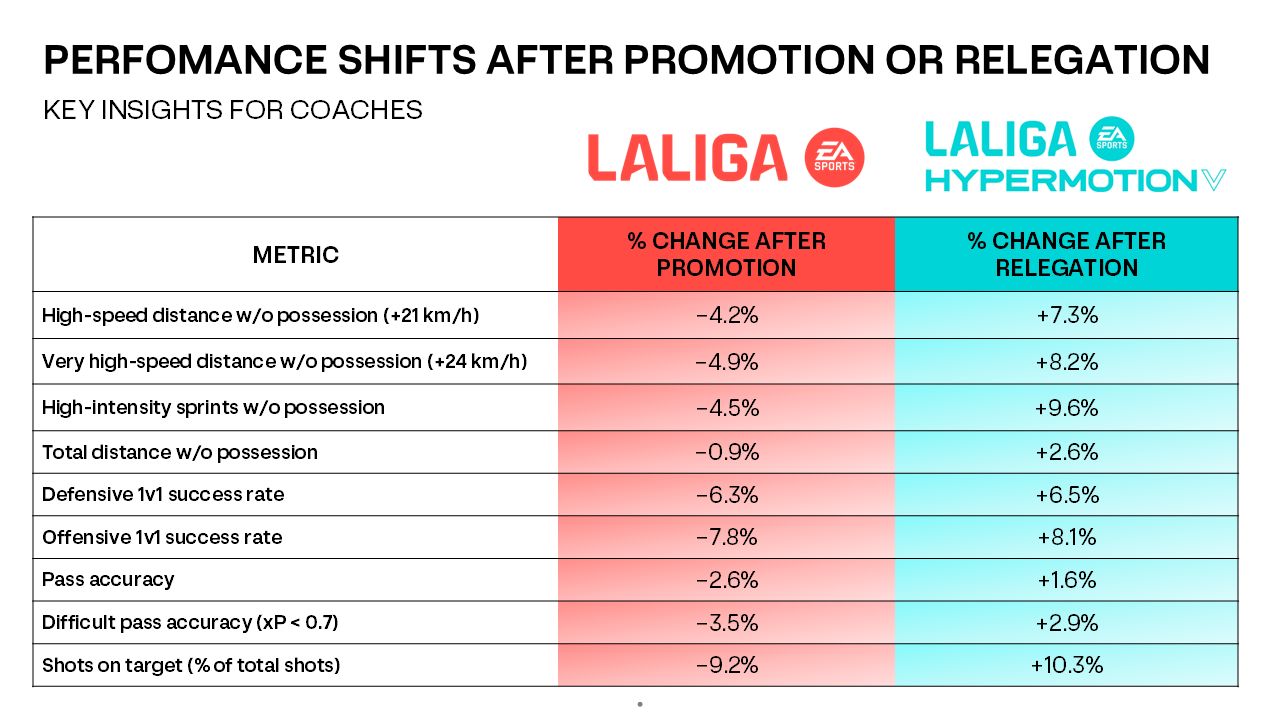
We analyzed objective data from players who played at least 400 minutes in two consecutive seasons with the same club — one in LALIGA EA SPORTS, the other in LALIGA HYPERMOTION.
The results are not only clear. They’re useful.
After relegation: more quality or less demand?
When a team drops to a lower division, the player’s performance improves. Not because the player gets better — but because the conditions shift in their favor. Let’s break it down:
- Shots on target: +10.3%
- Offensive 1v1 success rate: +8.1%
- Defensive 1v1 success rate: +6.5%
- Difficult pass accuracy (xP < 0.7): +2.9%
- High-intensity sprints without possession: +9.6%
- Very high-speed distance w/o possession (>24 km/h): +8.2%
- Overall pass accuracy: +1.6%
There’s more space. Opponents make more mistakes. Players have more time on the ball. All of this impacts decision-making and execution.
So… how should training adapt?
What if the player who couldn’t stand out in the top tier becomes decisive in the second division — if you activate them differently?
Could you use this context to develop specific attacking patterns or pressing habits?
Are you designing tasks that leverage their strengths now that the demands have shifted?
After promotion: same player, different movie?
Promotion is a reward. But for the player, it’s also a leap. In speed. In pressure. In decision-making under duress. Here’s what happens to the numbers:
- Shots on target: −9.2%
- Offensive 1v1 success rate: −7.8%
- Defensive 1v1 success rate: −6.3%
- Difficult pass accuracy (xP < 0.7): −3.5%
- High-intensity sprints without possession: −4.5%
- Very high-speed distance w/o possession (>24 km/h): −4.9%
- Overall pass accuracy: −2.6%
The game gets faster. The spaces get tighter. The opponent punishes every hesitation. Even solid performers in the second division may struggle to maintain their output.
How can a coaching staff anticipate this?
What if you trained not just running speed, but speed of thought?
Do your drills simulate the time-pressure of elite competition?
Are you preparing players for a league they haven’t experienced yet?
Performance isn’t a constant. It’s a consequence.
Too often, we judge players by what they do… without considering where they do it.
A 75% pass completion rate doesn’t mean the same against a low block in Segunda as it does under high press in LALIGA EA SPORTS. A successful 1v1 in midfield carries different weight depending on the level of tactical cohesion of the opponent.
So, what is the player’s “true” performance?
Are you assessing the player — or the context they operate in?
This study doesn’t rank players. It doesn’t claim who’s good enough and who’s not.
Instead, it challenges a dangerous assumption: that a player “is the same” just because they haven’t changed clubs.
But what if they aren’t the same anymore — simply because the football around them has changed?
Moving up or down a league isn’t just administrative. It’s transformative. And if we don’t adapt our analysis, training and expectations accordingly, we may be missing the real picture.
The name on the back stays the same. But the context changes everything.
Same jersey. Same role. Maybe even the same system. But what changes is invisible: decision windows, pressure density, physical thresholds, risk tolerance.
Shouldn’t we be coaching players for the reality they’ll face — not the one they used to know?