


27 Jun The Champion That Defends the Least… and Presses the Best: Insights from LALIGA EA Sports 2024/25
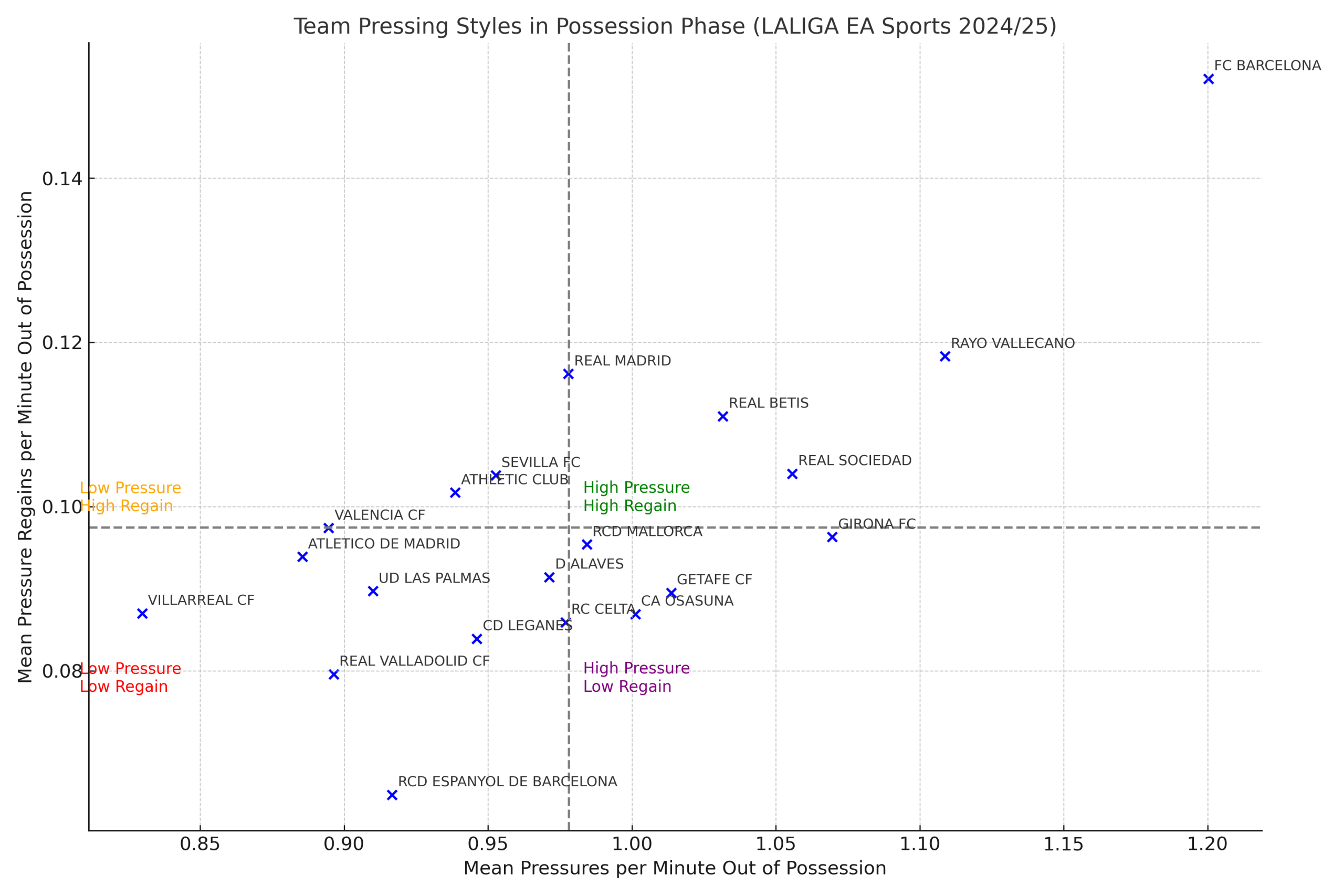
How did FC Barcelona win the LALIGA EA Sports 2024/25 title while also leading the league in pressing and ball recovery?
Are we truly assessing our players’ defensive efforts correctly, or are we ignoring the tactical context behind their roles?
From the Football Intelligence Department at LALIGA, we analyzed data from over 360 players (excluding goalkeepers and those with fewer than 200 defensive minutes) during the 2024/25 season. To ensure fairness and avoid distortions caused by differences in team playing styles, we normalized all defensive actions per minute out of possession. This allowed us to compare players based on what they do when they’re actually defending—not just on raw totals.
The goal wasn’t just to measure who presses the most, but to understand who presses best: that is, who turns pressure into actual ball recoveries.
The FC Barcelona Case: Less Defending, More Efficiency
In our team-level analysis, FC Barcelona emerged as a clear outlier in the High Pressure / High Regain quadrant:
- They spent less time without the ball than almost any other team,
- Yet they executed more pressures per minute out of possession, and
- Were among the most effective in regaining possession after pressing.
This behavior is perfectly aligned with a game model based on ball control, a high defensive line, and instant counterpressing after losing the ball. The effectiveness of their pressure isn’t a product of volume alone—it’s about structure, timing, and coordinated execution.
What does this mean for training and tactical planning? That success doesn’t come from simply pressing more, but from pressing better.
Not Every Player Should—Or Can—Press the Same Way
One of the key findings of our study is that defensive behavior varies significantly by playing position. The demands of pressing and recovery are not the same for a forward as they are for a central midfielder, or for a full back compared to a center back. Applying the same expectations across positions can lead to unfair or misleading evaluations.
This is strongly supported by recent scientific literature: across multiple professional leagues, researchers have shown that central midfielders are typically the main initiators and sustainers of collective pressing, operating across both middle and advanced zones. Full backs and wide midfielders carry out high-speed recovery sprints in wide and transitional areas. Forwards initiate pressure high up the pitch, with more variability in recovery success. Meanwhile, central defenders specialize in deep recoveries via interceptions and duels.
| Position | Pressures/min | Recoveries/min |
|---|---|---|
| Central Attacking Midfielder (CAM) | 1.35 | 0.12 |
| Centre Midfielder (CM) | 1.17 | 0.13 |
| Forward (FW) | 1.13 | 0.07 |
| Full Back (FB) | 0.89 | 0.11 |
| Center Back (CB) | 0.50 | 0.08 |
These data show, for example, that forwards press frequently but tend to recover less. Does it make sense to demand the same defensive output from them as from a central midfielder? Conversely, central midfielders show a strong balance between pressing volume and impact, which may inform how defensive responsibilities are distributed within the team.
So how do we evaluate a player’s defensive performance? Are we adjusting for their tactical context, or applying the same standard whether they’re pressing in the final third or covering their box?
Practical Implications for Training and Competition
- Train not just defensive effort, but pressing effectiveness.
Design tasks that reward recovery, not just running. - Tailor defensive tasks to each position’s role.
Demands should reflect the different tactical and spatial realities of each position. - Contextualize performance evaluation.
A high number of pressures doesn’t mean much if few result in regaining possession—or if the player rarely defends.
Conclusion
Data from the 2024/25 LALIGA EA Sports season clearly shows that pressing more does not always mean pressing better. FC Barcelona, the league champions, spent the least time defending… yet were among the most effective in both pressing and recovering the ball.
This analysis invites coaching staffs to rethink what we train, how we measure it, and how we interpret defensive performance. The key may not be how much your players press, but how much they recover when they do.
Are your training sessions focused on maximizing pressure… or maximizing its actual impact?
References
- Dellal, A., Wong, D., Moalla, W., & Chamari, K. (2010). Physical and technical activity of soccer players in the French First League – with special reference to their playing position. ISMJ International SportMed Journal.
- Díez, A., Lozano, D., Arjol-Serrano, J. L., Mainer-Pardos, E., Castillo, D., Torrontegui-Duarte, M., et al. (2021). Influence of contextual factors on physical demands and technical-tactical actions regarding playing position in professional soccer players. BMC Sports Science, Medicine and Rehabilitation.
- Lobo-Triviño, D., García-Calvo, T., Manzano-Rodríguez, D., et al. (2024). Examining tactical sprint actions and distribution among playing positions attending to match status in soccer: Implications for specific training. PLoS ONE.
- Ponce-Bordón, J. C., Díaz-García, J., López-Gajardo, M., et al. (2021). The influence of time winning and time losing on position-specific match physical demands in the top one Spanish soccer league. Sensors Conference Proceedings.
- Ju, W., Doran, D., Hawkins, R., et al. (2022). Contextualised high-intensity running profiles of elite football players with reference to general and specialised tactical roles. Biology of Sport.