


28 Ene A Longitudinal Exploration of Match Running Performance during a Football Match in the Spanish La Liga: A Four-Season Study
Posted at 12:50h
in Paper
Practical Summary for Coaches and Analysts
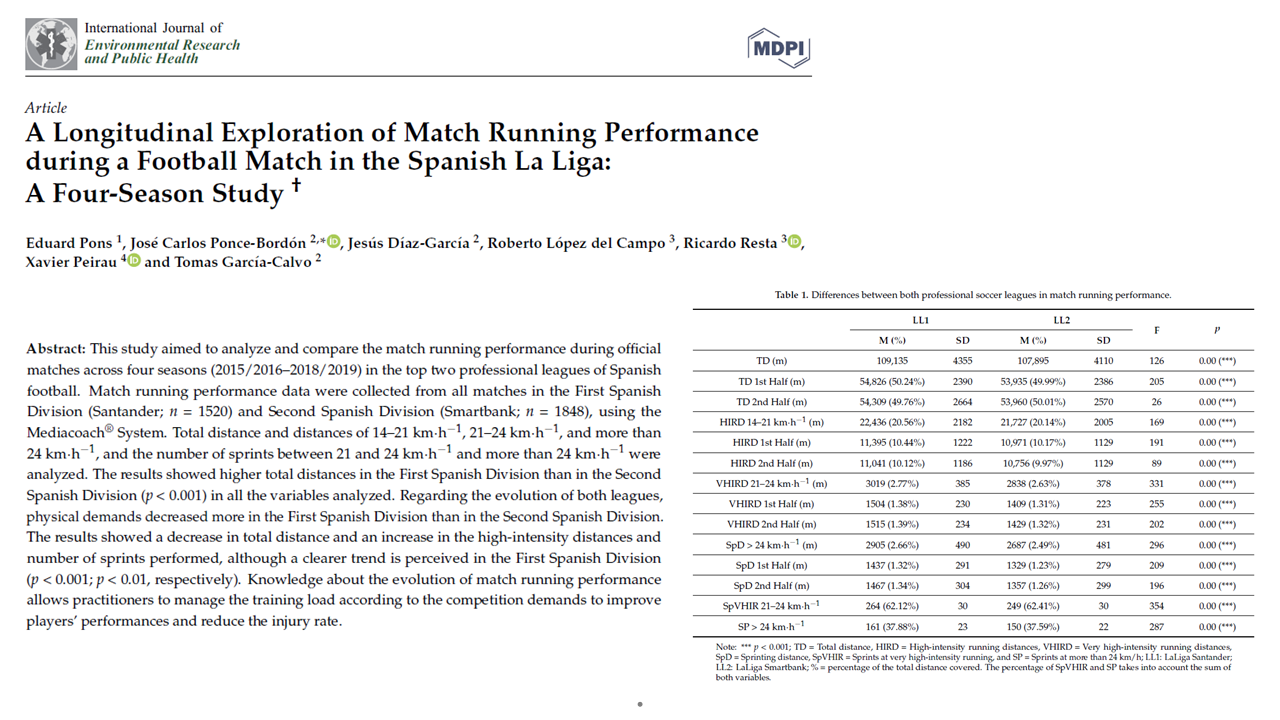
Football evolves every season — not only tactically, but also physically. This four-season study (2015/16 to 2018/19) analyzed nearly 6,000 matches from LaLiga Santander and LaLiga Smartbank, using Mediacoach® data, to track how running demands have changed at the top levels of Spanish football.
Key findings
- LaLiga Santander is more demanding. Teams in the First Division covered greater distances at high intensity and performed more sprints compared to the Second Division.
- Less total distance, more intensity. Across four seasons, total distance decreased slightly, but high-intensity running (14–21 km/h), very high-intensity running (21–24 km/h), and sprinting (>24 km/h) increased, especially in LaLiga Santander.
- Second halves are decisive. High-intensity efforts rose in the second half of matches, showing that decisive actions are concentrated in the later stages.
- Impact of VAR. The introduction of VAR coincided with reduced effective playing time, contributing to less total distance covered, but also creating longer pauses that allowed players to sustain high-intensity actions.
- Evolution is clear. Football is trending toward shorter but more explosive efforts, requiring players to sustain repeated sprints and accelerations under greater tactical pressure.
What this means in practice
- Training must adapt. Coaches should reduce the emphasis on total distance and increase the focus on repeated sprint ability, high-intensity intervals, and explosive actions, since these now dominate the game.
- Match analysis should separate halves. Understanding that more high-intensity actions occur in the second half helps in planning substitutions and rotation strategies.
- Preparation for promotion. Clubs in LaLiga Smartbank should anticipate the physical jump to LaLiga Santander, where sprint demands and high-intensity efforts are clearly higher.
- Injury prevention. Designing training tasks that mimic match-intensity demands is not only performance-oriented but also a way to reduce injury risks.
In short: modern LaLiga football is less about running more and more about running faster, more often, and at the right moments.