


26 Abr Running Patterns in LaLiga Before and After Suspension of the Competition Due to COVID-19
Posted at 13:34h
in Paper
Practical Summary for Coaches and Analysts
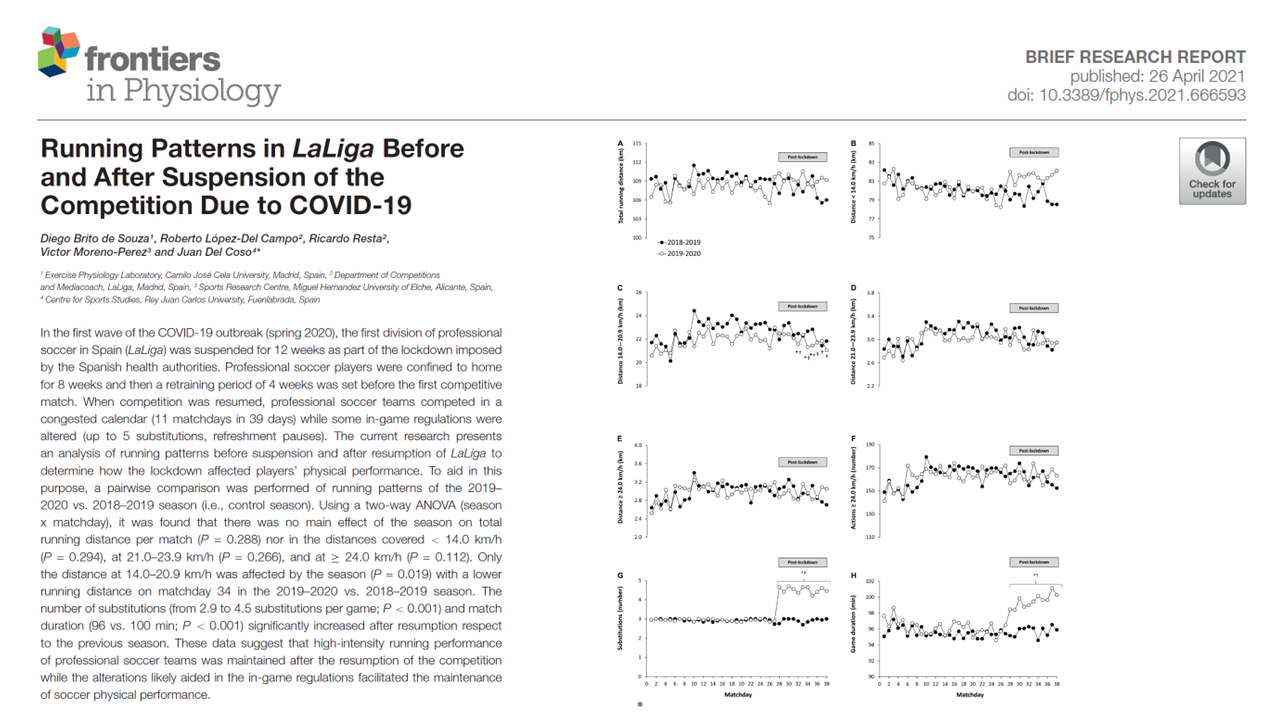
The COVID-19 lockdown in 2020 forced LaLiga to stop for 12 weeks. Players spent 8 weeks confined at home, followed by 4 weeks of retraining before resuming competition. Matches were then played in a congested schedule: 11 fixtures in 39 days, with new in-game rules (up to 5 substitutions and mandatory refreshment pauses). This study compared the running patterns of LaLiga players in the 2019/20 season (disrupted by COVID-19) with the previous season (2018/19).
Key findings
- High-intensity running preserved. Distances covered at >21 km/h and sprint actions were maintained after the restart, showing that players could still perform explosive efforts despite lockdown and fixture congestion.
- More substitutions, longer matches. The average substitutions increased from 2.9 to 4.5 per game, and match duration went up from 96 to 100 minutes. These factors likely helped maintain physical performance levels.
- Moderate-intensity running decreased. Players ran less in the 14–20.9 km/h range, possibly as a pacing strategy to save energy for high-intensity actions.
- Total distance stable. Overall distance covered per match did not change significantly compared to the previous season.
- Strategic rule changes worked. The allowance of 5 substitutions and refreshment pauses was key in protecting performance and reducing fatigue risk in a congested calendar.
What this means in practice
- Training after long breaks. Teams should prioritize progressive retraining phases (4 weeks in this case) before resuming competition after interruptions.
- Rule adaptations matter. Temporary measures like extra substitutions and cooling breaks helped preserve high-intensity performance. This suggests that fixture congestion can be managed with smart regulation.
- Focus on efficiency, not volume. Coaches should prepare players to adapt their pacing — reducing medium-intensity running but preserving peak sprints when decisive.
- Lessons beyond COVID-19. These findings are valuable for planning post-vacation periods, mid-season breaks, or future disruptions, showing that high-level performance can be protected with structured retraining and smart scheduling.
In short: LaLiga players maintained their explosiveness after lockdown thanks to rule changes, efficient pacing, and targeted retraining — valuable lessons for any future interruptions in competition.