


23 Sep “Does Running More Really Mean Playing Better?”
Five rounds into the new LALIGA EA Sports 2025/26 season, conversations on the training ground and in press rooms are already circling around a familiar question: “Who looks sharper, who has started stronger, who is already struggling?”
GPS reports are filling up with numbers. Some teams are covering more distance than anyone else. Others appear less explosive on paper. But here’s the real provocation: does running more at this early stage really mean your team is performing better?
That’s the exact question addressed in a recent study by the Football Intelligence & Performance Department at LALIGA. And with the current season just five games old, its findings couldn’t be more relevant.
Early Season: Fitness Advantage or Illusion?
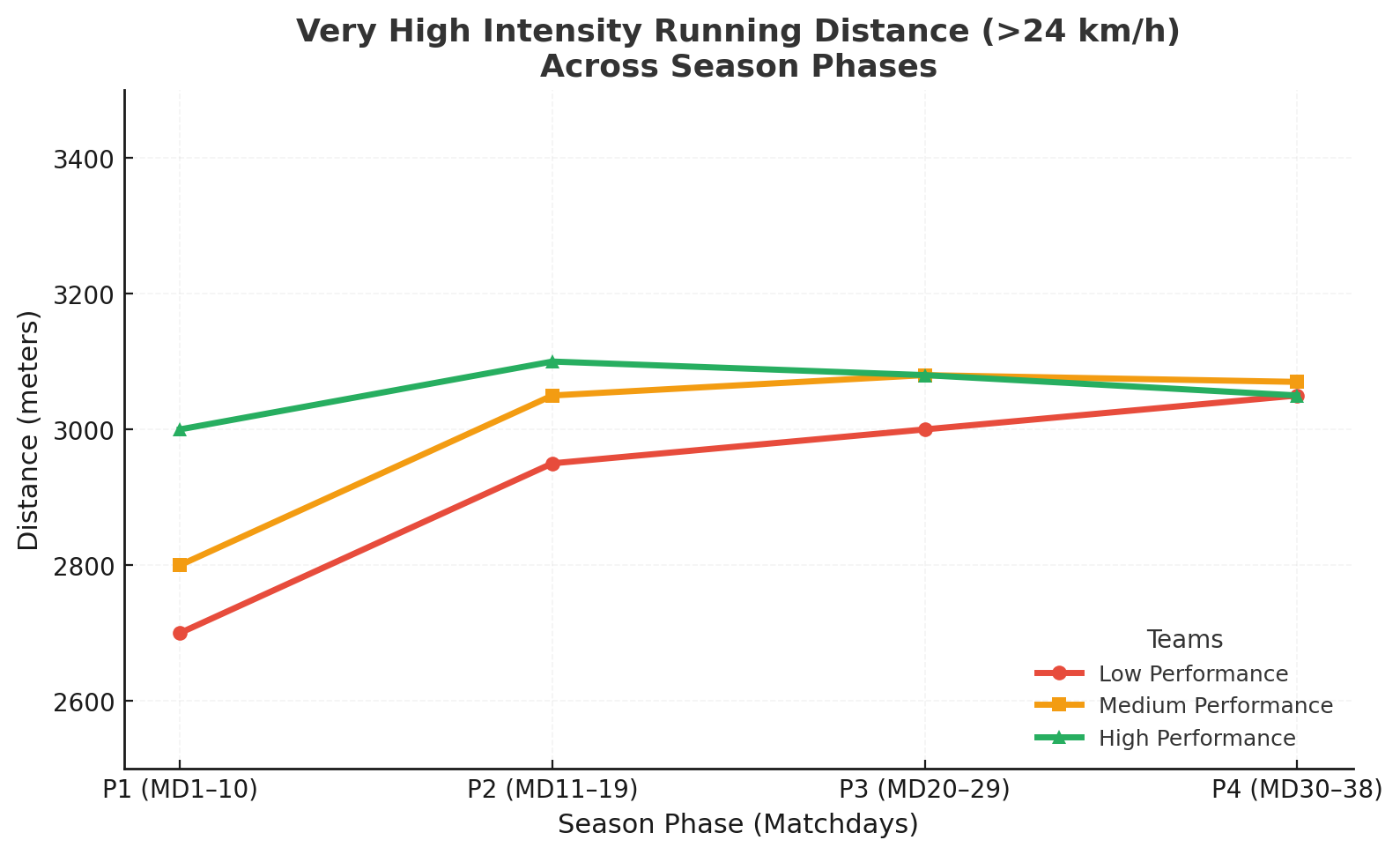
Our research, covering four full LALIGA seasons, revealed that in the opening phase of the competition, the strongest teams—those judged by expert coaches as high-performing—were also those that ran more, especially at high intensity and sprinting levels.
In other words: starting fit matters. Early-season physical sharpness not only translates into better performances, but it can also set the tone for the entire campaign.
Think about it today: some teams are already unbeaten, pressing high with relentless intensity, while others are struggling to match that tempo. The data suggests this gap is not just tactical—it’s physical readiness born out of pre-season work.
Why Running More Won’t Always Equal Success
But here’s the twist. The same study found that by mid-season, this relationship flips. Teams that ran excessively at medium intensities were often those perceived as underperforming. And by the final stretch, the most successful sides were those that actually ran less, playing more efficiently and letting tactical coordination do the work.
So as you analyze your GPS outputs after these first five games, remember: volume is not destiny. Today it matters to be fit and explosive, but as the season unfolds, the meaning of “running more” will change.
Practical Reflections for 2025/26
- Capitalize now: if your team has started with high physical output and results, keep building momentum—early fitness often shapes the final ranking.
- Be cautious: if you’re running the most but struggling for points, ask yourself: are these meters purposeful, or are they wasted in chasing the ball?
- Plan ahead: remember that by spring, efficiency and tactical control will matter more than raw distance. Preparing for that transition now can prevent late-season fatigue.
Beyond the Numbers: Context is Everything
This isn’t just theory. Other studies reinforce the message:
- Bundesliga research shows higher-ranked teams succeed not by running more overall, but by covering more distance with the ball.
- Champions League analyses reveal that sprinting in possession relates directly to goal chances created.
- Recent findings suggest locomotor demands can predict success with 70%+ accuracy—but only when contextualized with tactical roles.
The message for coaches in September 2025 is clear: interpret running data within context. A fast start is a weapon, but don’t confuse effort with efficiency.
Closing Thought
Five games in, the temptation is to look at the distance rankings and label the “hardest-working” team as the one performing best. But science warns us: that’s only true at the start. As the season evolves, the meaning of those kilometers changes.
So treat your pitch as a living laboratory. Challenge assumptions. Ask whether your running is dominance—or desperation. Because in professional football, success isn’t measured in kilometers, but in how intelligently those kilometers are used.
Read the full scientific article here: DOI: 10.1038/s41598-022-05519-x