


07 Mar No sport for old players. A longitudinal study of aging effects on match performance in elite soccer
Posted at 10:30h
in Paper
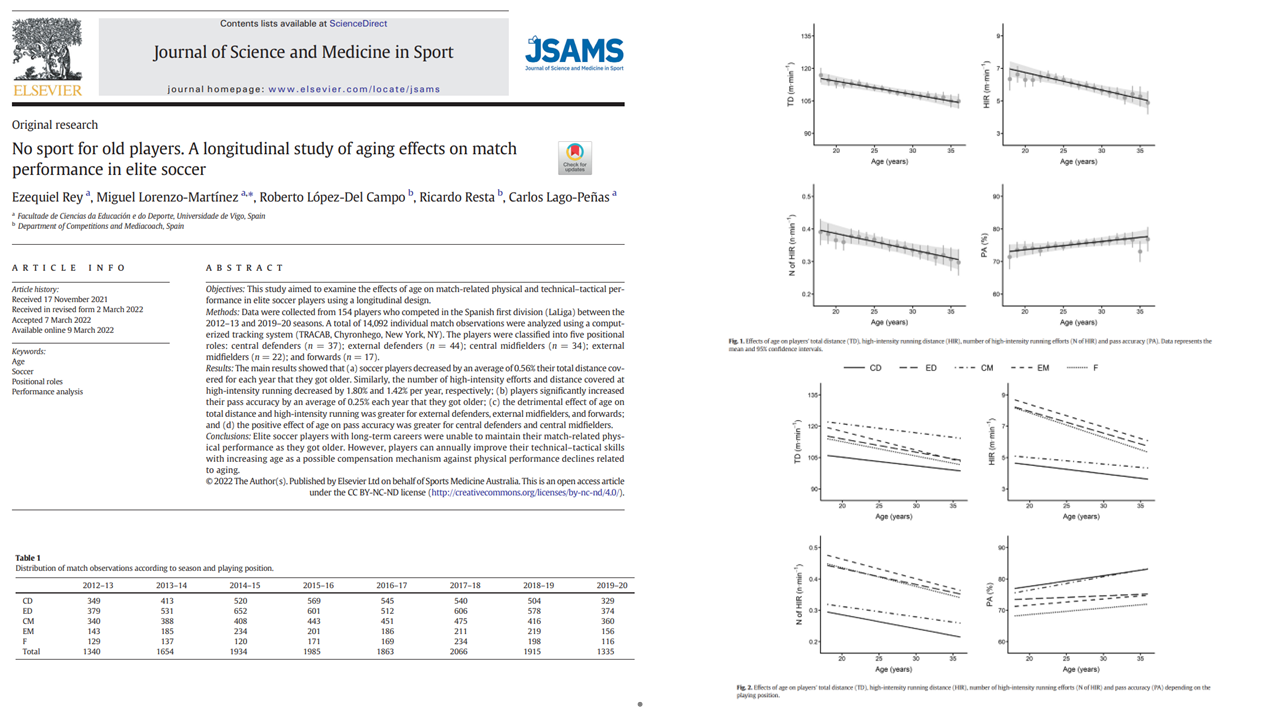
Aging is inevitable, but how does it affect performance in elite football? This longitudinal study followed 154 LaLiga players over eight seasons (2012–2020), analyzing more than 14,000 match observations to understand how physical and technical performance evolve with age.
Key insights for coaches and performance staff:
- Physical decline is progressive: Each year, players reduced their total distance by 0.56%, their high-intensity running (HIR) distance by 1.42%, and the number of HIR efforts by 1.80%. These declines hit harder for external defenders, external midfielders, and forwards.
- Passing improves with age: Despite physical decline, players improved their passing accuracy by 0.25% per year, with central defenders and central midfielders showing the biggest gains. This suggests a compensation mechanism through better decision-making and tactical awareness.
- Position matters: Wide players (ED, EM) and forwards suffer the most from aging physically, while central positions (CD, CM) can prolong careers thanks to increased technical contribution.
- Game intelligence as longevity tool: Older players rely more on efficiency and ball circulation, which can extend careers even when physical output drops.
Practical applications:
- Training programs should adjust progressively with age, reducing the emphasis on repeated HIR and focusing more on maintaining sharpness and recovery.
- Contract and recruitment decisions can benefit from age-related insights: wide players and forwards may face earlier decline, while central roles can remain effective longer due to tactical and technical value.
- Use individualized monitoring of distance and HIR in microcycles to adapt load and protect older players.
- Integrate technical-tactical training to leverage experience and passing efficiency as players age.
Read the full paper here (DOI): https://doi.org/10.1016/j.jsams.2022.03.004