


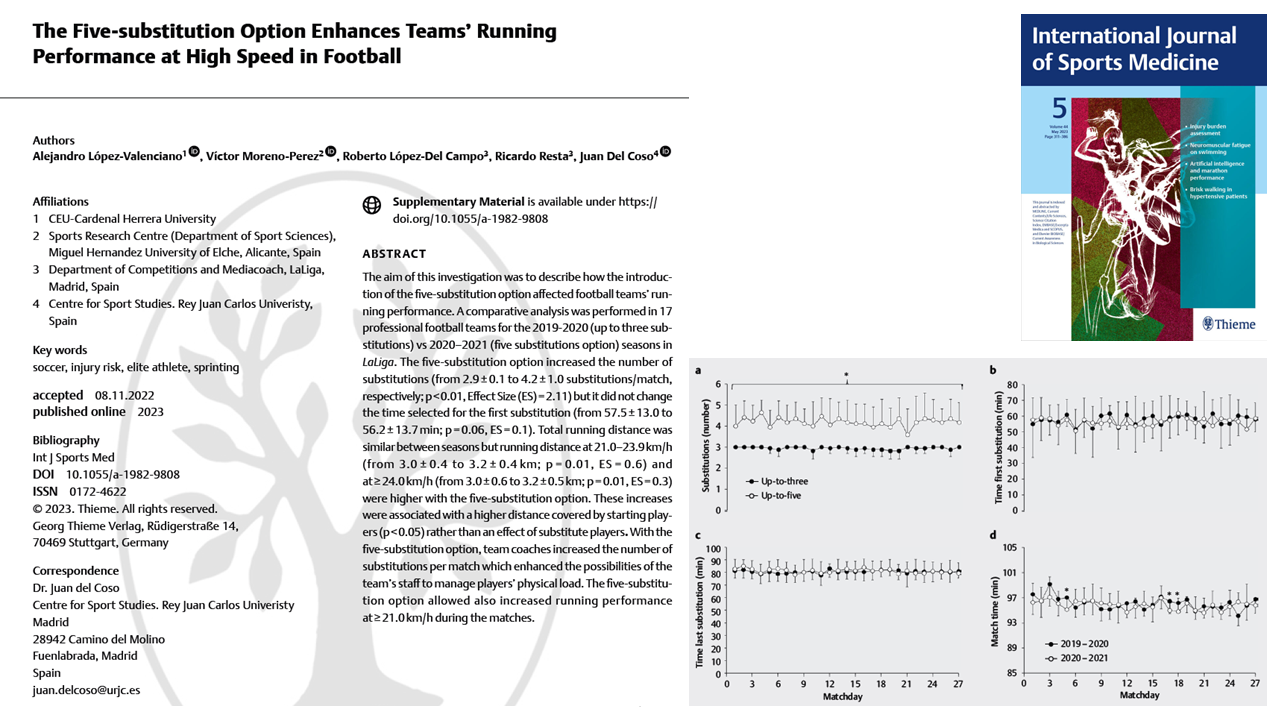
20 Ene The Five-substitution Option Enhances Teams’ Running Performance at High Speed in Football
Introduction
When football’s laws temporarily changed during the COVID-19 pandemic to allow five substitutions instead of three, the goal was simple: protect players in an overloaded competition schedule. But beyond injury prevention, did this new rule influence how teams performed on the pitch?
A scientific study using LaLiga data compared the 2019/20 and 2020/21 seasons and found a clear answer: the five-substitution option improved teams’ high-speed running performance.
Study Context and Methods
Researchers from LaLiga, Universidad Miguel Hernández, and Rey Juan Carlos University analyzed 506 matches (253 from each season) involving 17 professional teams that competed in both seasons.
Using Mediacoach, LaLiga’s validated multi-camera tracking system, the study examined:
- The number and timing of substitutions
- Match duration
- Total and high-intensity running distances (≥21 km/h)
The comparison between the three-substitution rule (2019/20) and the five-substitution option (2020/21) allowed a direct assessment of the regulation’s physical impact.
Key Findings: More Substitutions, Faster Football
| Variable | 3-Sub Rule | 5-Sub Rule | Effect |
|---|---|---|---|
| Substitutions per match | 2.9 ± 0.1 | 4.2 ± 1.0 | ↑ Significant |
| Total distance | 108 km | 109 km | No change |
| Distance 21–23.9 km/h | 3.0 km | 3.2 km | ↑ Moderate |
| Distance ≥24 km/h | 3.0 km | 3.2 km | ↑ Small |
Although the total running distance did not vary between seasons, teams covered more distance at high speed when the five-substitution rule was applied.
Interestingly, this improvement was not due to substitutes but to starting players, who ran longer distances at both 21–23.9 km/h and ≥24 km/h.
In other words, starters maintained higher intensity for longer without an increase in overall match time.
Coaching Behaviour and Match Dynamics
- Coaches increased substitutions by 45% on average (from 2.9 to 4.2 per match).
- The timing of substitutions (first around 57’, last around 81’) remained stable.
- Match duration slightly decreased (95.8 vs 96.1 minutes).
Thus, the new rule allowed for better load management without disrupting the rhythm or duration of the game.
Moreover, the number of players completing the entire match dropped from 4347 to 3663, reducing accumulated fatigue — a key factor in preventing overuse injuries.
Why Did Starters Run Faster?
Several mechanisms may explain this finding:
- Reduced fatigue exposure: players could sustain higher efforts knowing that replacements were available.
- Motivational adaptation: greater competition for playing time may have raised intensity levels.
- Collective freshness: distributing workload among more players allowed teams to maintain higher tempo and pressing actions.
These effects were particularly evident in the first matchdays of the 2020/21 season, highlighting early adaptation to the rule.
Practical Implications for Coaches
This study reframes the way substitutions should be understood in elite football:
- Substitutions are performance tools, not just tactical adjustments.
Coaches can strategically use them to sustain physical intensity and manage recovery during congested periods. - Rotation is a performance variable.
Substitution planning should consider players’ high-speed thresholds (≥21 km/h) to optimize pressing and transition phases. - Load management supports injury prevention.
Reducing the number of players completing full matches lowers the exposure to fatigue-related risks.
Maintaining the Spectacle
Contrary to initial concerns, increasing substitutions did not extend match duration or affect its entertainment value.
With match rhythm preserved and high-intensity efforts enhanced, the five-substitution rule appears to improve both performance quality and player well-being.
As the authors conclude:
“The five-substitution option enhanced teams’ running performance at high intensity while allowing coaches to reduce players’ physical stress across the season.”
Takeaway
The five-substitution rule is more than an emergency regulation — it is a structural innovation that allows coaches to optimize both performance and recovery.
In a sport increasingly defined by high intensity, this rule provides an effective tool to sustain tempo, protect players, and improve the physical quality of the game.
Reference
López-Valenciano A, Moreno-Pérez V, López-Del Campo R, Resta R, & Del Coso J. (2023). The Five-substitution Option Enhances Teams’ Running Performance at High Speed in Football. International Journal of Sports Medicine.
DOI: https://doi.org/10.1055/a-1982-9808