


04 Jul Evolution of Tactics in Professional Soccer: An Analysis of Team Formations from 2012 to 2021 in the Spanish LaLiga
Summary for coaches and performance staff
This study analyzed more than 3,400 matches across nine seasons in LaLiga to understand how tactical formations have evolved and how they relate to team success. The results clearly show that Spanish football has shifted from uniform tactical setups to a much richer diversity of formations, reflecting the modern game’s tactical flexibility.
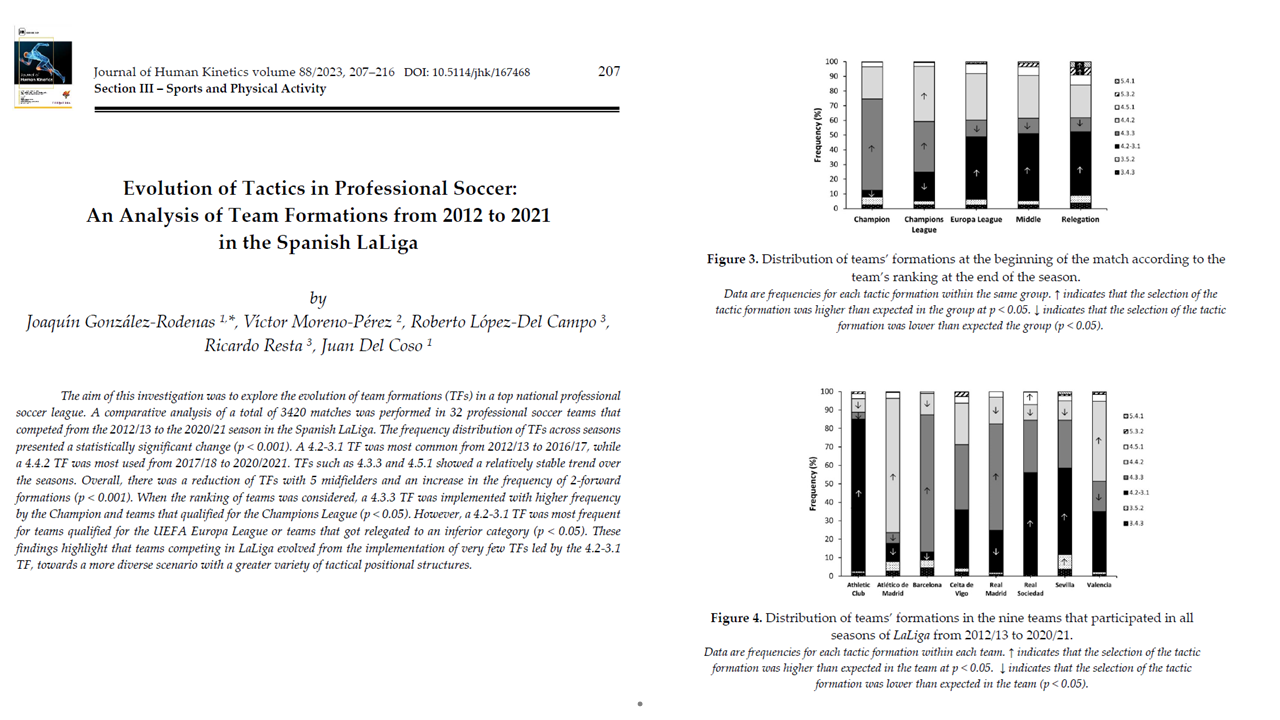
From 2012 to 2017, the 4-2-3-1 dominated LaLiga, offering balance between attack and defense. However, from 2017 onward, the 4-4-2 became the most frequent choice—mainly due to its compact defensive structure and the growing demand for energy efficiency and pressing stability. Meanwhile, top-ranked teams like FC Barcelona and Real Madrid increasingly adopted the 4-3-3, which correlated positively with total points and Champions League qualification.
Practical Takeaways for Coaches
- Tactical diversity is growing: top coaches no longer rely on one “winning” formation; adaptability and fluidity are key.
- The 4-3-3 is consistently linked to higher league success, emphasizing technical quality, width, and positional play.
- The 4-4-2 remains valuable for defensive compactness and efficient pressing structures.
- The 4-2-3-1, once dominant, is now less common—suggesting that balance alone is no longer enough without adaptability.
- Lower-ranked teams tend to use 5-back formations (5-3-2 or 5-4-1) to reinforce defensive security, often at the cost of attacking output.
What This Means for the Training Ground
For coaches and analysts, this evolution points to the need for training scenarios that reproduce multiple structural demands—for example:
- Shifting from 4-2-3-1 to 4-4-2 mid-match.
- Building mechanisms to sustain compactness when pressing high.
- Creating width and short-pass progression patterns typical of the 4-3-3.
Ultimately, LaLiga’s tactical evolution highlights that success depends less on the system itself and more on how flexibly players execute within it.
Read the full paper: https://doi.org/10.5114/jhk/167468