


08 Ago Changes in Physical and Technical Match Performance Variables in Football Players Promoted from the Spanish Second Division to the First Division
Summary for coaches and performance staff
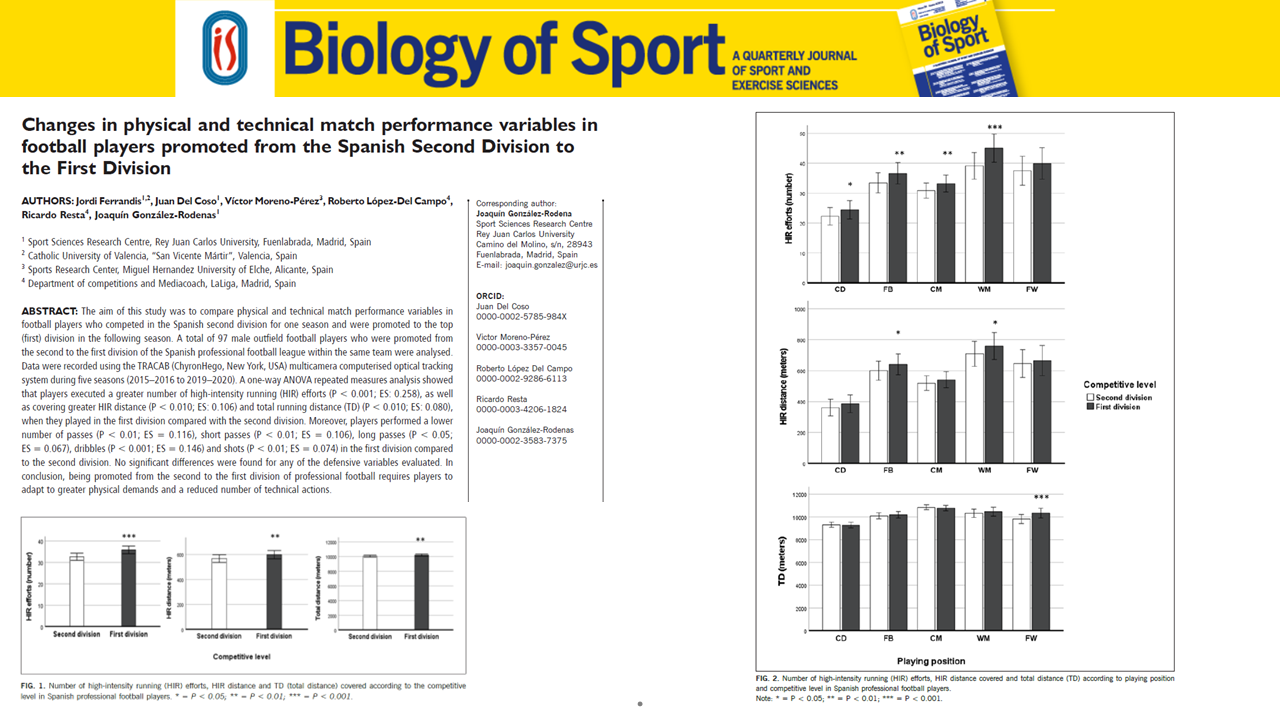
This study followed 97 professional players from 12 teams that earned promotion from LaLiga SmartBank to LaLiga EA Sports between 2015 and 2020. Using Mediacoach® tracking and match data, it analyzed how individual performance changes when the same players move from the second to the first division — providing a unique, within-player view of adaptation to elite competition.
Main Findings
When promoted to the top division, players faced a clear rise in physical demands and a reduction in technical involvement with the ball:
- High-intensity running (HIR): Players executed more HIR efforts and covered greater distance at >21 km/h in LaLiga than in the second division.
- Total distance: Slightly higher in LaLiga, especially for forwards, who ran ~500 meters more per match.
- Positional impact: The increase in high-intensity running was most pronounced for full backs and wide midfielders, positions requiring both defensive recovery runs and overlapping or transition play.
- Technical actions: In LaLiga, players made fewer passes, short and long passes, dribbles, and shots, though passing accuracy and verticality remained similar.
- Defensive work: No significant differences across divisions, except forwards who registered more aerial duels and interceptions in the first division — reflecting increased defensive contribution.
Practical Implications for Coaches
- Physical readiness for promotion: Training must anticipate the jump in high-intensity demands, emphasizing repeated sprint ability and recovery capacity — especially for wide players.
- Tactical adaptation: In higher competition, time and space are reduced, leading to fewer technical actions per player. Training should replicate these constraints to enhance decision-making speed and precision.
- Defensive transition: Forwards and attacking players need preparation for greater defensive workloads and pressing intensity.
- Coaching message: Promotion doesn’t just mean “more of the same.” It demands reconditioning — both physically and cognitively — to sustain performance under higher tempo, pressure, and tactical complexity.
As the authors summarize, “Being promoted to the first division requires players to adapt to greater physical demands and a reduced number of technical actions.”
Read the full paper: https://doi.org/10.5114/biolsport.2024.127386