


03 Dic “If Set Pieces Decide Matches… Why Don’t They Decide Our Training?”
A data-driven provocation for coaches who want to win the invisible battles of modern football.
The Scenario Every Coach Has Lived
It’s the 84th minute.
Your team has dominated phases of open play, controlled territory, and built momentum.
But the scoreboard still shows 1–1.
You prepare the final substitution.
A corner arrives.
One duel is lost.
One detail collapses.
And the match is gone.
Eighty minutes of organised football undone by an eight-second situation.
This invites a simple but uncomfortable question:
Do we train set pieces in proportion to the impact they truly have on results?
To address it, the Football Intelligence & Performance Department at LALIGA analysed every match of the LALIGA EA Sports 2024/25 season, treating the pitch as a living laboratory instead of relying on intuition or tradition.
Introduction — Challenging Football’s Quietest Assumption
Football has long accepted a comforting idea:
“Set pieces matter, but open play decides matches.”
Scientific literature consistently shows that set pieces represent 25–35% of goals in elite competition.
But this tells us little about their competitive value.
The key question is this:
Does a set-piece goal influence points and match outcomes as much as an open-play goal?
With match-by-match data across an entire LALIGA EA Sports season, this study answers that question directly.
Methods — Turning the Pitch Into a Living Laboratory
Across 760 team-match entries (380 matches), we examined:
- Goals scored and conceded in set pieces
- Goals scored and conceded in open play
- Goal differentials in both phases
- Points earned per match
- Winning probability via logistic regression
- Close matches (decided by one goal or ending in a draw)
- Team-specific sensitivity to set-piece performance
The aim was to convert academic rigour into practical insights for coaches, analysts and physical trainers.
Results — What the Data Reveals About Set Pieces in LALIGA EA Sports 2024/25
1. Set pieces are present in the moments that decide matches
When analysing all matches decided by a single goal, one finding stood out:
- Around 42% of these one-goal matches included at least one set-piece goal.
This figure is naturally symmetrical:
if the winning team scored from a set piece, the losing team necessarily conceded one.
Additionally:
- Around 33% of all draws also included at least one set-piece goal.
In practical terms:
Set pieces appear disproportionately in the exact moments where minimal differences decide results.
They are not sporadic events; they are structural to competitive balance.
2. A set-piece goal “is worth” the same as an open-play goal
Regression modelling showed:
- +1 set-piece goal → +0.67 points
- +1 open-play goal → +0.72 points
Statistically equivalent.
When analysing goal differential:
- Set-piece differential → +0.65 points
- Open-play differential → +0.65 points
Identical.
This challenges a deeply rooted belief:
A goal is a goal — and the league table does not care how it was scored.
3. A set-piece goal dramatically increases the probability of winning
Logistic regression revealed:
- 1 open-play goal → 6.7× higher odds of winning
- 1 set-piece goal → 4.8× higher odds of winning
- Home advantage → 1.8× higher odds
The conclusion is clear:
A single dead-ball goal influences winning probability more than playing at home.
If no coach would ignore home advantage, why underuse set pieces?
4. Set pieces are symmetrical competitive exchanges
Winning teams score more set-piece goals and concede fewer.
Losing teams do the opposite.
Draws sit in between.
This symmetry reveals something fundamental:
Set pieces are not isolated events — they are exchanges you win or lose every weekend.
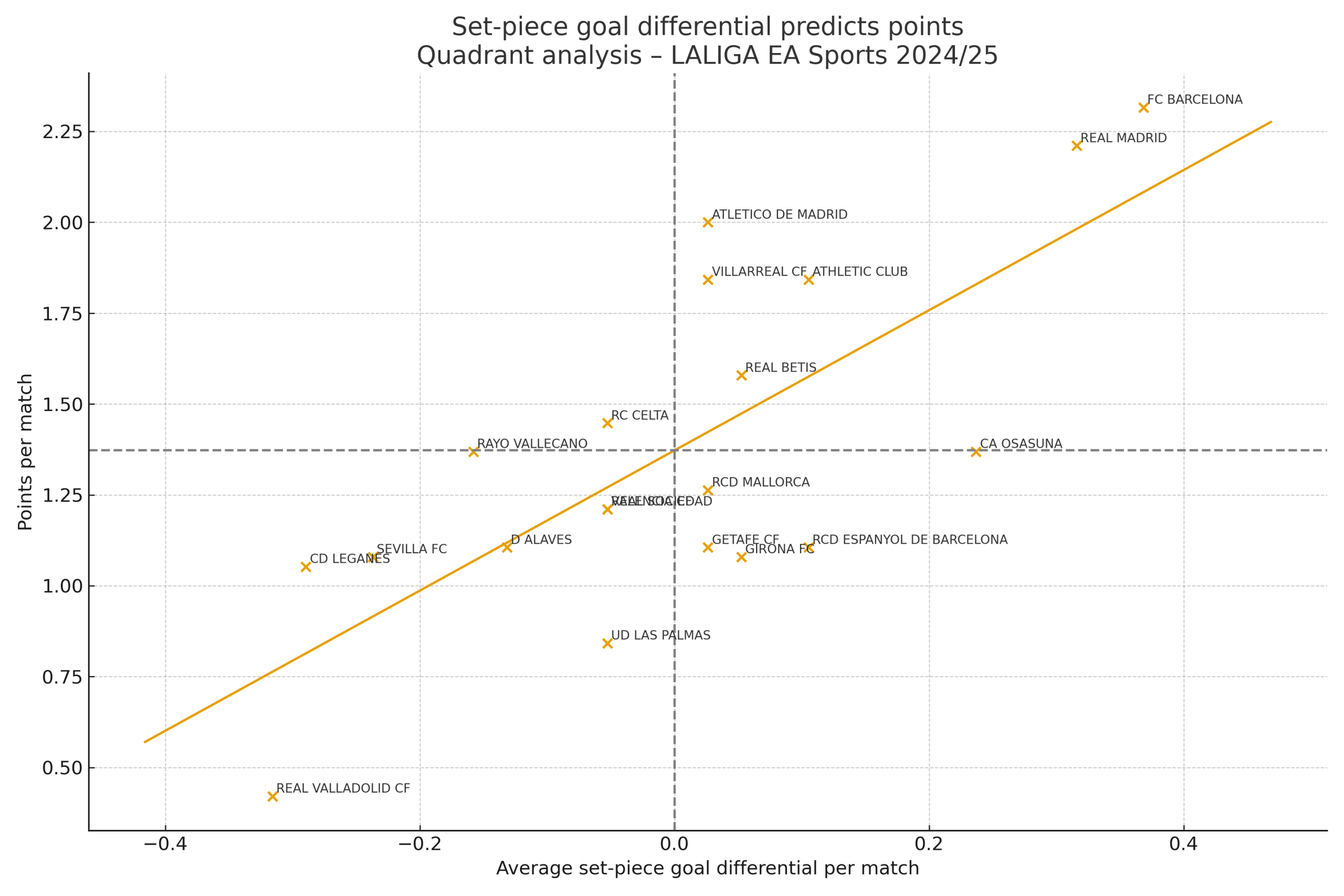
5. Adding context from the league: what the teams tell us
The quadrant analysis of LALIGA EA Sports 2024/25 adds a compelling layer of evidence.
When plotting average set-piece goal differential per match against points per match, a striking pattern emerges:
- The teams with the highest overall performance — FC Barcelona, Real Madrid, Atlético de Madrid, Athletic Club, Villarreal CF — are also teams with positive set-piece differentials.
This reinforces the central idea of the study:
Winning teams tend to win the set-piece battle as well.
Excellence in open play and excellence in dead-ball situations are not opposites — they coexist.
One particularly interesting case is CA Osasuna.
Osasuna shows one of the highest set-piece differentials relative to their total points, meaning:
They extract exceptional competitive value from set pieces.
They don’t just use set pieces — they leverage them as a strategic accelerator.
This illustrates a key insight for coaches:
Set pieces are not just a survival tool for underdogs.
They are an amplifier of performance for any team, regardless of stylistic identity.
Discussion — What Should Coaches Take from This?
1. Rebalance your training time
If ~30% of your goals (for and against) come from set pieces —
and set-piece goals have the same competitive value as open-play goals —
does your microcycle reflect that?
Often, the answer is no.
Our findings suggest this imbalance costs points.
2. Treat set pieces with the same tactical sophistication as open play
Set pieces allow:
- Structured repetition
- Clear roles
- Manipulation of space
- Exploitation of individual advantages
- Predictable behaviour under pressure
They are one of the most controllable phases of the game.
3. Use KPIs that reveal real set-piece performance
Beyond goals:
- Set-piece differential
- First-contact success
- Delivery and second-ball quality
- Occupation of high-value zones
- Defensive clarity
- Opponent adaptation
You cannot improve what you do not measure.
4. Base your emphasis on team identity, not habit
Does your team depend on set pieces?
Do you suffer when you concede them?
Does open play already dominate your performance profile?
Evidence, not tradition, should dictate emphasis.
Conclusion — Small Moments, Massive Impact
This full-season analysis of LALIGA EA Sports 2024/25 confirms:
- Set pieces appear disproportionately in decisive phases
- Their competitive value equals that of open-play goals
- They significantly increase winning probability
- They reveal structural strengths and weaknesses across teams
- They offer one of the most scalable, controllable advantages in modern football
The pitch is a laboratory.
The data is clear.
Set pieces deserve more time, more detail, and more intentional design.
This research was conducted by the Football Intelligence & Performance Department at LALIGA, using match-by-match data from the 2024/25 LALIGA EA Sports season.