


04 Dic Why Only 10% of Players Score More Than Half of All Goals?
Introduction — A question every coach faces
Imagine this scenario.
Your team has generated enough xG to win the match, you’ve controlled territory, pressed well, and created the right platforms for finishing.
But you still depend on two or three players to put the ball in the net.
You feel it every weekend: goals come from very few players, and the entire game can hinge on whether they deliver.
Is this just a feeling?
Or is it a structural truth of elite football?
At the Football Intelligence & Performance Department of LALIGA, we decided to test this assumption with scientific discipline. We treated the pitch as a “living laboratory” and analysed five full seasons of LALIGA EA SPORTS to understand how goals are truly distributed across players, and what characterises the small group that sustains goal production year after year.
What we found challenges several common beliefs about goals, roles, and the profiles clubs should be looking for.
Methods — A simple question, a robust approach
We analysed five full seasons of LALIGA EA SPORTS (2020/21 to 2024/25), including every player who appeared in at least one match. For each season we identified:
The “Top 10% Scorers”
Players who scored 5 or more goals, representing roughly 10% of all players active in a given season.
The “Remaining 90%”
Players who scored fewer than 5 goals.
Across both groups we compared:
- age
- games played
- games as starter / substitute
- minutes played as starter / substitute
- global and specific positions
- nationality (Spain vs non-Spain)
The goal was not to label players, but to understand the structural factors that shape goal production in elite football.
Results — What the data reveals
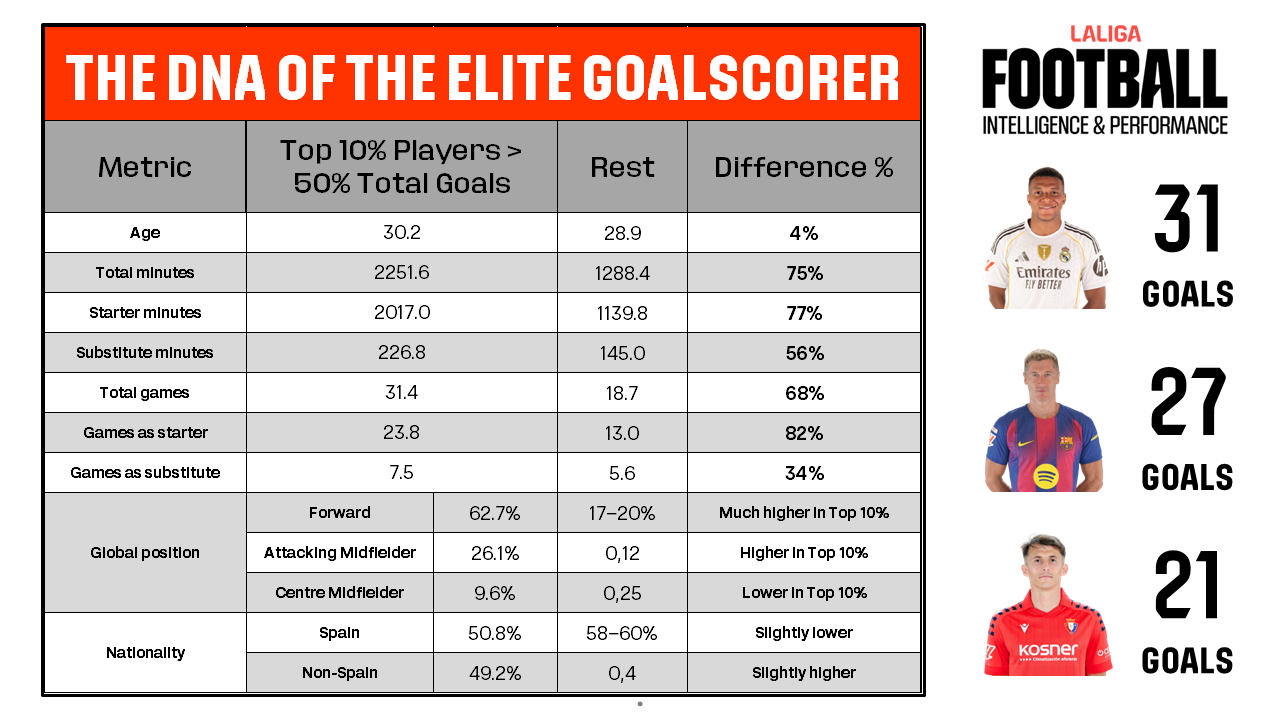
1. An extraordinary concentration: 10% of players score 57% of all goals
Across five seasons:
- The top 10% of players scored 57% of all goals.
- The remaining 90% scored the other 43%.
This is not a coincidence.
It’s a structural pattern that repeats every single season.
It confirms something coaches intuitively feel: goals come from very few players, and these players disproportionately shape match outcomes and competitive success.
This aligns with earlier research showing that goal scoring is one of the most skewed performance variables in football, where a minority of individuals generate a majority of the decisive actions.
2. The profile of the top scorer: older, more stable, more trusted
Age difference (statistically significant)
- Top 10%: 30.2 years
- Remaining 90%: 28.9 years
- Difference: +4.5%
Goals come from maturity, experience and game-reading ability, not from raw physical attributes alone.
This matches findings from performance science showing that cognitive-tactical skills stabilise later than physical ones, and tend to predict decisive actions better at high competitive levels.
3. The strongest signal: role and continuity
This was the most striking finding.
Games played
- Top 10%: 31.4
- Remaining 90%: 18.7
- Difference: +68%
Games as starter
- Top 10%: 23.8
- Remaining 90%: 13.1
- Difference: +82%
Minutes as starter
- Top 10%: +77% more minutes than the rest
Minutes as substitute
- Still +56% higher for the top scorers
Interpretation:
The top scorers are not “streaky players.”
They are structural pieces of their teams — players who start often, stay on the pitch, and remain available across the season.
Important nuance: the “perverse effect”
We must acknowledge this explicitly.
Players who score tend to play more — and players who play more tend to score.
This feedback loop means that role and performance reinforce each other.
However, even with this loop in mind, the magnitude of the differences (often 60–80%) shows that role consistency is a key ingredient in sustaining goal output.
This reinforces the idea that coaches should evaluate:
- the stability of a player’s role,
- the trust they receive from their coach,
- and their availability across the season
before expecting them to deliver goals at scale.
4. Positional identity: goals come from inside players, not wide players
Global positions (Top 10%)
- Forwards: 62.7%
- Attacking midfielders: 26.1%
- Central midfielders with arrival: 9.6%
Specific positions (Top 10%)
- Striker (classic 9): 26.7%
- Right centre forward: 13.5%
- Left-sided CAM entering the box: 13.5%
This confirms what recent tactical literature highlights:
goals increasingly come from players who operate in interior spaces, even when they start from a nominal wide or hybrid position.
5. Nationality: Spain vs non-Spain — a surprising balance
Top scorers:
- Spain: 50.8%
- Non-Spain: 49.2%
The data shows that Spain produces as many high-performing scorers as it imports — an important insight for talent development and recruitment strategies.
Discussion — What does this mean for coaches, analysts and scouts?
1. Goal scoring is a highly specialised, highly concentrated skill
Most players contribute in many ways, but only a few convert actions into goals.
Training, role assignment and expectations should reflect this asymmetry.
2. Profiles with stability, maturity and centrality matter
The top scorers are:
- older
- more trusted
- more consistent
- more central in the team’s tactical structure
This challenges the idea that “young talents will naturally add goals” and supports the need for experience-based pathways in attacking roles.
3. The pitch is a laboratory — test assumptions
Every coach has beliefs about which roles score more, or when to substitute certain players.
This research shows that many assumptions are worth revisiting:
- Does our positional structure favour interior finishers?
- Are our most decisive players receiving enough continuity?
- Do we overestimate output from wide players?
- Are we evaluating strikers based on minutes, or based on role stability?
Encouraging a mindset of disciplined curiosity can significantly enhance decision-making.
Conclusion — What this research adds
This five-season analysis provides a clear, evidence-based picture:
Goal scoring in LALIGA is a rare skill held by very few players, shaped by experience, continuity, and interior positional roles.
For clubs, this has immediate implications for:
- scouting
- performance analysis
- player development
- matchplanning
- recruitment strategies
And for coaches, it offers a simple but powerful question:
Are we giving our most decisive players the continuity, context and interior spaces they need to produce goals?