


06 Oct Technical and tactical evolution of the offensive team sequences in LaLiga between 2008 and 2021. Is Spanish football now a more associative game?
Over the last decade, Spanish professional football has not just changed players or systems — it has changed how teams attack. This study analyzed 4,940 LaLiga matches across 13 seasons (2008/09–2020/21) to understand how offensive team sequences have evolved, focusing on collective behavior, not isolated actions.
What has really changed in LaLiga attacks?
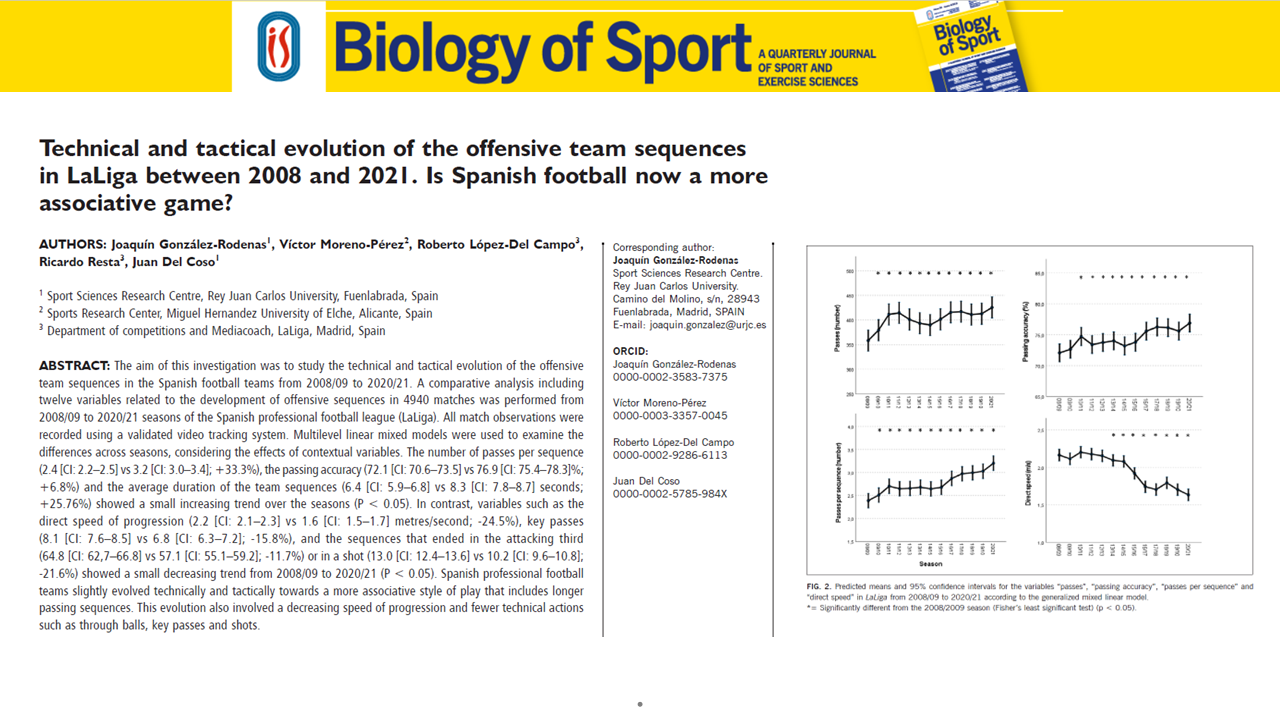
The data clearly show a shift toward a more associative and patient attacking style:
- Teams now use longer possession sequences, both in time (+33%) and number of passes (+34%).
- Passing accuracy has increased, meaning teams are not just passing more, but passing better.
- At the same time, the speed of progression toward goal has decreased, indicating less direct play and fewer vertical attacks.
In practical terms, LaLiga teams today build attacks with more circulation, more control, and more collective involvement, often prioritizing when to attack rather than how fast to attack.
Fewer shots, fewer key passes… but not fewer goals
One of the most interesting findings for coaches and analysts is that:
- Key passes, through balls, entries into the final third, and shots per sequence have all decreased over time.
- However, goal scoring has remained stable.
This suggests that modern attacks are more selective and more structured, waiting for clearer advantages instead of forcing early penetration. Attacks are longer, but decision-making moments are more precise.
What does this mean for coaching and training?
From a practical perspective, these findings have direct implications for daily work with first-team players:
- Build-up play matters more than ever
Central defenders and deeper players are increasingly involved in constructing attacks. Training tasks should reflect this reality, emphasizing:- Positional play
- Decision-making under pressure
- Ball circulation speed, not just running speed
- Breaking defensive organization is now the key challenge
As defenses have become more compact and organized, simply playing faster is no longer enough. Teams need players capable of:- Creating numerical or positional superiority
- Executing high-quality dribbles or passes in tight spaces
- Identifying the right moment to accelerate the attack
- Direct play is not disappearing — it is becoming more valuable
Even though through balls and key passes are less frequent, players who can consistently produce these actions may offer a competitive advantage, especially against well-organized defensive blocks.
Why this study matters for modern football
Rather than confirming a tactical trend based on opinion, this research provides longitudinal evidence that LaLiga has evolved toward a more controlled, combinative attacking model. It helps coaches and analysts reflect on an essential question:
Are we training our players for the football that exists today, or for the football that existed ten years ago?
Understanding this evolution allows technical staffs to align training methodology, player profiling, and tactical planning with the real demands of elite competition.