


19 Dic Tell me how much your opponent team runs and I will tell you how much you should run: A predictive model applied to Spanish high-level football
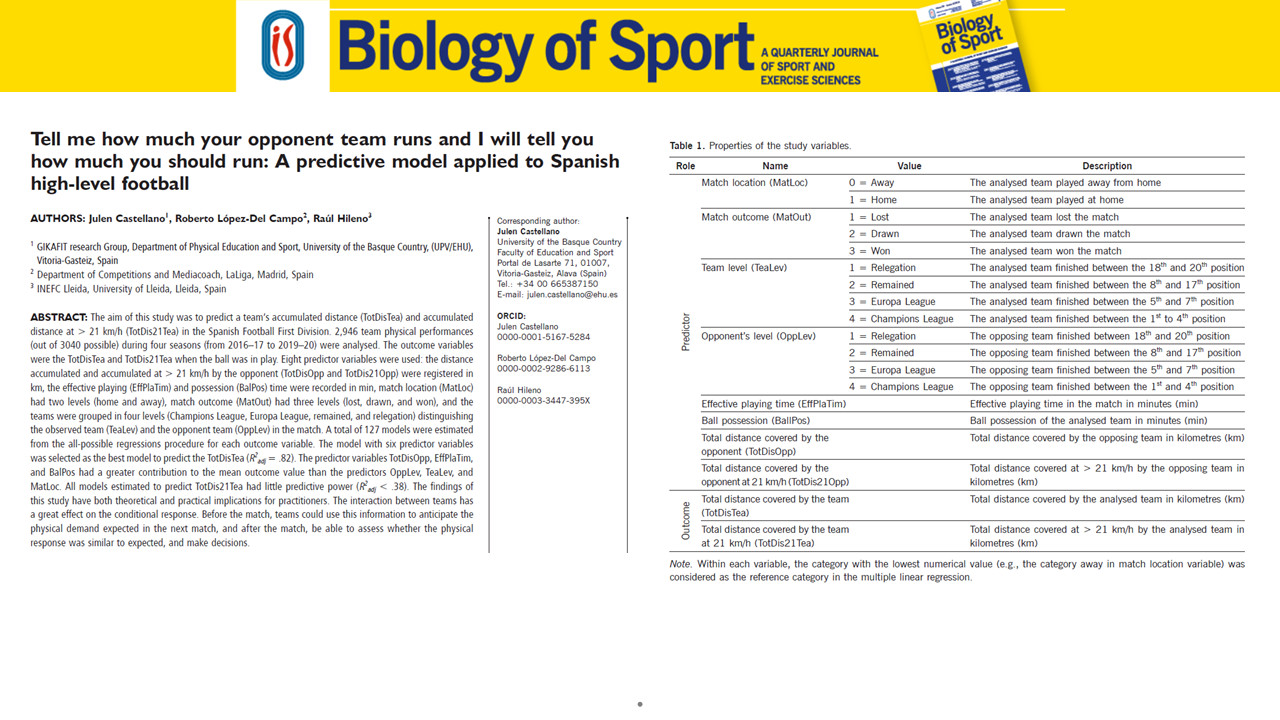
Football is not played in isolation. Every physical demand your team faces is shaped by the opponent. This study confirms that idea with real competition data from LaLiga. It shows that how much your players run is strongly linked to how much the opponent runs, how long the ball is actually in play, and how much time your team has possession.
The key message is simple. You cannot plan physical performance without understanding the opponent. For every extra kilometre the opponent runs, your team is forced to run around 700 metres more. This happens regardless of tactics, team level, or match outcome. The opponent sets the physical tone of the match.
Effective playing time matters more than total match duration. When the ball is in play for longer, physical demands rise sharply. Most of the running load, and almost all high-speed running, occurs during this active time. Matches with fewer stoppages demand more from players, even if the final score or tactical approach looks similar.
Ball possession changes the physical profile of the team. The more time your team has the ball, the less total distance it tends to cover. This does not mean possession football is “easier”. It means the physical load shifts. Teams run less overall but must still manage intense actions in specific moments. When teams defend more, they run more per minute. When they attack more, they run less but with different positional and tactical demands.
Team quality also plays a role, but it is secondary. Playing against stronger opponents increases physical demands. Playing at home slightly increases total distance covered. Match outcome, however, is not a reliable predictor of how much a team runs when the analysis focuses only on effective playing time. This highlights how misleading traditional post-match interpretations can be.
One important finding is what cannot be predicted well. High-speed running above 21 km/h could not be accurately forecast using these contextual variables. This suggests that sprint demands depend more on specific tactical events, transitions, and player roles than on global match context.
For coaches and performance staff, the application is immediate. Training load should be adjusted based on the expected opponent behaviour, not just your own style. Match preparation should consider whether the opponent usually plays at high intensity and forces long effective playing time. Recovery strategies should reflect whether the team was exposed to unusually high opponent-driven running demands. Post-match analysis should compare actual physical output against what was expected given the opponent and match context.
This model allows staff to move from reactive analysis to proactive planning. Before the match, you can anticipate the physical stress your team will face. After the match, you can judge whether the physical response was normal or excessive. That improves decision-making across training, rotation, and recovery in elite football.