


24 Jun Summarizing physical performance in professional soccer: development of a new composite index
Modern elite football generates an enormous amount of physical data. Every match produces hundreds of variables. Distances. Speeds. Accelerations. Decelerations. High-intensity actions. The challenge is not collecting data anymore. The real challenge is understanding it and using it to make better decisions.
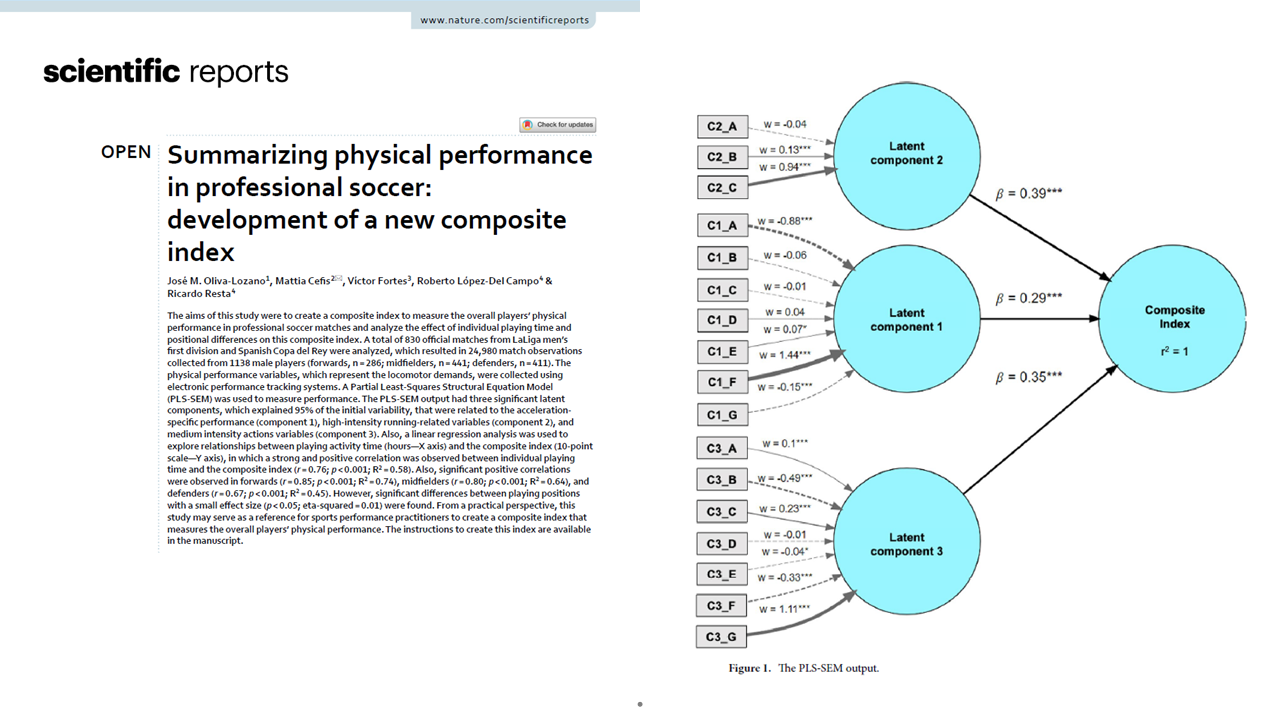
This study was built to solve that problem. It proposes a single composite index that summarizes a player’s overall physical performance during a match. One number. One scale. Clear meaning. And strong links to what actually happens on the pitch.
The index was developed using data from 830 official matches in LaLiga and the Spanish Copa del Rey. Almost 25,000 individual match performances were analysed. The players were forwards, midfielders, and defenders. Goalkeepers were excluded because of their unique demands.
The idea behind the index is simple. Physical performance in football is not one thing. It is the result of different types of effort that coexist during a match. The model identified three main physical dimensions that explain almost all the physical output seen in competition.
The first dimension is acceleration-based performance. This includes explosive distance, repeated accelerations and decelerations, and the constant changes of speed that define modern football. This component reflects how often and how intensely a player has to start, stop, and re-accelerate.
The second dimension is high-intensity running. This captures actions at very high speeds, including sprinting and near-sprinting efforts. These moments are less frequent but often decisive. They are linked to pressing, counter-attacks, defensive recovery runs, and attacking depth.
The third dimension is medium-intensity activity. This includes sustained running at moderate speeds, average speed, metabolic load actions, and overall energy expenditure. This component reflects the engine of the player. The ability to stay involved, connected, and active throughout the match.
By combining these three dimensions, the model produces a single composite score on a clear 0 to 10 scale. A higher score means a higher overall physical contribution in that match.
One of the most important findings is the strong relationship between playing time and the composite index. As expected, the longer a player stays on the pitch, the higher the physical output. The correlation is strong across all positions. This confirms a key message for practitioners. Physical performance must always be interpreted in relation to minutes played. Comparing raw outputs without considering time on the pitch will lead to wrong conclusions.
However, the index also shows small but consistent differences between playing positions. Forwards, midfielders, and defenders express their physical performance differently, even when total output looks similar. This reinforces the need for position-aware interpretation. A “good” physical performance does not look the same for every role.
From a practical perspective, this composite index offers a powerful tool for daily work in elite football environments.
It allows staff to move beyond long tables of variables and focus on a single, meaningful indicator. This is especially useful for post-match reporting, weekly load reviews, and communication with coaches. One number is easier to discuss, easier to track, and easier to compare.
The index is also highly valuable for contextual analysis. It can be linked with technical and tactical data to understand how physical output supports performance. It can help answer questions such as whether high physical demands are associated with effective pressing, successful transitions, or defensive solidity.
For rotation and squad management, the index provides a clear overview of cumulative physical exposure. Players with similar minutes may show very different physical scores. This can highlight hidden load, underloading, or inefficient effort profiles.
In training design, the three underlying components give clear guidance. If a player’s score is low because of acceleration demands, training can target repeated accelerations and decelerations. If high-speed running is missing, exposure can be progressively increased. If medium-intensity load is insufficient, session structure can be adjusted.
Importantly, this approach does not replace detailed analysis. It complements it. The composite index acts as a gateway. A clear signal that tells staff when to look deeper and where to focus.
In an era where data overload is one of the biggest risks in performance departments, this study offers a practical solution. Reduce complexity. Preserve meaning. Support better decisions.