


28 May Association Between the COL5A1 rs12722 Genotype and the Prevalence of Anterior Cruciate Ligament Rupture in Professional Football Players
Anterior cruciate ligament injuries remain one of the most disruptive events in elite football. They are rare, but when they occur, they change careers, squad planning, and season outcomes. This study explored whether a specific genetic variant, the COL5A1 rs12722 genotype, is linked to ACL injuries in professional football players, and more importantly, whether it shapes how and when those injuries occur.
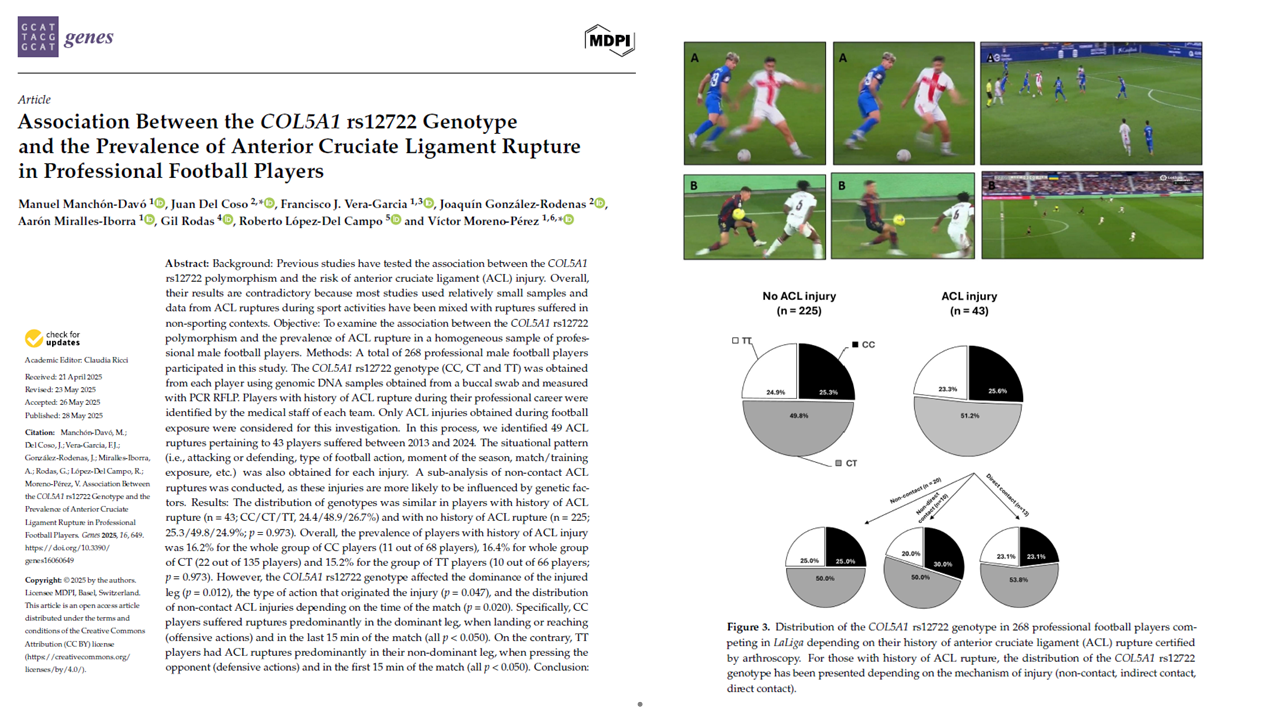
The first and most important message for practitioners is clear. This genetic variant does not increase or reduce the overall likelihood of suffering an ACL rupture in professional football. Players with CC, CT, or TT genotypes showed almost identical ACL injury prevalence across more than a decade of elite competition. From a practical perspective, this means genetic testing should not be used to label players as “high risk” or “low risk” for ACL injury in general terms.
However, the study becomes highly relevant once we move beyond incidence and focus on injury context. When only non-contact ACL injuries were analysed, clear and consistent patterns emerged. These are the injuries most influenced by intrinsic factors and therefore the most preventable through training and load management.
Players with the CC genotype showed a very specific profile. Their non-contact ACL injuries occurred almost exclusively in the dominant leg. They happened during attacking actions such as landing or reaching. They appeared late in matches, often in the final 30 minutes. This pattern points directly to fatigue as a key contributor. As physical and neuromuscular fatigue accumulates, movement quality during high-risk attacking actions deteriorates. For practitioners, this highlights the importance of late-match robustness in dominant-leg mechanics, especially under fatigue.
In contrast, players with the TT genotype showed the opposite profile. Their non-contact ACL injuries occurred mainly in the non-dominant leg. They happened during defensive actions, particularly pressing. They appeared early in matches, often in the first 15 minutes. This pattern suggests that neuromuscular readiness and bilateral control, rather than fatigue, may be the main issue. Early-match injuries are less about physical depletion and more about coordination, decision-making, and joint control under sudden high-intensity demands.
The CT genotype showed an intermediate behaviour, without a strong bias toward one leg, game phase, or match moment. This reinforces the idea that genetic effects are not binary but progressive, interacting with training exposure and match demands.
From a practical standpoint, this study does not support genetic screening as a standalone injury prediction tool. But it does support a more intelligent use of individual profiles when designing prevention strategies. For CC players, prevention should focus on maintaining landing and reaching quality under fatigue, managing late-match load, and reinforcing dominant-leg stability during offensive actions. For TT players, the priority shifts toward bilateral neuromuscular control, non-dominant leg strength, and cognitive readiness for high-intensity pressing, especially at the start of matches.
The study also highlights an important warning signal. A disproportionate number of players with the TT genotype suffered multiple ACL ruptures, often in the opposite leg. While numbers are small, this suggests that secondary prevention in these players may require even greater attention and longer-term planning.
For elite football environments, the key takeaway is simple. ACL injuries are multifactorial. Genetics does not decide who gets injured, but it may influence how injuries happen. When combined with video analysis, load monitoring, and neuromuscular assessment, this information can help practitioners refine prevention strategies rather than replace them.
The real value of this research lies in moving from generic prevention models to more nuanced, player-specific approaches that reflect the real demands of professional football.