


20 Nov Analysis of Video Footage and Running Metrics Around Anterior Cruciate Ligament Injuries in Men’s Elite Football. A Retrospective Observational Study of 43 Cases
Anatomy of an ACL Rupture: Understanding What Happens on the Pitch
Anterior cruciate ligament (ACL) ruptures are among the most serious injuries in professional football. While their biomechanical characteristics have been extensively investigated, less is known about the running demands and game situations surrounding these events.
A new study published in Scandinavian Journal of Medicine & Science in Sports, involving researchers from LALIGA and several Spanish universities, provides a multidimensional analysis of 43 ACL ruptures across six LALIGA seasons (2019/20–2024/25).
By combining match footage, optical tracking, biomechanics and observable neurocognitive indicators, the researchers reconstructed the circumstances surrounding these injuries.
According to the authors, the study provides the first objective quantification of running speed and acceleration around the estimated moment of ACL rupture in professional LALIGA players.
Reconstructing the injury
The research examined 43 complete, primary ACL ruptures sustained during official matches, all confirmed by magnetic resonance imaging.
Two experienced observers independently analysed match footage using predefined criteria. They identified two critical moments:
- Initial contact (IC): when the injured foot first contacted the ground.
- Estimated injury frame (IF): when visible signs consistent with ligament rupture first appeared.
These moments were synchronised with Mediacoach optical tracking data to extract running speed and acceleration.
The 26 non-contact ruptures were additionally examined for joint positions and behavioural indicators related to attention and motor-response inhibition.
Observer agreement was assessed using appropriate measures for continuous and categorical variables. The interval between initial contact and the estimated injury frame showed excellent reproducibility (ICC = 0.974). Detailed reliability results for individual variables, including categorical assessments, are provided in the study’s supplementary materials.
The football context: where do ruptures occur?
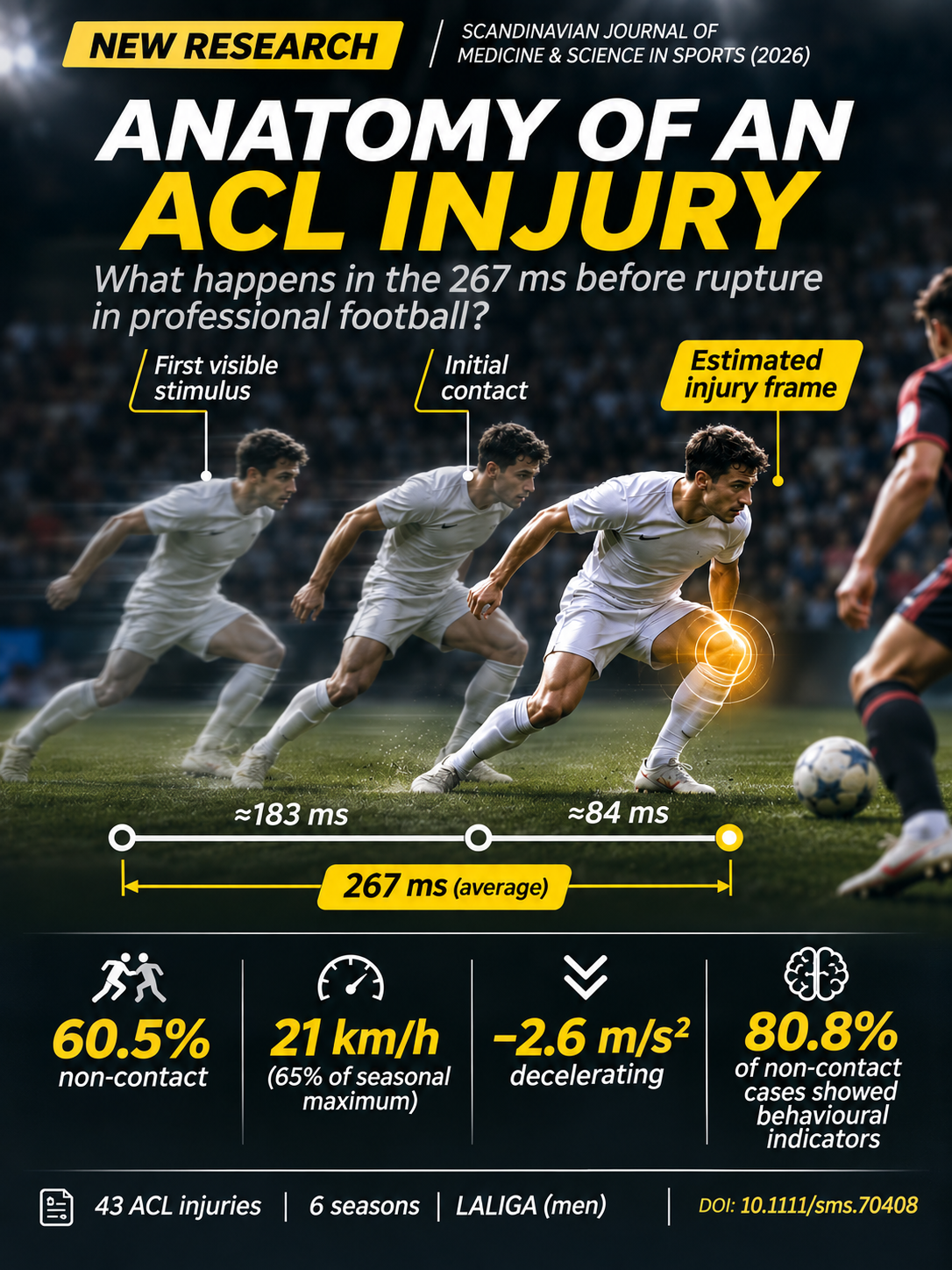
Of the 43 ACL ruptures, 26 (60.5%) occurred without player contact, 10 (23.3%) involved direct contact and seven (16.3%) indirect contact.
Defensive situations accounted for 65.1% of cases, while pressing or tackling was the most frequent action (39.5%). Defenders represented 51.2% of the sample, and 53.5% of ruptures occurred in the middle third of the pitch.
Together, these findings describe the situational context of ACL ruptures in professional football, with defensive actions featuring prominently.
Running demands: speed and braking at the moment of injury
In the 26 non-contact ruptures, tracking data revealed that players were moving at an average speed of 20.96 ± 5.06 km/h at the estimated injury frame. This represented approximately 65% of their individual seasonal maximum speed.
Average acceleration was −2.63 ± 2.03 m/s², indicating deceleration.
At initial ground contact, mean speed was slightly higher (22.12 km/h), while acceleration averaged −2.20 m/s².
These results provide objective estimates of the running demands surrounding ACL ruptures. The observed events involved substantial running speeds and braking demands, rather than exclusively maximal-speed sprinting.
No statistically significant differences in speed or acceleration were identified between direct-contact, indirect-contact and non-contact mechanisms.
Biomechanics: how does the body move?
Video-based biomechanical analysis of non-contact ruptures revealed changes in knee and body positioning between initial ground contact and the estimated injury frame.
Average knee flexion increased from 25° to 60°, while knee valgus—an inward alignment of the knee—was observed in 18 of 25 evaluable cases (72%) at the estimated injury frame.
The analysis also identified changes in trunk orientation, hip positioning and foot rotation.
These findings reinforce the relevance of examining the entire movement pattern, rather than focusing exclusively on the knee.
Neurocognitive indicators: adapting to unexpected events
Football requires players to continuously adjust their movements in response to opponents, the ball and changing space.
In 21 of the 26 non-contact ruptures (80.8%), researchers identified observable behavioural indicators consistent with attentional or motor-response inhibition errors.
Among these 21 cases, the researchers classified:
- 11 cases (52.4%) as attentional inhibition indicators, involving a visible redirection of attention away from relevant game information.
- 10 cases (47.6%) as motor-response inhibition indicators, involving difficulty adapting an initiated movement after an opponent’s deceptive action.
The distribution was different in pressing situations. Of the 12 non-contact ruptures occurring during pressing, 11 showed behavioural indicators. Among those 11 cases, nine involved motor-response inhibition indicators, compared with two attentional indicators.
The classifications were based on systematic observation of behaviour in match footage, rather than direct measurement of cognitive processes.
A 267-millisecond sequence
In the 21 non-contact cases with observable neurocognitive indicators, researchers quantified the interval between the first visible stimulus and the estimated injury frame.
The average sequence was:
First visible stimulus → 183 ms → Initial contact → 84 ms → Estimated injury frame
The total interval averaged 267 milliseconds.
This sequence illustrates the limited time available to modify movement in rapidly changing game situations. The measurements represent observed event intervals, not neural reaction times or the exact moment of ligament failure.
What can coaches and performance staff take from these findings?
ACL prevention and return-to-play programmes commonly include strength training, neuromuscular control, balance, jumping, landing and change-of-direction exercises.
These components address important physical demands. However, football also requires players to execute movements while responding to unpredictable information.
The study suggests several questions for future training and research.
Movement under uncertainty. How does braking technique change when players must react to an opponent rather than follow a predetermined direction?
Defensive pressing. How do players adjust their movement when an opponent feints, accelerates or changes direction after the defender has initiated a response?
Return-to-play assessment. Could reactive movement tasks provide additional information alongside conventional strength, jumping and change-of-direction assessments?
Such questions may help guide future investigations into more representative training and assessment environments. They should not be interpreted as evidence that specific reactive exercises prevent ACL ruptures.
What this study cannot establish
The main limitation is the absence of non-injury control actions.
Professional players perform thousands of pressing actions, decelerations and unexpected changes of direction without sustaining ACL ruptures. Without comparing injured and non-injured actions, it is impossible to determine whether the observed characteristics distinguish injury events from normal football movements.
Other limitations include the relatively small sample, its restriction to male professional players, the use of two-dimensional video for joint-angle estimates and the indirect classification of neurocognitive indicators.
Optical tracking also provides estimates of the locomotor context, not precise instantaneous mechanical thresholds.
Consequently, the findings describe the circumstances surrounding ACL ruptures but do not demonstrate causality, identify risk thresholds or establish the effectiveness of preventive interventions.
Understanding the injury within the game
This research illustrates the value of combining football context, running metrics, biomechanics and observable player behaviour to study ACL ruptures.
Its contribution is a more detailed reconstruction of the injury event, integrating physical and behavioural information obtained directly from professional competition.
The next step is to determine whether these characteristics differ from those observed during comparable actions performed without injury.
That comparison will be essential for moving from understanding how ACL ruptures occur towards identifying potentially modifiable risk factors.
Scientific reference
Manchón-Davó, M., Miralles-Iborra, A., Del Coso, J., Vera-Garcia, F. J., Urban, T., López-Del Campo, R., Resta, R., & Moreno-Pérez, V. (2026).
Analysis of Video Footage and Running Metrics Around Anterior Cruciate Ligament Injuries in Men’s Elite Football. A Retrospective Observational Study of 43 Cases.
Scandinavian Journal of Medicine & Science in Sports, 36, e70408.