


13 Abr Match running performance upon return to play in professional male LaLiga football players following anterior cruciate ligament rupture
Returning to play after an anterior cruciate ligament rupture is not the same as returning to performance.
That is the main message for coaches from this study. A player may be medically cleared, back in the squad and already playing official minutes, but still not have recovered the competitive profile he had before the injury.
This research followed 51 professional male LaLiga players who suffered a complete ACL rupture. The authors analysed what happened during the three seasons after return to play: whether players stayed at the highest competitive level, how much they played, and how their match running performance changed. Running data were obtained through Mediacoach® for the players who remained in LaLiga across the follow-up period.
What the study found
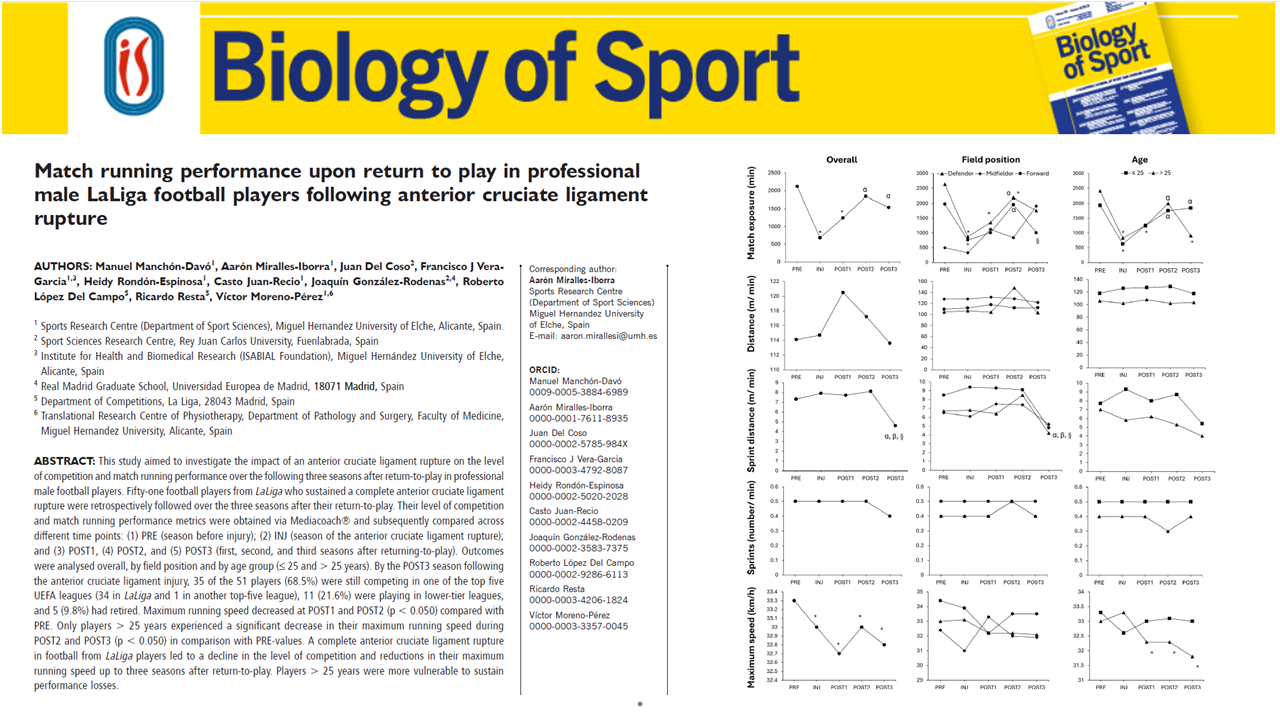
The first important finding is that most players returned, but not all stayed at the top. In the first season after return to play, 90.2% of players were still competing in one of the top five European leagues. Three seasons later, that figure had dropped to 68.5%. At that point, 21.6% were playing in lower-level leagues and 9.8% had retired.
Age mattered. Players over 25 were more vulnerable to a decline in competitive level. Three seasons after return to play, only 51.9% of them were still competing in a top-five European league, compared with 88% of players aged 25 or younger.
The second key finding is even more relevant for training: maximum speed was the match running variable most affected after ACL rupture. Total distance, sprint distance and number of sprints did not show the same clear long-term reduction, but maximum running speed decreased in the first and second seasons after return to play.
For coaches, this matters because maximum speed is not just a physical number. It is a tactical weapon. It allows a defender to recover space, a winger to separate from his opponent, a striker to attack depth, and a team to defend higher or transition faster.
The third important point is that the speed deficit was more persistent in players over 25. In this group, maximum speed was still significantly reduced in the second and third seasons after return to play.
What this means for coaches
The player’s first match after ACL injury should not be seen as the end of the process. It is the start of a new phase: the return to performance.
A player can be available without being fully restored. He may tolerate training, complete match minutes and look ready from the outside, while still lacking the peak-speed capacity that shaped his pre-injury game.
That means coaching and performance staff should monitor more than availability. They should compare the player with his own pre-injury profile: minutes, sprint exposure, maximum speed, position-specific actions and ability to repeat high-intensity efforts under match conditions.
The most practical message is clear: do not assume sprint capacity will return automatically through normal football training. Maximum speed needs to be rebuilt deliberately, progressively and in football-specific contexts.
Practical takeaways
After ACL rupture, return-to-play planning should include a longer return-to-performance strategy. The priority is not only to make the player fit enough to play, but to restore the actions that made him effective before injury.
For players over 25, this process may need even more individualisation. They may require longer monitoring, more specific sprint exposure and a more careful progression of match minutes.
The key coaching question is not only: “Can he play?”
The better question is: “Can he still perform the actions that his role demands at elite level?”
In this study, the answer often depended on one decisive variable: maximum speed.
Reference
Manchón-Davó, M., Miralles-Iborra, A., Del Coso, J., Vera-Garcia, F. J., Rondón-Espinosa, H., Juan-Recio, C., González-Rodenas, J., López Del Campo, R., Resta, R., & Moreno-Pérez, V. Match running performance upon return to play in professional male LaLiga football players following anterior cruciate ligament rupture. Biology of Sport, 43, 1161–1180.
Full paper: https://doi.org/10.5114/biolsport.2026.160857