


06 Mar Age & Career-Stage Bias: When Football Misreads Aging
In professional football, age often becomes a silent verdict.
Once players pass 30, the narrative tends to repeat itself. Physical decline. Reduced resale value. Minutes carefully managed. Eventually, replacement by younger profiles.
This logic appears everywhere: scouting reports, performance dashboards, contract decisions.
But how much of that “decline” is real? And how much is simply the result of how we measure performance?
The Hidden Assumption Behind Player Comparisons
Modern football analytics relies heavily on physical indicators.
Total distance.
High-speed running.
Sprint counts.
Accelerations and decelerations.
These metrics are extremely valuable. They help quantify match demands and monitor physical output with great precision.
But when players of different ages are compared using the same metrics, an implicit assumption appears: performance evolves linearly.
Older players run less.
Therefore, they perform worse.
It sounds logical. Yet the data suggests something more complex.
What Longitudinal Data Reveals
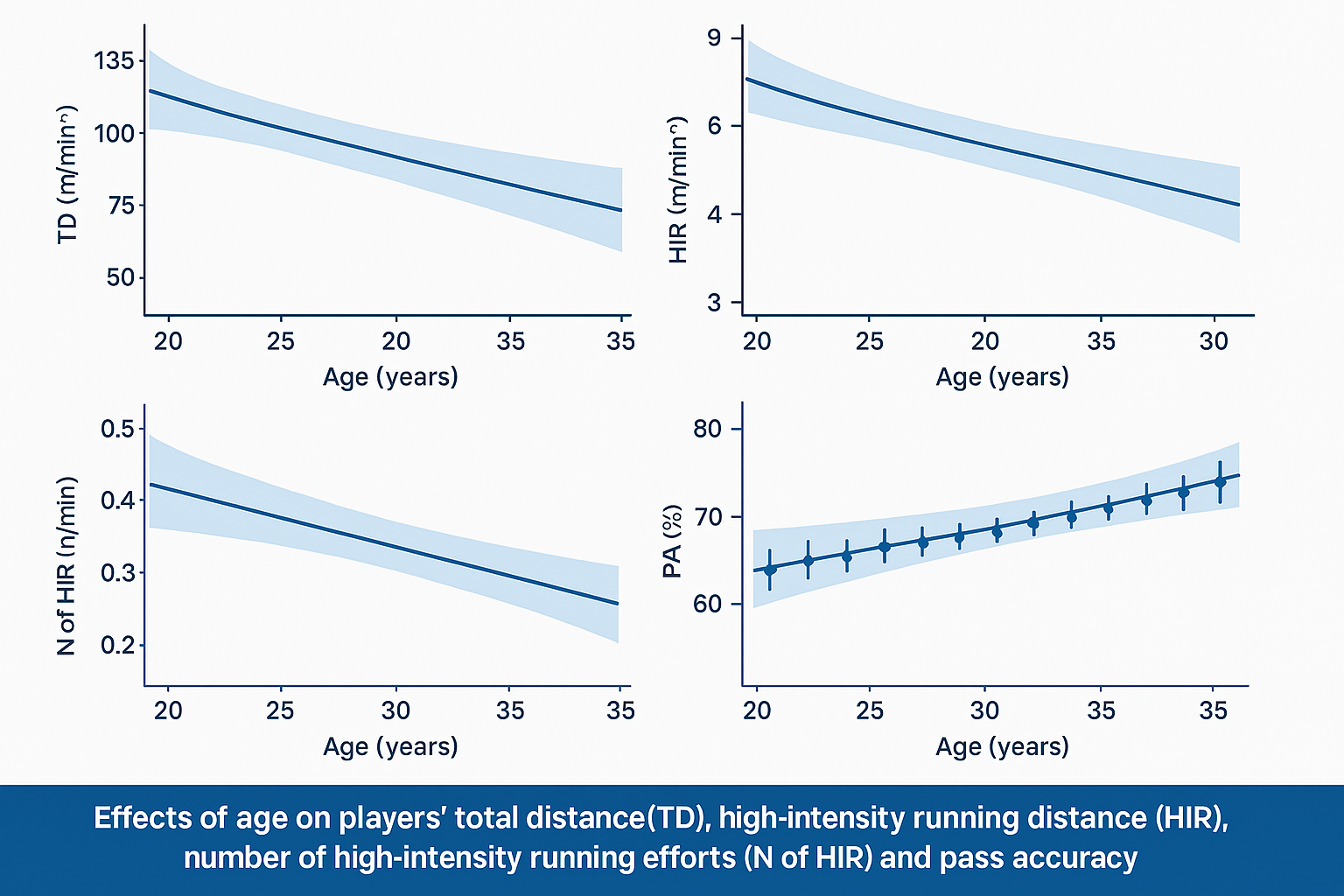
A longitudinal analysis of professional players competing in LaLiga over multiple seasons allows us to observe something rare in football research: how the same players evolve over time.
The physical trend is clear.
As players age:
- Total distance decreases by approximately 0.56% per year
- High-intensity running distance decreases by around 1.8% per year
- The number of high-intensity efforts also declines
At first glance, this confirms the traditional belief. Older players produce less physical output.
But stopping the analysis here would miss the most interesting part of the story.
Because another dimension of performance moves in the opposite direction.
Aging Does Not Only Reduce Performance — It Redistributes It
The same longitudinal evidence shows that technical–tactical efficiency improves with age.
For example, pass accuracy increases by approximately 0.25% per year.
This improvement is particularly visible in central defenders and central midfielders, where decision-making, positioning, and game understanding are central to performance.
In other words, physical volume decreases while technical efficiency increases.
Performance does not simply decline.
It reorganizes.
Experienced players often perform fewer actions, but they tend to perform them with better timing, positioning, and tactical awareness.
That adaptation is rarely captured by physical KPIs alone.
The Acceleration Puzzle
Acceleration data adds another layer to this discussion.
Players aged 31–38 perform fewer high-intensity acceleration and deceleration actions during matches.
However, research shows that their maximum acceleration capacity does not significantly decline.
The difference lies in the frequency of actions, not necessarily in their maximum physical capability.
This distinction is crucial.
If performance models prioritize the number of high-intensity actions, experienced players will appear to decline faster than they actually do.
But that may reflect strategic adaptation, not simply physical deterioration.
Older players often choose their actions more carefully.
Less volume.
More selectivity.
Aging Is Also Position-Dependent
Another important insight is that aging does not affect every position equally.
External defenders, wingers and forwards tend to show larger declines in high-intensity actions.
Central defenders and central midfielders, on the other hand, are less affected physically and often show stronger improvements in technical efficiency.
This suggests that there is no universal aging curve in football.
Instead, each role follows its own performance trajectory across the career cycle.
Ignoring this positional context can easily lead to misleading comparisons.
Why This Creates a Performance Bias
This is where the concept of Age & Career-Stage Bias appears.
When performance evaluation relies primarily on physical metrics, experienced players may be systematically undervalued.
The evaluation system becomes biased toward players whose performance profile is dominated by physical output.
But football performance is multidimensional.
As players age, the balance between those dimensions changes.
Less physical volume.
More tactical intelligence.
Greater efficiency with the ball.
If models only capture the first dimension, they fail to capture the second.
And what looks like decline may simply be a shift in the way performance is expressed.
Implications for Clubs
For clubs working with performance data every day, this has several practical consequences.
🔍 Scouting and recruitment
Age comparisons should be contextualized by role and career stage rather than relying only on raw physical outputs.
🔍 Performance analysis
Dashboards should integrate technical and tactical efficiency indicators alongside physical KPIs.
🔍 Training design
Experienced players may benefit more from workload optimization and tactical integration than from attempts to preserve maximum physical volume.
🔍 Squad construction
Different career stages contribute different types of value within a team structure.
Understanding those differences can improve decision-making across recruitment, contract management and squad balance.
Rethinking the Aging Curve in Football
The key insight is simple, but often overlooked.
Aging in football is not only about decline.
It is about adaptation.
Physical output tends to decrease.
Experience and tactical efficiency tend to increase.
When performance models ignore this redistribution, they introduce a hidden bias into evaluation and decision-making.
So the real question for coaches, analysts and sporting directors is not simply whether older players run less.
The real question is:
Are we measuring decline… or are we measuring the wrong variables?