


23 May Analysis of player speed and angle toward the ball in soccer
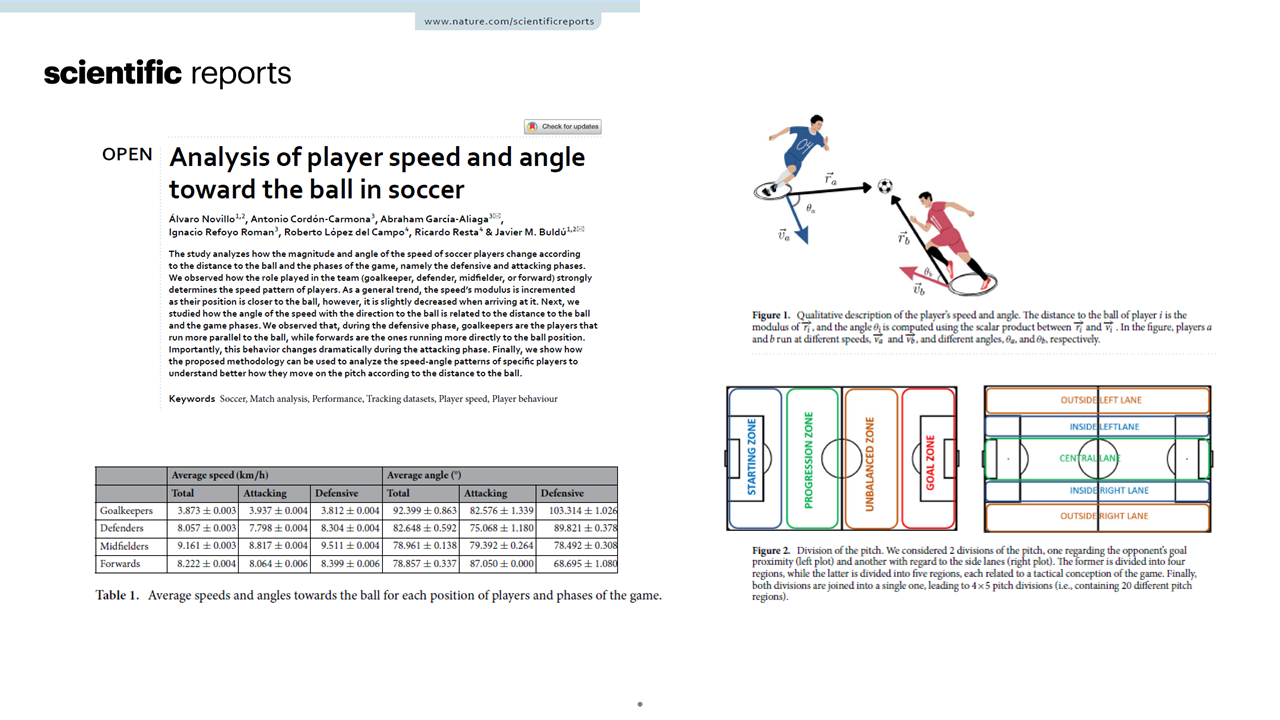
Modern football is played at speed, but speed alone does not explain behaviour. Direction matters. This study goes deeper than traditional running metrics and looks at how fast players move and where they move in relation to the ball. It shows that player behaviour changes constantly depending on distance to the ball, playing role, and game phase. These changes are not random. They follow clear patterns that can be trained, monitored, and exploited.
The closer a player is to the ball, the faster they tend to move. This is true across all positions and pitch zones. However, when players are extremely close to the ball, around two metres or less, speed drops. This slowdown is not a sign of fatigue. It reflects technical reality. Players reduce speed to control the ball, adjust body position, or execute a technical action. This detail is critical when interpreting high-speed data around ball actions. Not every deceleration near the ball is negative. Many are functional.
Defensive phases consistently demand higher running speeds than attacking phases. This is especially clear for defenders and midfielders. Pressing, covering space, and reacting to ball movement require constant acceleration. Forwards show a different pattern. Their speed profiles are more similar in attack and defence. This reflects their dual role. They sprint to attack space behind the line, but they also sprint to press and defend from the front. Their speed is task-driven, not phase-driven.
Distance to the ball also defines who moves the fastest. Forwards are the fastest players when close to the ball, especially in attacking situations. These are the moments linked to runs in behind, attacking duels, and goal-related actions. Midfielders, however, record the highest average speeds when they are far from the ball. This reflects their role as connectors. They constantly move to offer support, cover space, and rebalance the team. Conditioning work for midfielders must respect this continuous, medium-to-long distance demand rather than focusing only on short explosive actions.
Where players run matters as much as how they run. Speeds are higher in wide areas and near the corners of the pitch. These zones offer more space and fewer immediate opponents. This explains why fast players are often positioned wide. It also explains why high-speed actions frequently precede crosses, cut-backs, and box entries. Training drills that overload central zones but ignore wide acceleration patterns will miss a key part of match reality.
The most novel contribution of this study is direction. Speed is treated as a vector, not just a number. The angle of movement relative to the ball reveals tactical intent. Goalkeepers mostly move parallel to the ball, especially in defence. They protect space, adjust position, and stay connected to the defensive line. Defenders tend to move parallel to the ball when defending, closing gaps and shifting as a unit. When attacking, they move more directly towards the ball to support build-up.
Forwards show the opposite behaviour. They run more directly towards the ball when defending. This reflects modern pressing demands. In attack, they move more laterally, timing movements and managing offside lines. Midfielders sit in between. Their movement direction changes little between attack and defence. They are the tactical hinge of the team.
These directional patterns have clear practical value. Two players may cover the same distance at the same speed but with completely different tactical behaviours. One may be pressing aggressively. The other may be shifting space. Without angle information, both actions look identical in traditional metrics. With angle data, context becomes visible.
This methodology also allows individual profiling. Players can be compared to positional benchmarks not only by how much they run, but by how they move in relation to the ball. Deviations from positional norms may reflect tactical instructions, physical limitations, or energy management strategies. This opens a new layer of player evaluation that goes beyond volume and intensity.
For training design, the message is clear. Conditioning drills should replicate both speed and direction demands. Pressing drills should include direct angles toward the ball. Defensive block work should emphasise lateral movement at speed. Attacking drills should respect the speed drop close to the ball and the explosive demands just before ball contact. Load management should consider that defensive phases are often more physically demanding than attacking ones.
For analysts, this work offers a way to contextualise running data. Not all high-speed running is equal. Direction, distance to the ball, and phase of play define its meaning. For coaches, it reinforces that movement behaviour is role-specific and tactically driven. For performance staff, it provides a framework to better align physical preparation with match reality.
Football is not just about how fast players run. It is about when, where, and why they run. This study helps turn those questions into measurable answers.