


13 May Analyzing Positional and Temporal Variations in Worst-Case Scenario Demands in Professional Spanish Soccer
Football matches are not decided by averages. They are decided by short, intense moments. These moments push players to their physical limits. This study focuses exactly on those moments. The worst-case scenarios of match play.
The research analysed one full season of LALIGA. Every team. Every position. Every minute of the match. The goal was simple. To understand what players really face during the most demanding one-minute passages of competition, and how often those extreme demands appear.
Worst-case scenarios represent the highest physical stress a player experiences in a match. Not total distance. Not match averages. One intense minute. This is the reference point that should guide elite training.
The first key message is clear. Worst-case demands are highly position-specific. They are not shared equally across the pitch.
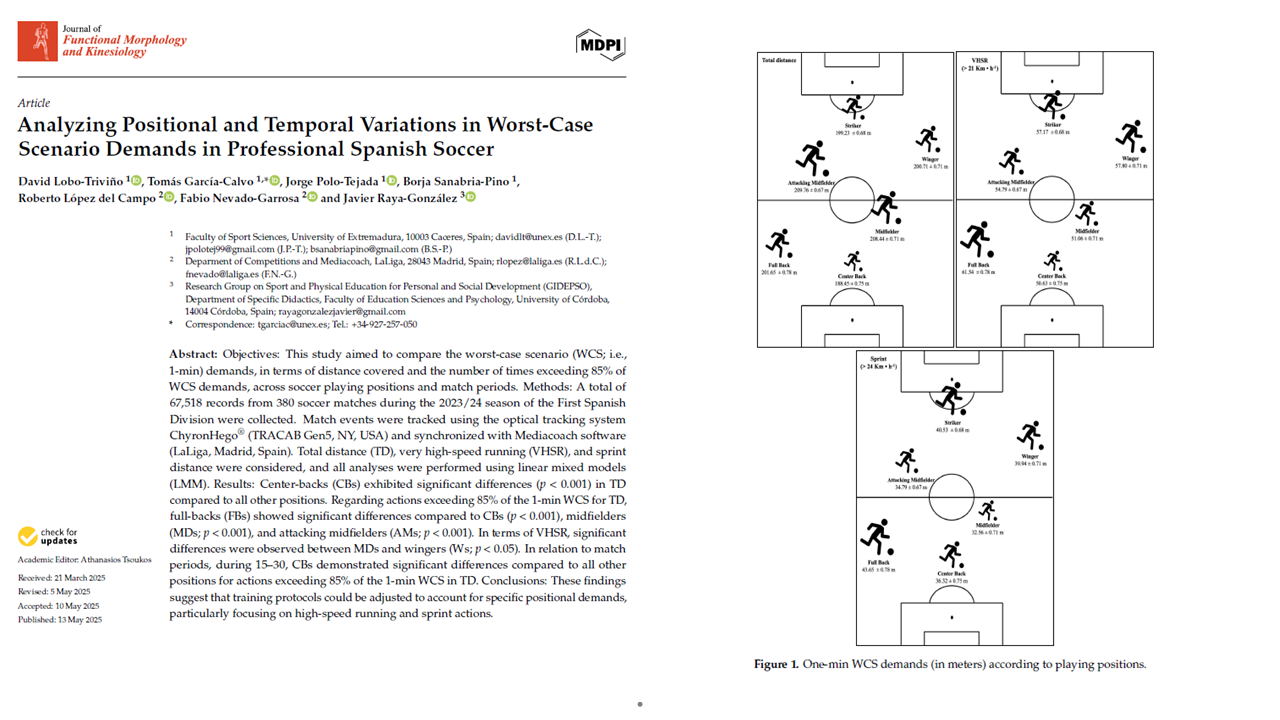
Full backs are the most exposed position. They cover the highest distances during their most demanding minute. They also repeat these extreme efforts more often than any other role. This applies especially to high-speed running and sprinting. In real terms, this means full backs are repeatedly asked to operate at near-maximal intensity throughout the match.
Wingers and strikers also face very high worst-case demands. Their peak minutes include more high-speed and sprint distance than central defenders and midfielders. These players are often involved in decisive actions. Transitions. Runs in behind. Counterattacks. Defensive recoveries. Their worst moments are explosive and repeated.
Central defenders and central midfielders show a different profile. Their peak minutes involve high total distance but less high-speed running. They accumulate load through movement and positioning rather than repeated sprinting. Their risk profile is different. Their preparation should be different.
The second major finding is time-related. Worst-case scenarios are not evenly distributed across the match.
The opening phase of the game already contains extreme demands. Players hit high-intensity passages very early. This reinforces the importance of proper warm-ups and match readiness from the first whistle. There is no gradual entry into peak demands.
The final 15 minutes are the most critical period. Across all positions, the number of extreme high-speed and sprint actions increases. Attacking players show the highest exposure in this phase. Matches are often decided here. Players push harder. Fatigue accumulates. Sprint actions increase.
This has direct consequences for training design. Conditioning should not only prepare players for early intensity but also for repeated high-intensity actions under fatigue late in the match.
Another important contribution of this study is the focus on frequency. It is not only about how demanding the worst minute is. It is about how often players get close to that worst minute.
Full backs repeatedly exceed 85% of their worst-case demands. This happens across all match periods. Their load is not accidental. It is structural. If training does not expose them to repeated high-speed and sprint actions, they will be underprepared.
Attacking players increase their exposure late in the game. This supports the need for position-specific conditioning that reflects match reality, not generic running volumes.
From a practical perspective, the message is straightforward. Training based on match averages is not enough. Preparing players for worst-case scenarios is essential.
Small-sided games, large spaces, and tactical drills must be designed with density and intensity in mind. Full backs, wingers, and strikers require higher exposure to high-speed and sprint demands. Midfielders and central defenders need sustained movement under tactical constraints.
Load management must reflect positional roles. Recovery strategies should consider how often players hit extreme demands, not only how much they run.
Worst-case scenarios are not rare events. They are repeated, predictable, and position-dependent. Ignoring them means leaving performance and injury prevention to chance.
This study provides a clear reference for elite football environments. Train for the hardest minute. Prepare players to repeat it. That is what the match will demand.