


05 Abr Analyzing the impact of non-participation in the FIFA World Cup Qatar 2022 on LaLiga players’ physical performance
A mid-season World Cup breaks every rule of the traditional football calendar. Some players compete at the highest level for a month. Others stay at home. Train. Recover. Prepare. But without official matches. This study focuses on those players. LaLiga footballers who did not take part in the FIFA World Cup Qatar 2022. And what really happened to their physical performance once domestic competition restarted.
The context is critical. Competition stopped for almost four weeks. Training continued. There was no match stress, no travel, no congested schedules. From a performance perspective, this was not a full detraining period. It was a pause in competitive stimulus. That difference explains many of the findings.
Playing time did not change after the World Cup. Coaches did not reduce minutes for these players once LaLiga resumed. Total distance per match also remained stable. Aerobic output was preserved. The base physical engine did not decline.
The major changes appeared in high-intensity actions.
After the World Cup break, players performed more high-speed running actions. They covered more distance above 21 km/h. They spent more time at high speed. Sprinting output also increased. More sprints. More sprint distance. More repeated sprint sequences. From a match-demand perspective, these players returned with greater explosive capacity.
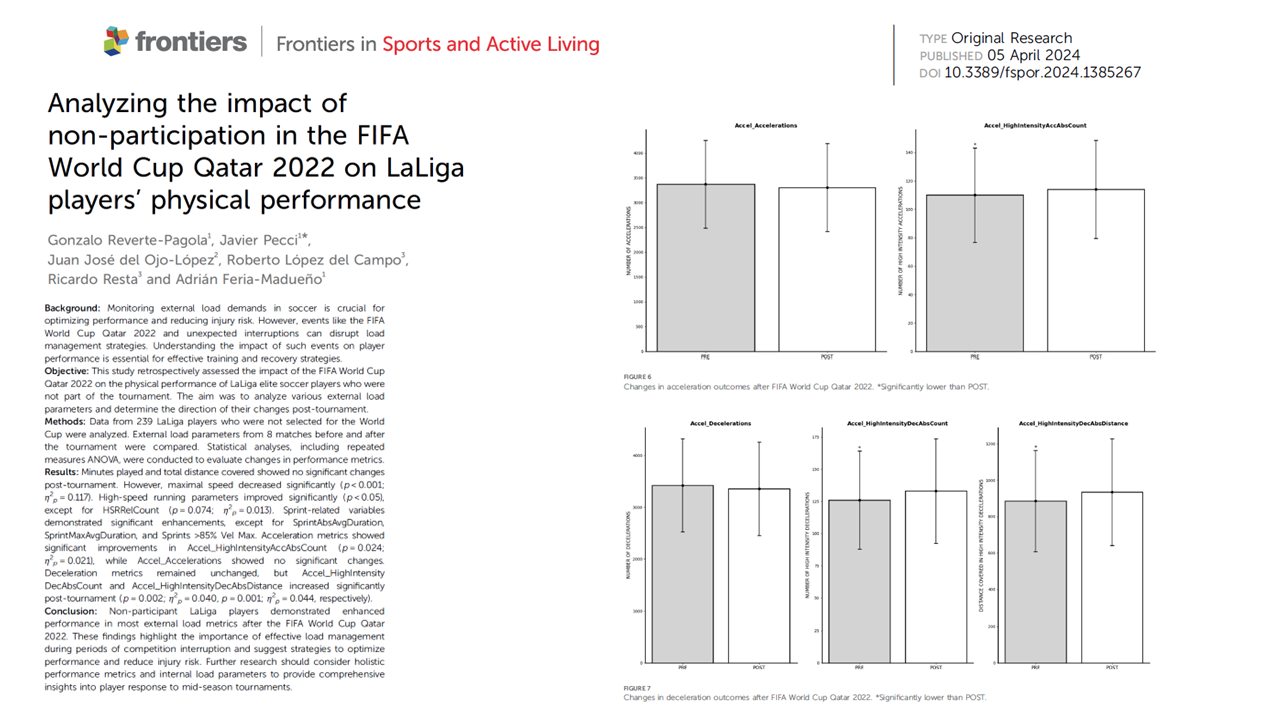
Accelerations followed the same pattern. High-intensity accelerations increased. High-intensity decelerations also increased, both in frequency and distance. This suggests improved neuromuscular readiness rather than physical decline.
There was only one clear negative effect. Maximum speed decreased.
Players reached slightly lower peak velocities after the break. Not because they sprinted less, but because they were exposed to fewer true maximal sprint situations. Training rarely reproduces the contextual pressure of match sprinting. Without competition, peak speed is the first quality to suffer.
This finding has direct consequences for elite practice.
Periods without competition are not inherently negative. If managed correctly, they can improve high-intensity output, repeated sprint ability, and braking demands. This creates a valuable window to build physical robustness, especially in players who usually accumulate high match loads.
However, maximum speed requires specific protection. It does not maintain itself. If peak velocity is not deliberately exposed during training, it will decline. For teams whose playing model depends on sprinting actions, this variable must be planned intentionally during competition breaks.
The study also reinforces a key concept for performance departments. Match performance is not defined only by training load. Competition itself shapes the physical stimulus. Removing matches alters the load profile in ways that can be beneficial or harmful depending on how staff manage the process.
For strength and conditioning coaches, the message is clear. Short competition interruptions can be used to raise neuromuscular capacity and high-intensity tolerance. But sprint exposure must be safeguarded.
For analysts, increases in high-speed running or sprint counts after a break should not be misinterpreted as tactical noise. They may reflect improved physical readiness.
From an injury prevention perspective, higher sprint and deceleration output also means greater stress on the posterior chain. Recovery strategies and strength levels must evolve accordingly. Fitness improves recovery. Strength protects tissue.
Performance does not stop when competition stops. It adapts. The role of the performance staff is to guide that adaptation in the right direction.