


20 Jun Are You Really Comparing What Matters? How Game Phase Bias Can Change Performance Analysis
What seems obvious… is it actually accurate?
As coaches, we often turn to post-match data for answers: who ran the most? Who intervened more? Who was more active with the ball? But have we ever truly stopped to consider how much time each player actually spent in a situation where those actions were possible?
Not all actions can occur at any moment in the game. A pass, for instance, only happens when the team is in possession. A tackle, only when out of possession. Despite this, we often compare players’ physical and technical performance without adjusting for the time each of them actually spent in offensive or defensive phases. This creates structural biases that can mislead our conclusions—and our decisions.
This study, conducted by the Football Intelligence Area of LALIGA, is based on real match data from the 2024/25 LALIGA EA SPORTS season. It aims to highlight how failing to account for each player’s actual exposure to the different phases of play can distort performance analysis—even when comparing players within the same position.
What did the study involve?
From the full-season data, we calculated for each player:
- Minutes played in offensive and defensive phases.
- Number of offensive and defensive actions.
- Total and high-intensity distance (>21 km/h), separated by phase.
- Metrics normalized by minutes played in each phase, yielding fairer and more meaningful comparisons.
How was the normalization done?
The normalization was based on each individual player’s minutes spent in offensive and defensive phases, rather than on team-wide possession percentages. This distinction is critical: not all players experience the same game context during their minutes on the field.
A team might show 58% total possession, but one player—who played only during a more defensive period—might have experienced just 50% possession. Another player, subbed on later, may have played in a phase where their team held 65%.
Additionally:
- Positional analysis was based on each player’s actual position in every segment of play.
- If a player switched roles within a match, their minutes and data were segmented and reassigned accordingly by phase and position.
This ensures a genuinely individualized and context-rich analysis, avoiding the common pitfalls of team-aggregated possession or static positional assignments.
Key findings and practical takeaways
1. A team’s style can inflate or deflate a player’s apparent performance
Some players appear in the top rankings when looking at raw totals, but fall out of the Top 5 when normalized by phase. For example:
- Jules Koundé (FC Barcelona) appears among the leaders in total offensive actions from the full-back position. However, once normalized by minutes in the offensive phase, he drops out of the Top 5. His high volume is partially explained by FC Barcelona’s prolonged possession phases, which increase his exposure to attacking actions.
- In contrast, full-backs like Andrei Ratiu (Rayo Vallecano) and Arnau Martínez (Girona FC), despite playing for teams with shorter offensive sequences, register more offensive actions per minute of possession, highlighting greater efficiency during limited attacking time.
- In defensive contribution, players such as Jesús Navas (Sevilla FC) and Fran García (Real Madrid) cover high total distances in defensive phase, reflecting their tactical roles in teams that maintain long defensive structures. However, when normalized, full-backs from more reactive teams like Javi Hernández (CD Leganés) and Enric Franquesa (CD Leganés) show higher high-intensity distance per minute in defense—suggesting greater physical demand in shorter spans of time.
2. Positional demands vary more than we think
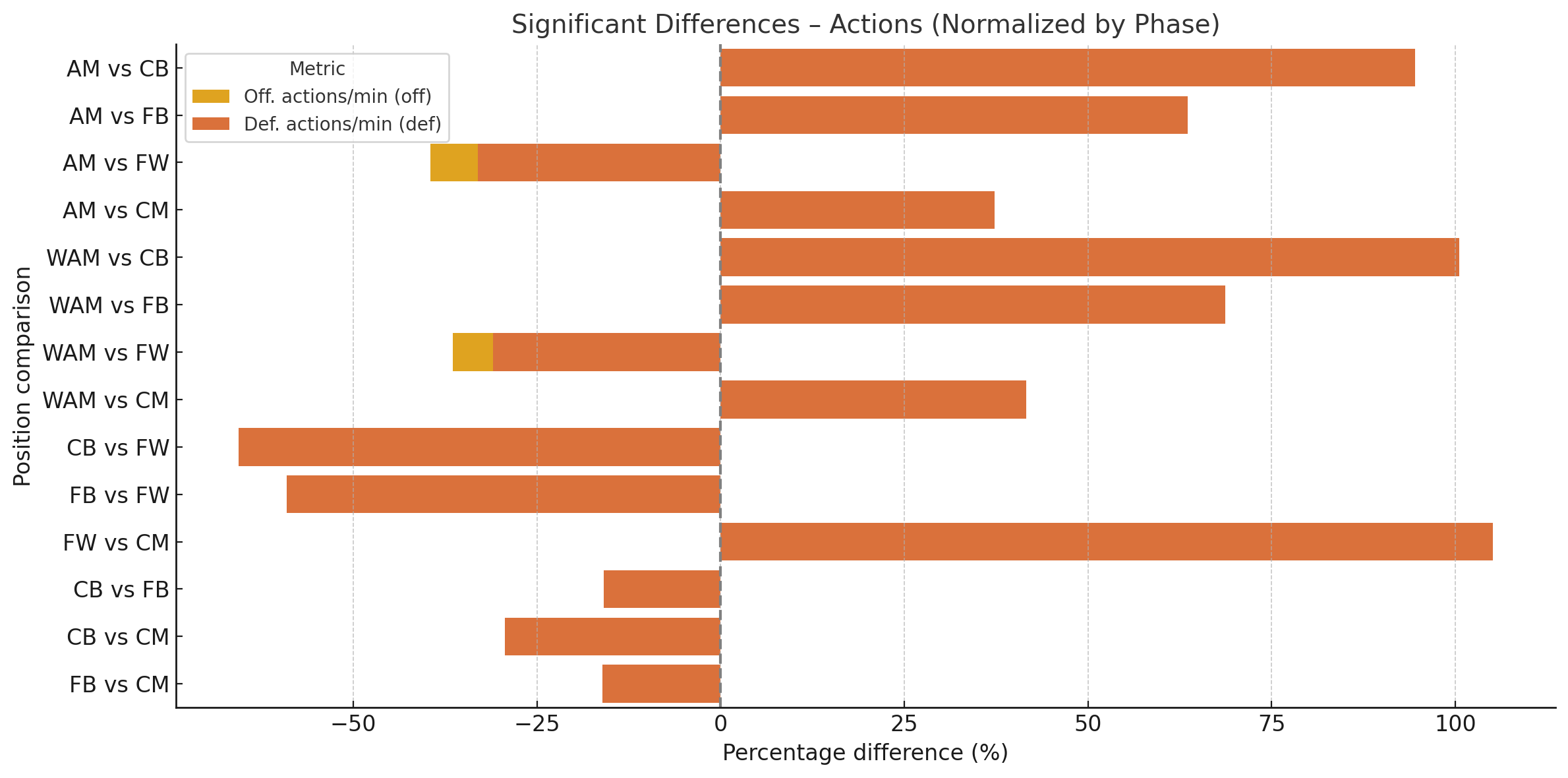
- Centre-backs perform up to 75% more offensive actions per minute of possession than forwards.
- Full-backs and centre-backs complete between 40% and 80% more defensive actions per minute than attacking players.
- Wingers and strikers lead in high-intensity distance with the ball, while central midfielders and full-backs dominate without it.
This confirms that comparing across positions without adjusting for context leads to misleading conclusions.
What does this mean for training and competition?
For training:
- Design phase-specific drills: if your wingers are sprinting more in attack, training should reflect that.
- Avoid misinterpreted overloads: a player running less does not necessarily mean they’re underperforming—it could be due to tactical exposure.
For post-match analysis:
- Not all who run the most have performed the best.
- Focus on impact per minute in the correct phase, not on totals alone.
For decision-making:
- Be cautious with raw rankings: players may appear more or less prominent depending on their team’s playing style—or the phase of the match they played in.
- Evaluate efficiency, not just volume.
Final thoughts
Are you evaluating what your players actually contribute… or just what the totals show?
Do you compare your centre-backs and wide midfielders based on unadjusted metrics?
Are your decisions built on individual performance… or shaped by collective context?
This study confirms that considering the phases of play is not just a methodological improvement—it’s a practical necessity. At the highest level, it’s the small details that define performance. And one of those details is knowing how, when, and in what tactical context actions actually occur.