


09 Nov The effect of coach dismissal on team performance and match physical demands in Spanish professional soccer leagues
Changing the head coach during the season is one of the most decisive moves a club can make. It is often driven by urgency. Results are not coming. Confidence is low. The environment needs a shock. But what really happens on the pitch after a coach dismissal. And how does it affect physical performance, not just results.
This study analysed four full seasons of professional football in Spain. It included all matches from the First and Second Divisions. Almost 6,000 games. Ninety-six mid-season coach dismissals. Real competition data. No simulations. No anecdotes. Just what actually happened.
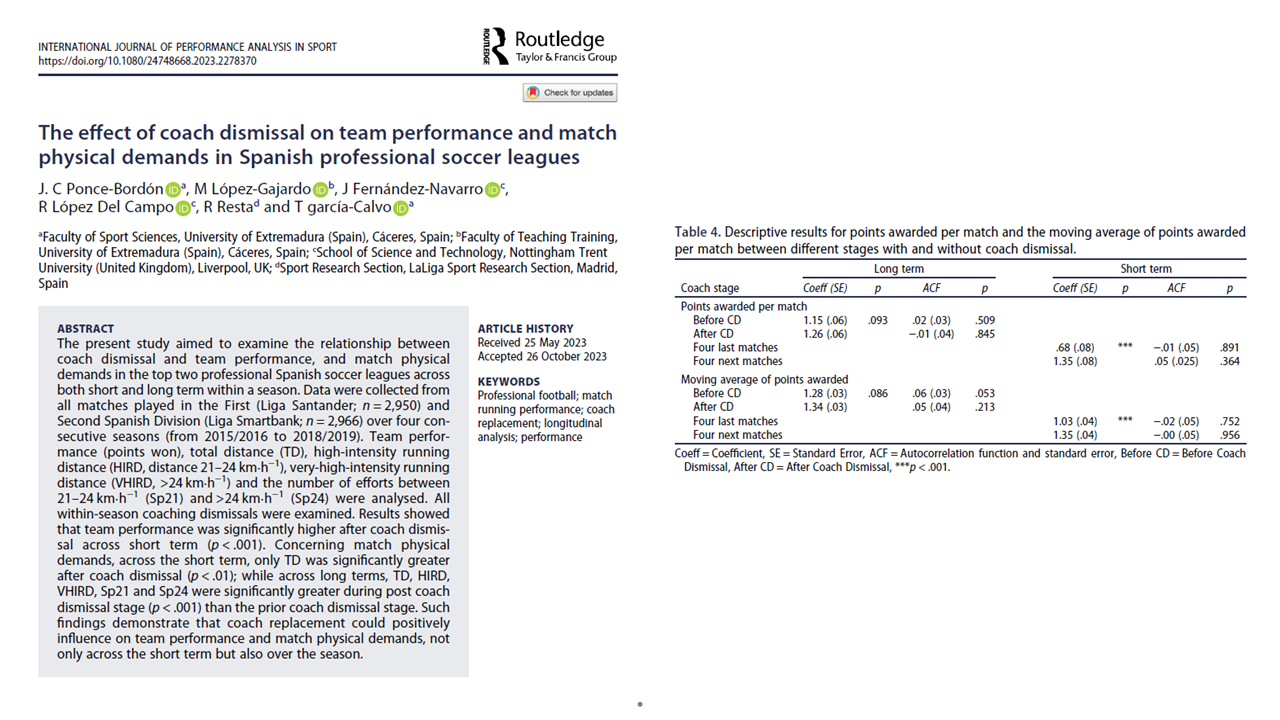
The first clear message is simple. In the short term, results improve. Teams win more points in the first four matches under the new coach. This effect is consistent and statistically robust. It confirms the well-known “new coach bounce”. Players respond immediately. Motivation increases. Focus sharpens. Competitive behaviour changes. In practical terms, teams almost double their points per match right after the coaching change.
But performance is not only about points. It is also about what players do physically on the pitch. And here the study offers very valuable insights for coaches, fitness staff and performance departments.
After a coach dismissal, teams run more. Total distance covered increases in the first matches under the new coach. This is not random. It reflects a clear rise in collective effort. Players press more. They cover more space. They compete harder for positions. The change in leadership acts as a physical stimulus.
More importantly, this increase is not limited to the short term. Across the rest of the season, teams that changed coach also showed higher physical demands. Total distance, high-intensity running and sprint actions all increased after the dismissal. This means the effect is not just emotional. It also reshapes how teams physically express themselves over time.
However, there is an important nuance. Teams that never changed coach still showed higher high-intensity performance across the season. Especially at the top level. Stability matters. Successful teams tend to maintain demanding physical outputs without needing disruption. Coach dismissal can raise physical effort, but it does not automatically turn a team into a high-performance reference.
From a practical perspective, this has several direct applications.
First, new coaches should expect an immediate rise in external load. Matches become more demanding. Players run more. High-speed actions increase. This requires careful load management in training. Adding too much physical work on top of this competitive spike increases injury risk.
Second, the performance boost seems driven more by motivation and behaviour than by physical conditioning. That means tactical clarity, role definition and collective organisation should be prioritised over heavy conditioning blocks in the first weeks.
Third, clubs should understand that coach dismissal is not a magic solution. The effect exists. It is real. But it is moderate. Team identity, player quality and long-term structure explain much more than the change itself.
Finally, performance departments should anticipate these transitions. Monitoring match load closely after a coaching change is not optional. It is essential. Injury risk can rise if the initial physical surge is not controlled properly.
In short, changing the coach can buy time. It can boost short-term results. It can raise physical output. But it also creates new demands that must be managed intelligently. Success does not come from running more. It comes from running better, at the right moments, with a clear game model.