


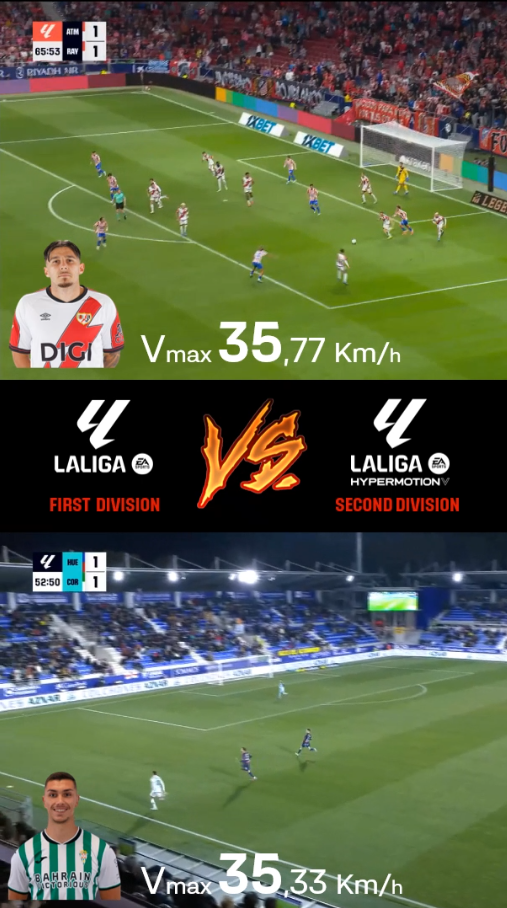
05 Feb Competitive Level Bias
Comparing players from different competitions is one of the most common practices in performance analysis. It is also one of the most misleading.
In professional football, physical metrics are often used as a shortcut to describe player capacity. Total distance. High-speed running. Sprint counts. These numbers are frequently compared across leagues as if they represented the same reality.
They do not.
Recent research based on LALIGA data shows that, when competitive context is properly controlled, physical demands between First and Second Division players are often very similar in absolute terms.
When match running performance is normalised by effective playing time, most of the apparent physical differences between divisions disappear. The game is more fragmented in some competitions, but the intensity during ball-in-play phases is comparable.
https://doi.org/10.5114/biolsport.2024.132993
When teams from different divisions face each other directly, as in Copa del Rey matches, overall physical demands are also remarkably similar. The total volume of running does not explain competitive level. What changes is how physical effort is distributed during the game.
https://doi.org/10.3390/app16031480
This does not mean that competitive level is irrelevant.
In the specific case of LALIGA EA Sports and LALIGA Hypermotion, the competitive level bias is subtle because both competitions are extremely demanding. The Second Division in Spain is above many First Divisions worldwide in terms of player quality, tactical organisation, and match intensity.
That is precisely why this comparison is so revealing.
The differences do not disappear. They move to context.
First Division teams tend to accumulate more physical load with ball possession. Second Division teams are more exposed without the ball. The same total distance can reflect completely different tactical realities.
This shift in interpretation is critical for practitioners.
A player who runs more is not necessarily fitter. He may simply be defending more. A player who runs less may not be underperforming. He may be operating in a more dominant game model.
Research has also shown that the meaning of physical effort differs between divisions. In LALIGA Hypermotion, running more without the ball is often associated with competitive success. In LALIGA EA Sports, the same defensive physical output does not explain performance outcomes in the same way.
https://doi.org/10.5114/biolsport.2023.118021
This example focuses specifically on the physical and conditional dimension of performance. Competitive level differences may be more evident in technical and tactical variables, but those dimensions require the same contextual care when being interpreted. The mistake is not comparing competitions. The mistake is comparing them without understanding the game context in which performance emerges.
For coaches, performance staff, and analysts, the practical implication is clear.
Physical KPIs cannot be transferred across competitions without context. Recruitment decisions, player benchmarking, and internal evaluations must account for possession, role, exposure, and effective playing time. Otherwise, competitive level bias quietly distorts decision-making.
Understanding how context shapes physical output is not a theoretical exercise. It directly affects how players are evaluated, trained, and trusted at the highest level of professional football.