


12 Dic Does Dominating Space Really Help You Win?
What 2024/25 LALIGA Data Reveals About Style, Space and Performance
“Control the space and you’ll control the game.”
It’s one of the most repeated ideas in modern football.
But when we actually test it against competition data, the picture becomes far more nuanced.
Using match data from the 2024/25 LALIGA EA Sports season, the Football Intelligence & Performance Department at LALIGA set out to answer a deceptively simple question:
Is spatial dominance a competitive advantage — or primarily a stylistic choice?
Why space needed a better analytical model
Space is omnipresent in tactical discourse, yet rarely modelled as a collective structure.
Most traditional indicators isolate dimensions:
- width,
- height of the defensive line,
- possession,
- positional heatmaps.
Our working hypothesis was clear:
If space really matters, it must be modelled as an integrated, contextual system — not as disconnected metrics.
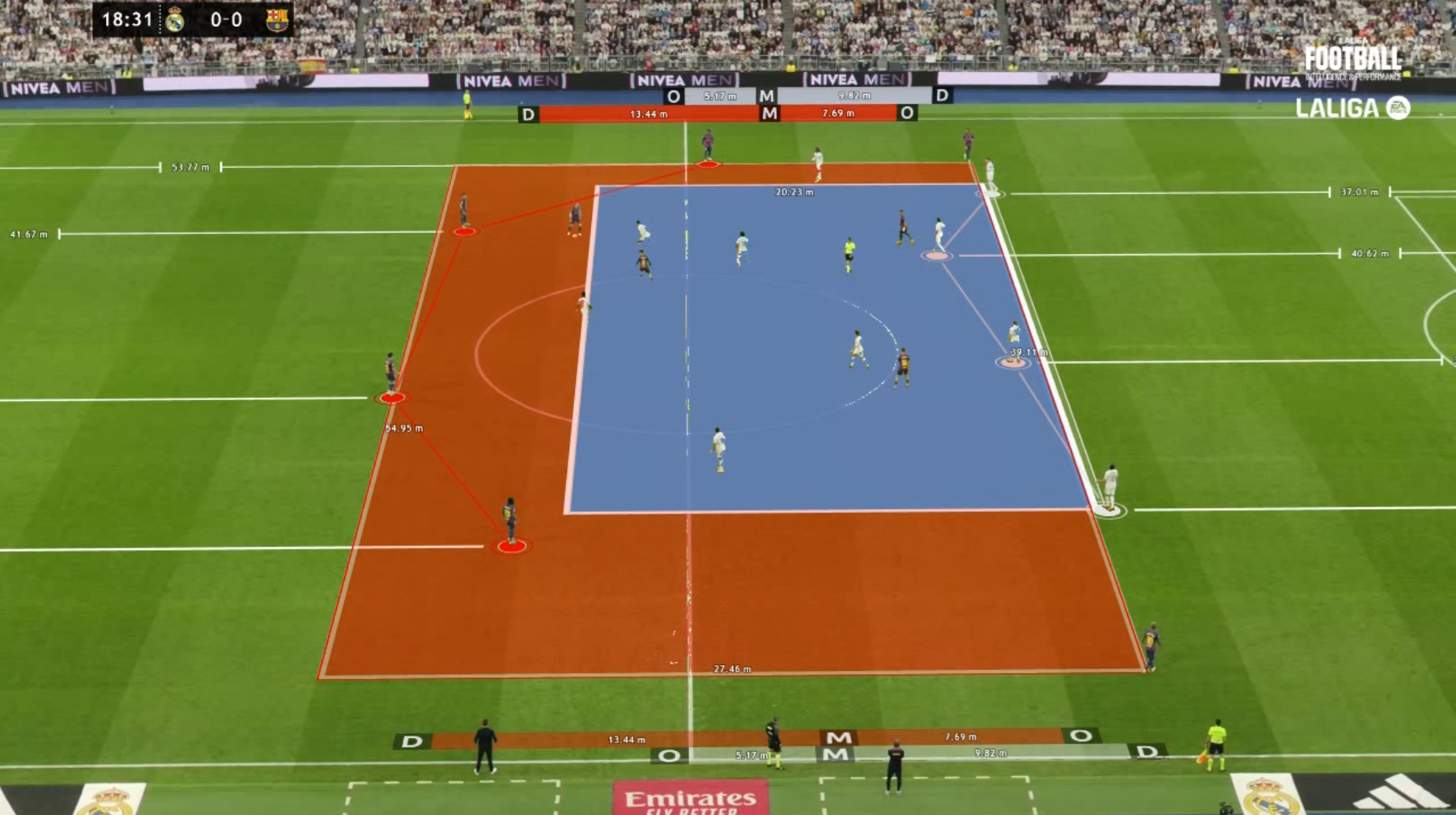
This led to the development of a new spatial model, specifically designed to capture how teams expand and compress the usable pitch during competition.
From intuition to structure: the spatial variables
The model is built around new composite variables, combining width and depth:
- AO (Offensive Area): width × attacking depth in possession
- AD (Defensive Area): width × depth when defending
- D (Spatial Differential): AO minus rival AD
- Dcorr (Corrected Spatial Differential): D adjusted by the opponent’s defensive line height
The correction is critical: a high defensive line effectively removes playable space via the offside rule. Dominating space against a high block is structurally more demanding than against a low one.
Designing these variables was a key contribution of the model — not a technical afterthought.
First key result: space explains how teams play, not who wins
Across the 2024/25 LALIGA EA Sports season, one result was immediate:
Spatial dominance does not correlate directly with match outcome.
Teams win and lose with:
- large or small offensive areas,
- high or low defensive blocks,
- positive or negative spatial differentials.
This challenges a common belief:
Space is a strong descriptor of playing style, but not a universal predictor of success.
Clustering teams by spatial style of play (2024/25)
Using AO, AD, D, Dcorr and defensive line height, teams were grouped into four distinct spatial styles.
🟦 Cluster 1 – Positional, high-block teams
FC Barcelona, Real Sociedad, RCD Espanyol, Villarreal CF
Characteristics:
- High defensive line
- Structured width and depth
- Strong territorial control and positional discipline
These teams aim to compress the pitch and dominate the opponent high up the field.
🟩 Cluster 2 – Expansive-positional teams
Real Madrid, Valencia CF, Real Valladolid CF, Real Betis, Sevilla FC, Athletic Club, Girona FC, RC Celta, UD Las Palmas
Characteristics:
- Large offensive areas
- Medium-to-high block
- Emphasis on width, circulation and sustained positional attacks
They stretch opponents both horizontally and vertically, but with more flexibility than strict high-block teams.
🟨 Cluster 3 – Compact, vertical teams
Getafe CF, Deportivo Alavés, RCD Mallorca
Characteristics:
- Low defensive line
- Small defensive area
- Direct progression and fast attacks
Their priority is reducing space and attacking it quickly once possession is regained.
🟥 Cluster 4 – Hybrid or mid-block structures
Atlético de Madrid, CA Osasuna, CD Leganés, Rayo Vallecano
Characteristics:
- Medium defensive height
- Balanced spatial areas
- Tactical adaptability depending on context and opponent
These teams adjust their spatial behaviour more than they impose a fixed structure.
When space actually matters: identifying dependent teams
The next question was not how teams differ from each other, but:
Does a team’s spatial behaviour change meaningfully when it wins versus when it loses?
By combining statistical sensitivity and real win–loss differences, a clear group emerged.
🔴 Teams that depend on spatial dominance to win
- FC Barcelona
- Real Madrid
- Villarreal CF
- Valencia CF
- Real Valladolid CF
For these teams, victories are associated with:
- greater offensive expansion,
- more favourable spatial differentials,
- better control of usable pitch.
When they fail to impose their spatial structure, performance drops.
(The remaining teams show no meaningful dependence on spatial variation.)
The 2×2 map: style meets dependency
To synthesise the analysis, we built a 2×2 map, crossing:
- X-axis: Spatial style (positional ↔ compact/vertical)
- Y-axis: Dependence on spatial dominance
Both axes are divided using their mean values, creating four objective quadrants.
🟦 Quadrant 1 – Positional & Space-Dependent
FC Barcelona, Real Madrid, Villarreal CF, Valencia CF, Real Valladolid CF
Interpretation:
These teams need to dominate width, depth and usable pitch to express their game model. Limiting their spatial structure directly impacts performance.
🟩 Quadrant 2 – Positional & Space-Independent
Real Sociedad, Real Betis, Sevilla FC, Girona FC, RC Celta, UD Las Palmas, RCD Espanyol
Interpretation:
They play positionally, but results depend more on rhythm, circulation, pressing or efficiency than on sheer spatial dominance.
🟥 Quadrant 3 – Compact & Space-Independent
Atlético de Madrid, CA Osasuna, Rayo Vallecano, Deportivo Alavés, RCD Mallorca
Interpretation:
Winning depends on duels, transitions, efficiency and defensive organisation. Spatial metrics remain stable regardless of outcome.
🟨 Quadrant 4 – Compact & Selectively Space-Dependent
Getafe CF, CD Leganés
Interpretation:
Here, spatial dependence exists mainly in defensive compactness. Success is linked to reducing AD rather than expanding AO.
What this means for coaches and analysts
- Space is not universally decisive. Its impact depends on team identity.
- Match preparation should be asymmetric. Removing space hurts some opponents far more than others.
- Data interpretation must be contextual. Width and depth only matter relative to who you are.
- Model design matters. New variables unlock insights hidden to traditional metrics.
A scientific mindset applied to the pitch
This work is not about replacing intuition.
It’s about testing it.
By questioning assumptions, building new models and accepting when data contradicts belief, football professionals can treat the pitch as what it truly is:
A living laboratory, where ideas must be tested — not assumed.