


20 Feb Effective Playing Time and Its Impact on Match Running Performance
Effective playing time changes how we interpret physical performance in elite football.
Most match reports describe performance per 90 minutes.
Total distance.
High-speed running.
Sprint count.
But football is not 90 minutes of continuous exposure.
In LALIGA, the ball is in play for roughly 55% of total match time. The rest is interruptions. Fouls. Throw-ins. Goal kicks. VAR. Injuries.
When we analyse performance without adjusting for effective playing time, we mix exposure with intensity.
This creates distortion.
The study “Elite Soccer Players Do Not Cover Less Distance in the Second Half of the Matches When Game Interruptions Are Considered” demonstrated a critical insight for professional environments. When match running performance is calculated using total match time, high-speed running and sprint distance appear to decline in the second half. It looks like fatigue. But when those same variables are normalised per minute of effective playing time, the decline disappears.
The practical message is simple. Total time overestimates fatigue-induced performance decline.
https://doi.org/10.1519/JSC.0000000000003935
A second study comparing the First and Second Divisions in Spanish professional football showed a similar pattern. When total match time is used, physical differences appear between competitive standards. When performance is normalised by effective playing time, those differences largely disappear.
The apparent physical gap was structural, not physiological.
https://doi.org/10.5114/biolsport.2024.132993
For coaches and performance staff, this has immediate implications.
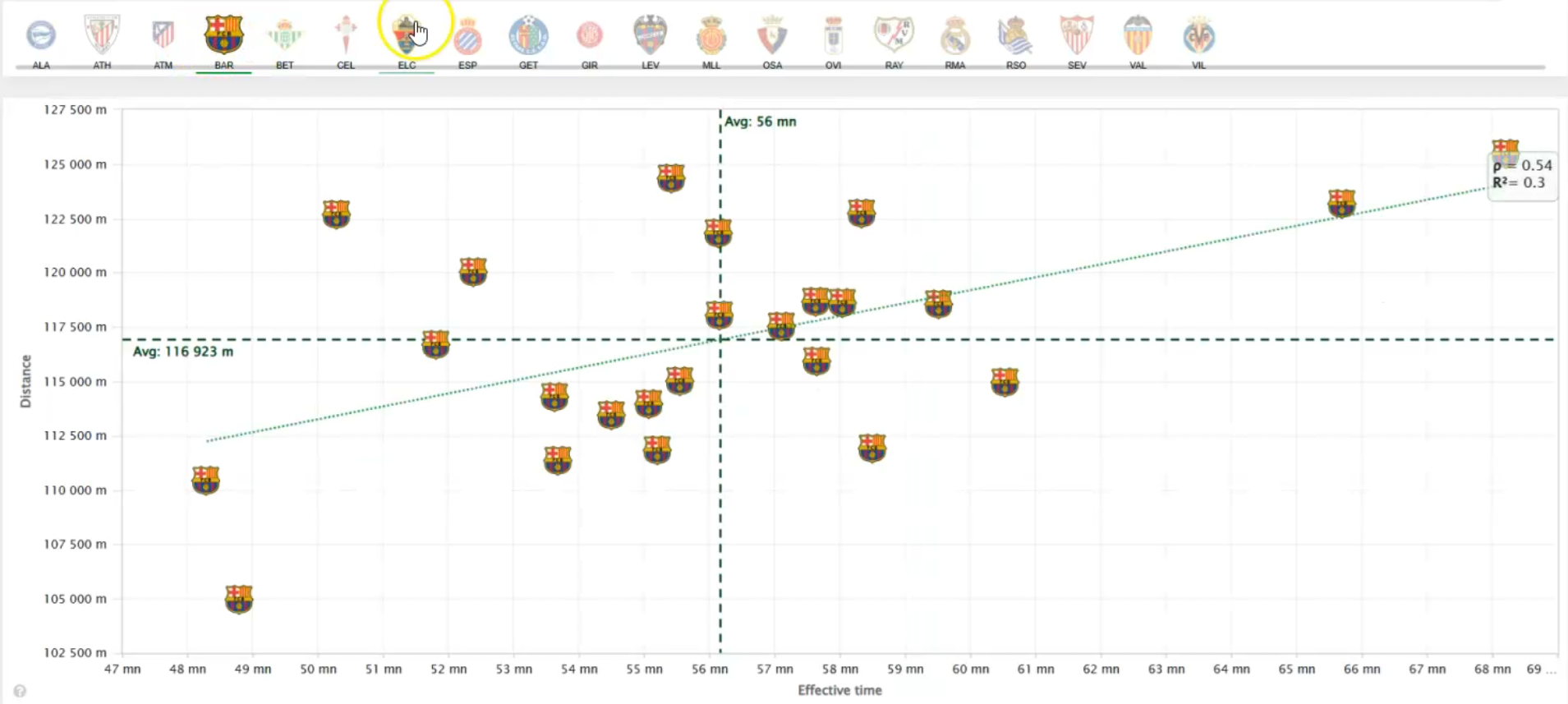
If two matches both last 90 minutes but one has 50 minutes of effective playing time and the other 60, the physical exposure is not the same. A player who runs 10.5 km in a fragmented match is not solving the same physical problem as one who runs 10.5 km in a flowing match.
Total distance is highly sensitive to effective playing time. High-speed running and sprint distance are also influenced, particularly when expressed in absolute values.
If we benchmark players using per-90 metrics without considering ball-in-play time, we risk misclassifying fatigue profiles, competitive level differences, and match intensity.
In training design, this matters.
If the objective is to replicate match intensity, the reference should not be total match distance. It should be metres per minute of effective playing time. Small-sided games often have effective playing time close to total task duration. Matches do not.
For match preparation, understanding expected effective playing time allows better load forecasting. High-flow games require greater density of high-intensity actions.
Fragmented games increase recovery opportunities and change pacing behaviour.
For recovery management, interpreting physical output without contextualising effective playing time can lead to inappropriate load decisions.
Effective playing time is not a statistical detail.
It is the denominator that defines exposure.
Performance per 90 is convenient.
Performance per effective minute is accurate.
If we want precise performance analysis in elite football, effective playing time must be part of the interpretation framework.