


17 Dic Elite Soccer Players Do Not Cover Less Distance in the Second Half of the Matches When Game Interruptions Are Considered
Posted at 11:23h
in Paper
Practical Summary for Coaches and Analysts
One of the most repeated ideas in football is that players “run less” in the second half due to fatigue. But is this really true? This study, based on more than 4,200 match observations in LaLiga, challenges that assumption by looking at effective playing time — the time the ball is actually in play, excluding stoppages.
Key findings
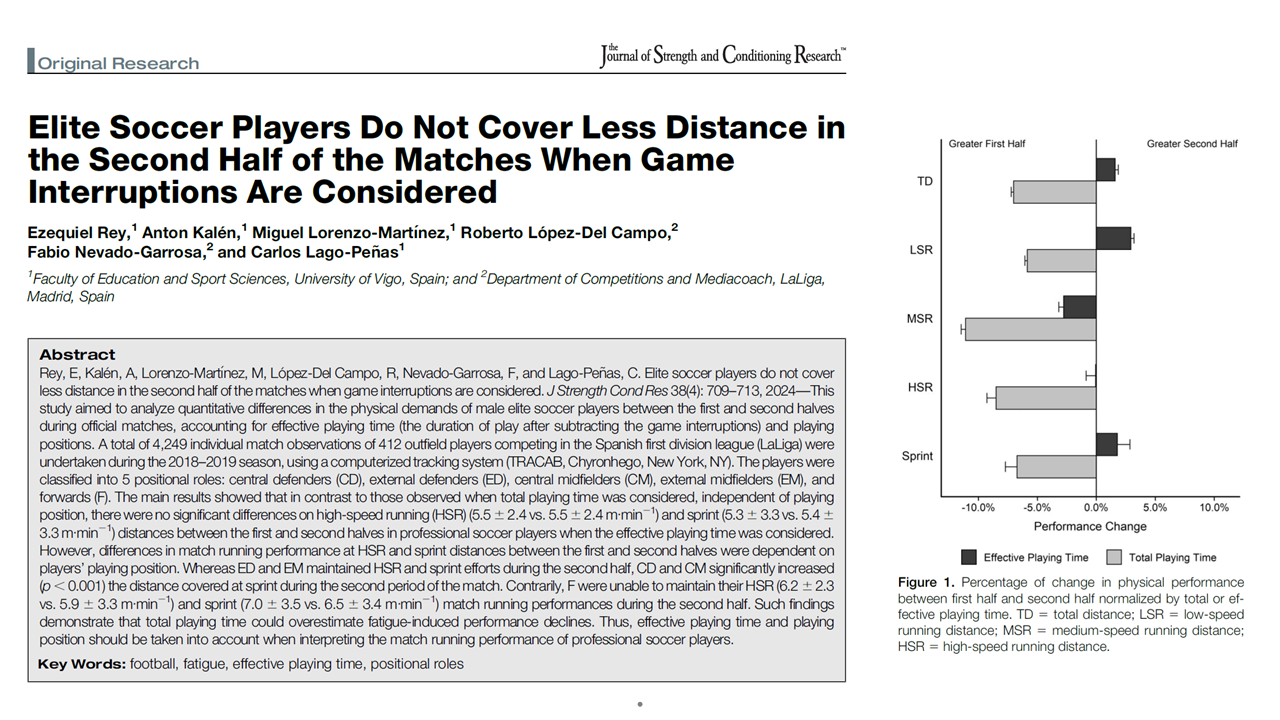
- The myth of the second-half drop-off. When analyzing total playing time, players appeared to cover less distance in the second half. But when interruptions (fouls, injuries, substitutions, time-wasting) were removed, the difference disappeared for high-speed running and sprints.
- Position-specific trends.
- External defenders and external midfielders maintained their sprinting and high-speed running in the second half.
- Central defenders and central midfielders even increased their sprint distance in the second half.
- Forwards were the only group that showed a real decline, with less high-speed running and sprinting in the second half.
- Effective time matters. On average, effective playing time in LaLiga was just over 52 minutes per match (about 55% of total match time). In the second half, effective time dropped by ~5%, largely due to increased stoppages.
What this means in practice
For coaching staff, the message is clear:
- Don’t overestimate fatigue. A simple look at total distances may give the impression of second-half decline, but when considering effective playing time, players show the capacity to sustain intensity.
- Focus on forwards. Forwards are the only group with clear reductions in high-speed and sprinting actions after half-time. Conditioning programs should therefore emphasize repeated sprint ability and high-intensity interval training tailored to strikers.
- Use effective time in analysis. Performance staff should always interpret GPS and Mediacoach® data considering effective playing time to avoid false conclusions about workload.
- Smart substitutions. The fact that forwards struggle to maintain sprinting explains why they are often the most substituted players — a tactical and physical necessity.
In short: it’s not that players run less in the second half — it’s that the game itself offers less effective time.
DOI Link
https://doi.org/10.1519/JSC.0000000000003935