


20 Dic Match running performance is similar in lower and higher competitive standards of Spanish professional soccer accounting for effective playing time
For years, match data seemed to tell a clear story. Higher-level teams run more. More sprints. More high-speed actions. More physical demands. This paper challenges that idea directly.
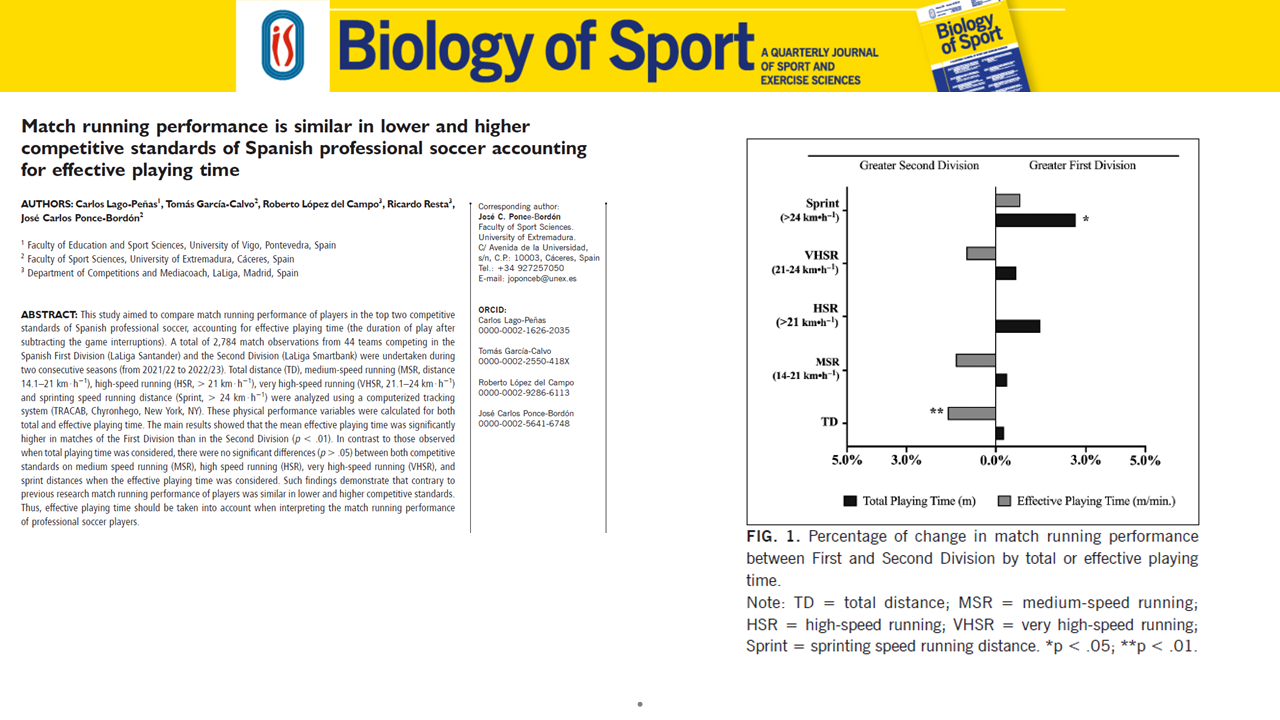
The study analysed almost 2,800 matches from LaLiga and LaLiga Smartbank across two full seasons. It used the same tracking system for every match. Same country. Same competition environment. The key difference was simple but decisive. The analysis separated total match time from effective playing time. Only the moments when the ball was actually in play.
When total match time is used, First Division teams appear to sprint more. This looks like a higher physical level. But this impression disappears when effective playing time is considered.
First Division matches simply have more ball-in-play minutes. Fewer interruptions. More continuity. When running performance is expressed per minute of effective play, the physical output is essentially the same across divisions.
Medium-speed running, high-speed running, very high-speed running and sprinting are all comparable. The players are not physically less demanding in the Second Division. They are exposed to a different game rhythm.
This changes how match demands should be interpreted. A player does not run less because the competitive level is lower. He runs less because the game stops more often. More fouls. More interruptions. Less flow.
For coaches and performance staff, this matters immediately. Match load should not be judged by total distance alone. Nor by raw sprint meters. Those numbers are heavily influenced by how much the ball is in play.
Effective playing time offers a cleaner picture. It shows what players do when football actually happens.
This has direct consequences for training design. If Second Division players show similar intensity per effective minute, they do not need a different physical model. They need exposure to longer continuous phases. More sustained game flow. Fewer artificial stops in training.
Small-sided games with frequent interruptions may underload players compared to real match demands. Large-sided games with rules that protect continuity may better reflect competitive reality.
For match analysts, this paper warns against simplistic comparisons between leagues. A team may look less intense on paper while producing the same physical output when the ball is in play. Context matters. Time matters.
For recovery planning, the message is also clear. Two matches with the same total distance can produce very different fatigue profiles depending on effective playing time. One match may be fragmented. Another may be relentless.
Ignoring this leads to wrong conclusions. About effort. About fatigue. About performance.
This research reinforces a key principle for elite football environments. Measure what truly happens. Not the clock on the scoreboard. But the minutes where the game is alive.
Only then can training loads, match preparation and player monitoring be aligned with reality.