


24 Mar Effects of the FIFA World Cup Qatar 2022 on match running performance in the Spanish professional soccer league: A pilot study
The modern football calendar is already demanding. The 2022 FIFA World Cup changed it completely. For the first time, a World Cup was played in the middle of the club season. This created a unique stress test for professional players, clubs, and performance staff.
This study analysed what really happened on the pitch in LaLiga after that tournament. Not opinions. Not simulations. Real match data from 582 professional players and more than 11,500 individual match observations across the 2022/23 season.
The key question was simple. Did players who went to the World Cup come back performing the same as those who stayed with their clubs?
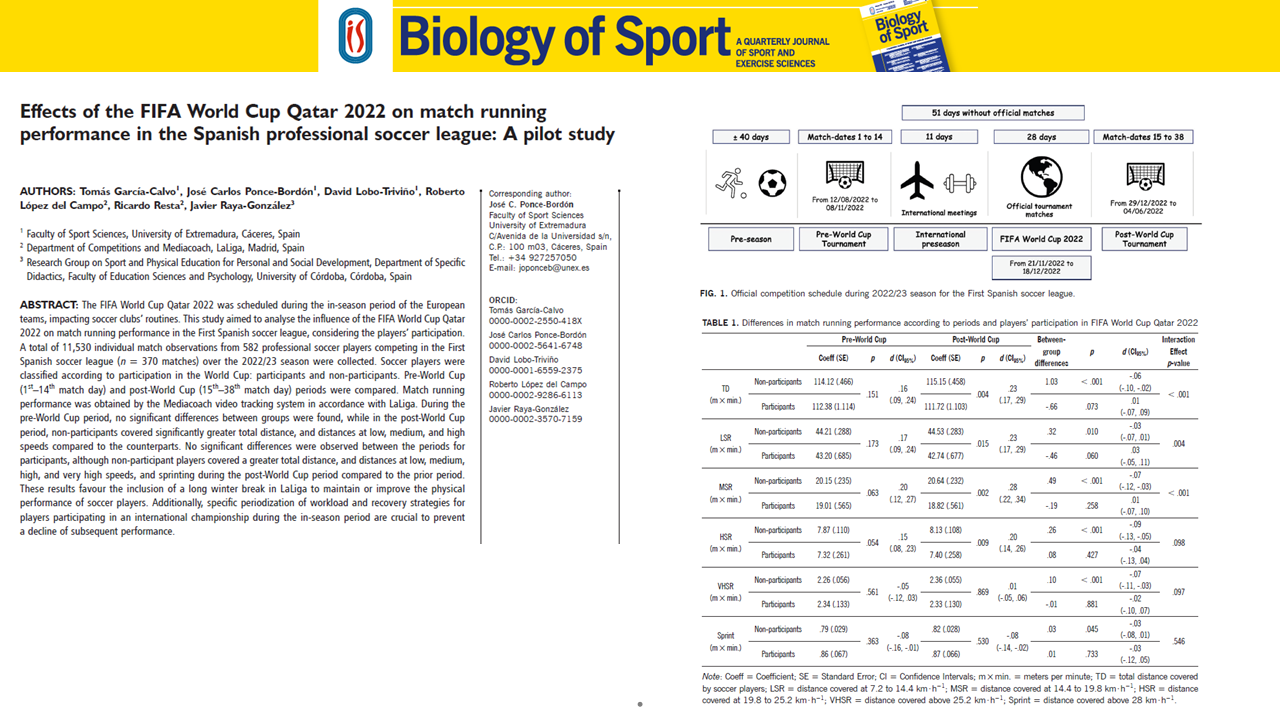
Before the World Cup, the answer was clear. There were no meaningful physical differences between players who would later go to Qatar and those who would not. Match running performance was similar across all speed zones. From low intensity to sprinting. This matters. It shows that any later changes were not caused by pre-existing differences.
After the World Cup, the picture changed.
Players who did not participate in the World Cup ran more. They covered more total distance. They accumulated more meters at low, medium, and high speeds. They also increased very high-speed running and sprint distance compared to their own pre-World Cup levels.
In contrast, players who participated in the World Cup did not improve. Their match running performance remained stable. In some intensity zones, it slightly declined, but without clear statistical changes. The key point is that they did not show the post-break boost seen in non-participants.
This is a critical message for elite performance staff.
The winter break acted as a performance enhancer for players who stayed with their clubs. They had time to recover. Time to recondition. Time to train without match congestion. When competition restarted, they ran more and sustained higher physical outputs.
World Cup players experienced the opposite context. More matches. Higher emotional load. International travel. Knockout pressure. Short recovery windows. They returned to domestic competition without the physical upside seen in their teammates.
This does not mean World Cup players underperformed. It means they lost a performance opportunity that others gained.
From a practical perspective, this study reinforces one idea. Equal schedules do not create equal readiness.
Performance staff cannot treat all players the same after a major in-season tournament. World Cup players need targeted reconditioning. They need structured recovery blocks. They need careful exposure to high-speed running. Not immediately. Not aggressively. But progressively.
Non-participants, on the other hand, respond positively to well-planned breaks. A short period of active recovery, followed by reconditioning and a controlled ramp-up, can increase match running output across all intensity zones.
This has direct implications for training design.
After international tournaments, physical benchmarks should be redefined by player profile, not squad averages. Match exposure, not calendar dates, should guide load progression. High-speed and sprint volumes must be reintroduced with intent, not assumption.
The findings also support the strategic value of a structured winter break in elite football. Not a passive break. An active one. With recovery at the start. Conditioning in the middle. Tapering before competition restarts.
For clubs competing in congested calendars, this study provides real evidence from elite competition. Performance does not decline because players rest. It declines when recovery and reconditioning are poorly managed.
The message is clear. International tournaments create two different players within the same squad. Performance models must reflect that reality.