


25 May The Biggest Mistake in Football Physical Analysis? Studying Metrics in Isolation
For years, football science has tried to answer a seemingly simple question:
Does physical performance help teams win football matches?
The answers have usually been frustrating.
Some studies showed that successful teams covered more high-speed running distance. Others showed no relationship at all. Some even found that losing teams ran more.
Eventually, many practitioners reached the same conclusion:
Physical metrics alone do not explain success in football.
And honestly, that conclusion made sense.
Football is not athletics.
The team that runs more does not necessarily win.
The team that sprints more is not automatically dominant.
But then we conducted a study using machine learning and locomotor data from professional football in Spain… and the results forced us to rethink something much deeper.
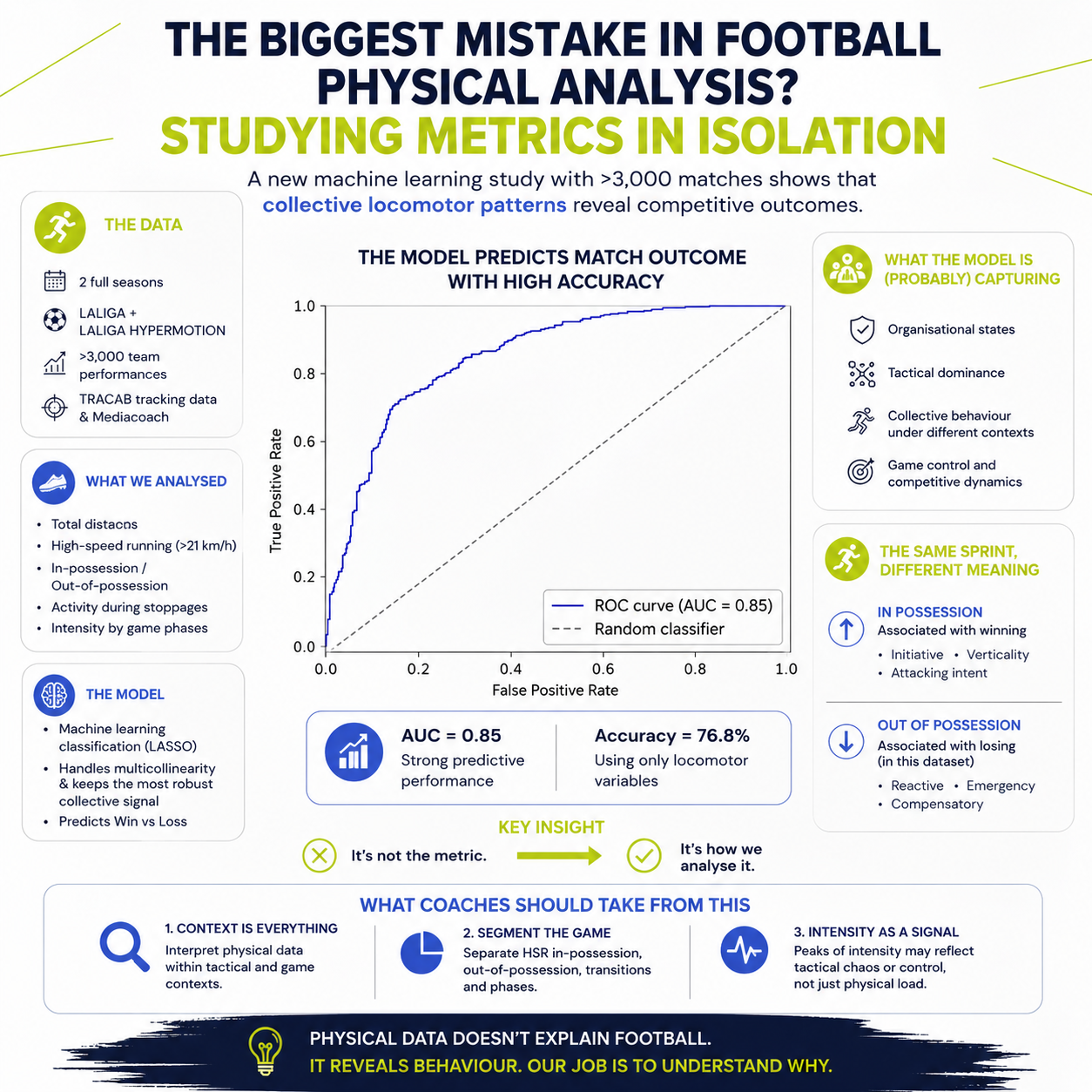
Using only locomotor variables collected during matches in LALIGA and LALIGA HYPERMOTION, the model achieved:
- 76.8% classification accuracy
- An AUC of 0.85
In football, these are exceptionally high predictive values.
Naturally, the first reaction could be:
“So physical performance predicts winning after all?”
But that is probably not the right interpretation.
And perhaps that misunderstanding reveals the biggest mistake we have made for years in football performance analysis:
studying physical metrics in isolation.
Maybe the Problem Was Never the Metrics
Perhaps the issue was not that locomotor variables lacked relevance.
Perhaps the issue was the way we analysed them.
For decades, football performance has often been divided into separate departments:
- Physical performance
- Tactical performance
- Technical performance
- Psychological performance
And inside the physical department:
- total distance,
- high-speed running,
- sprint counts,
- accelerations,
- decelerations.
Then we attempted to correlate each variable independently with success.
The result?
Weak relationships. Contradictory findings. Low explanatory power.
But football does not operate through isolated departments.
Football is a complex adaptive system where:
- tactical organisation changes locomotor demands,
- possession changes intensity,
- scoreline changes behaviour,
- spatial occupation changes effort,
- and collective coordination changes everything.
The same sprint can represent completely different realities depending on the tactical context in which it appears.
And that may be the real lesson behind this study.
Running Is Behaviour, Not Just Load
The study included:
- two complete seasons,
- both Spanish professional leagues,
- more than 3,000 team performances.
Using TRACAB tracking data and Mediacoach, several locomotor variables were analysed:
- total distance,
- high-speed running (>21 km/h),
- distance in possession,
- distance out of possession,
- activity during stoppages,
- and combinations between intensity and game phases.
Importantly, the study did not simply analyse “how much teams run”.
It analysed:
- when they run,
- in which phase,
- and at what intensity.
That distinction changes everything.
The model did not identify a “magic metric” that explains football success.
Instead, it detected something much more complex:
collective locomotor signatures associated with different competitive outcomes.
And this is where the findings become fascinating.
The Same Sprint Is Not the Same Action
One of the most interesting outcomes of the study was this:
High-intensity running IN possession was positively associated with winning.
Meanwhile, high-intensity running OUT of possession was negatively associated with winning in this dataset and modelling framework.
At first glance, that sounds contradictory.
How can high-speed running be both good and bad?
The answer is tactical context.
Imagine two teams performing the exact same amount of high-speed running.
Physically, the data may look almost identical.
But tactically, they may represent opposite realities.
One team performs high-intensity actions to:
- attack depth,
- break defensive lines,
- create overloads,
- exploit transitions,
- attack space aggressively.
Here, high-speed running reflects:
- initiative,
- offensive intent,
- coordinated behaviour,
- tactical superiority.
Another team performs high-intensity actions to:
- chase opponents,
- recover defensive positions,
- correct disorganisation,
- defend large spaces,
- react to instability.
Here, the exact same physical output may reflect:
- emergency behaviour,
- compensatory actions,
- delayed defensive responses,
- lack of collective control.
Physically similar.
Competitively very different.
And this is exactly why analysing locomotor metrics without tactical context can become deeply misleading.
Maybe GPS Data Is Revealing Tactical Behaviour
One of the strongest positive predictors in the model was total distance covered out of possession.
Not sprinting.
Not maximum intensity.
Simply maintaining a high collective activity level while defending.
This may represent:
- coordinated pressing,
- collective shifting,
- compactness,
- occupying spaces properly,
- timely defensive behaviour.
Meanwhile, excessive defensive sprinting was negatively associated with success in this dataset, suggesting that frequent defensive high-intensity actions may reflect reactive or compensatory behaviours rather than controlled defensive organisation.
That distinction matters enormously.
Because it suggests that winning teams may:
- defend actively,
- but not reactively.
They move collectively before situations become emergencies.
Losing teams, meanwhile, may end up performing more compensatory high-speed actions because they are constantly correcting problems after they appear.
This is a completely different way of interpreting physical data.
For years, GPS analysis often focused on questions like:
- How many meters did we run?
- How much high-speed running did we perform?
- Did the players reach target loads?
But perhaps a more relevant question is:
Why are these efforts happening?
Because locomotor data may not simply reflect physical output.
It may reflect:
- tactical organisation,
- collective synchronisation,
- pressing efficiency,
- transition quality,
- spatial control,
- and even emotional stability during matches.
The physical output becomes an observable expression of collective behaviour.
And this is where the study becomes conceptually interesting.
Why the Model Works
Another very important point:
The predictive power of the model does not come from isolated variables.
No single locomotor metric individually predicts football results with this level of accuracy.
The model works because it combines all variables simultaneously.
This is crucial.
Traditional football analysis often searched for:
- isolated correlations,
- individual predictors,
- single “winning metrics”.
But football probably does not work that way.
The interaction between variables matters more than the variables themselves.
And perhaps this is why previous studies frequently failed to find strong relationships between physical performance and success.
Many locomotor variables in the study shared large amounts of information with each other, a phenomenon known as multicollinearity. In practical terms, this means that isolated interpretation of single metrics becomes unstable and potentially misleading.
To address this, the study used LASSO regularisation, a machine learning technique designed to retain the most robust collective signal while reducing redundancy between highly correlated variables.
This is important because the model is probably not identifying isolated “winning metrics”.
Instead, it may be detecting organisational states expressed through locomotor behaviour.
And that changes the interpretation completely.
Maybe We Misunderstood Physical Performance
When analysed individually:
- total distance explains little,
- sprint distance explains little,
- high-speed running explains little.
But when analysed together:
- contextualised by game phase,
- combined through multivariate interactions,
- interpreted collectively,
meaningful structures begin to emerge.
This is very common in complex systems.
The whole contains more information than the isolated parts.
Football may be one of the clearest examples possible.
And perhaps this is why the study produced such surprising predictive values.
Not because locomotor data suddenly “explains football”.
But because analysing behaviours collectively may reveal structures that isolated analysis fails to capture.
A Predictive Model Is Not Necessarily an Explanatory Model
At this point, it is important to avoid overinterpreting the findings.
The study does NOT prove that:
- running more causes victory,
- high-speed running is inherently positive,
- physical performance alone explains football success.
This distinction matters enormously.
The model predicts match outcomes very well.
But prediction is not the same as explanation.
For example:
- umbrellas predict rain very accurately,
- but umbrellas do not cause rain.
Similarly, locomotor patterns may predict victory because they emerge from broader tactical and contextual states already unfolding during the match.
The model may therefore be identifying:
- organisational stability,
- tactical dominance,
- collective synchronisation,
- game control,
- behavioural adaptation,
rather than “fitness” itself.
That is a much more nuanced interpretation.
Football Is Temporal. The Model Is Static.
Another limitation is that the study uses aggregated match data.
But football evolves continuously.
The model does not know:
- when the sprint occurred,
- whether the team was winning or losing,
- if the action happened during transitions,
- or how the tactical structure evolved over time.
Future research should move toward:
- temporal analysis,
- phase-based modelling,
- transition identification,
- contextual game states,
- spatial tracking analysis,
- and integrated tactical-physical modelling.
That is probably where the next major breakthroughs will happen.
What Should Coaches Actually Take From This?
Probably not:
“We need more high-speed running.”
And definitely not:
“Physical data explains football.”
Instead, perhaps coaches should start asking different questions.
Not:
- How much did we run?
But:
- Why did we run?
- What tactical meaning did those efforts have?
- Were we sprinting to dominate?
- Or sprinting to survive?
Because the same locomotor output can reflect:
- tactical control,
or - tactical dysfunction.
And that changes how we should interpret physical performance forever.
Three Practical Takeaways for Clubs
First, physical data should never be interpreted without game context.
A sprint during an organised pressing sequence is not the same as a sprint recovering from defensive disorganisation.
Second, clubs should stop analysing high-speed running as a single global variable.
Separating:
- in-possession,
- out-of-possession,
- transition,
- and contextual phases
may reveal much more meaningful behavioural information.
Third, peaks of locomotor intensity should perhaps be interpreted not only as load indicators, but also as tactical signals.
Sometimes physical chaos is actually tactical chaos.
Perhaps This Is the Real Contribution of the Study
Maybe the most important finding is not the 76.8% accuracy.
Maybe it is this:
The historical difficulty in linking physical performance with football success may have been caused less by the absence of relationships… and more by the way we analysed the problem.
When analysed in isolation, locomotor variables appear weak and inconsistent.
But when analysed as interconnected components of a complex collective system, entirely new structures begin to emerge.
And perhaps that is where the future of football performance analysis truly lies:
Not in isolated metrics.
But in understanding how tactical, physical and contextual behaviours interact to create competitive performance.
Full paper: https://doi.org/10.3390/s26113278