


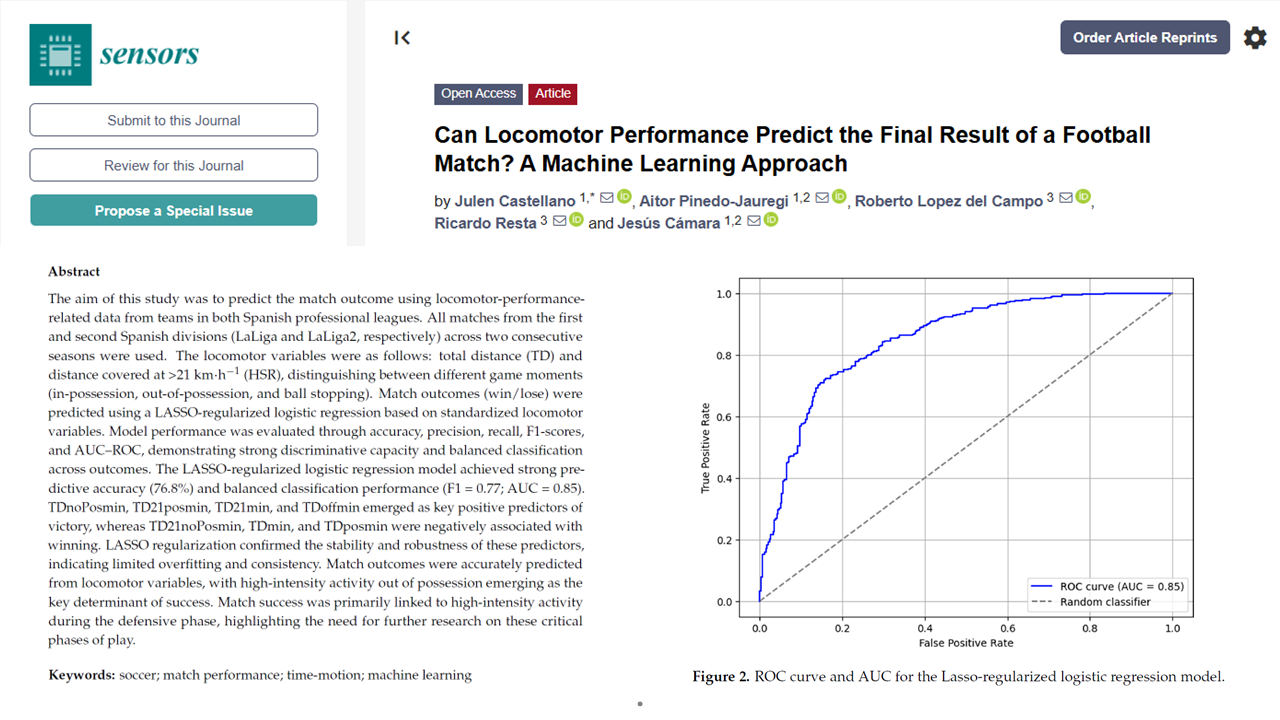
22 May #85. Can locomotor performance predict the final result of a football match? A machine learning approach
Running more does not necessarily mean playing better. What matters is not only how much a team runs, but when, how fast and under what circumstances.
This study analysed 3,170 team performances from LaLiga and LaLiga2 across the 2021/22 and 2022/23 seasons, using Mediacoach® tracking data to investigate whether physical performance could distinguish winning from losing teams.
A machine learning model correctly classified 76.8% of wins and defeats using only running-related variables. More importantly for coaches, the results revealed different relationships between running performance and match outcomes depending on whether teams had possession.
What the study found
The most interesting finding concerns defensive running. Teams covering more distance per minute without possession were more likely to be classified as winners. However, greater high-speed running above 21 km/h during the same phase was negatively associated with winning, after accounting for the other physical variables.
This apparent contradiction offers an important tactical perspective. Defending requires movement, but not every high-speed effort reflects effective defending. Some sprints may result from players having to recover lost positions, chase opponents or compensate for defensive disorganisation. An organised team may cover considerable distance while maintaining its defensive structure without constantly needing to sprint.
With possession, the pattern was different. High-speed running was positively associated with winning, whereas greater overall distance covered with the ball showed a negative association when the other variables were considered.
This suggests that the value of attacking movement may depend more on its purpose than its volume. Runs that create passing options, attack space behind defenders or break defensive lines may offer greater tactical value than simply accumulating distance during possession.
These interpretations are plausible explanations of the statistical relationships, not proof that specific running behaviours cause teams to win or lose.
What this means for coaches
The findings highlight why physical performance should always be interpreted in relation to the game.
Consider two defenders who each complete several high-speed runs. One is pressing an opponent as part of a coordinated defensive action. The other is sprinting back because his team has lost its defensive organisation. Their physical data may look similar, but their tactical situations are completely different.
The same applies in attack. A player covering substantial distance during possession is not necessarily contributing more than a teammate whose shorter, high-speed movements create space or disrupt the opposition’s defensive structure.
For coaches and performance analysts, this means that running metrics become more useful when connected to the tactical actions that produce them. Total distance and high-speed running remain valuable indicators, but possession phase, positioning and the purpose of each movement are essential to understanding what those numbers mean.
The study also has an important limitation: the model classified completed matches using their physical performance data. It did not predict results before kick-off, and draws were excluded. Its findings should therefore be understood as associations between running patterns and competitive outcomes, rather than evidence that increasing particular running demands will improve results.
Practical takeaways
Training and match analysis should go beyond measuring how much or how fast players run. The priority is to identify the football situations behind those efforts and evaluate whether they contribute to the team’s tactical objectives.
In possession, this means examining high-speed movements that create attacking advantages. Without possession, it means distinguishing the running required to maintain an effective defensive structure from the efforts needed to recover after that structure has been compromised.
The next step is to connect physical tracking data with tactical information, particularly in pressing, defensive transitions and attacking movements.
Ultimately, the most useful question is not how much a team runs, but what its running achieves on the pitch.
Reference
Castellano, J., Pinedo-Jauregi, A., Lopez del Campo, R., Resta, R., & Cámara, J. (2026). Can Locomotor Performance Predict the Final Result of a Football Match? A Machine Learning Approach. Sensors, 26(11), 3278.
Full paper: https://doi.org/10.3390/s26113278