


15 Sep #96. Rethinking recovery after hamstring muscle injury in elite football: speed exposure normalised to maximal speed reveals hidden sprint reductions after return to play
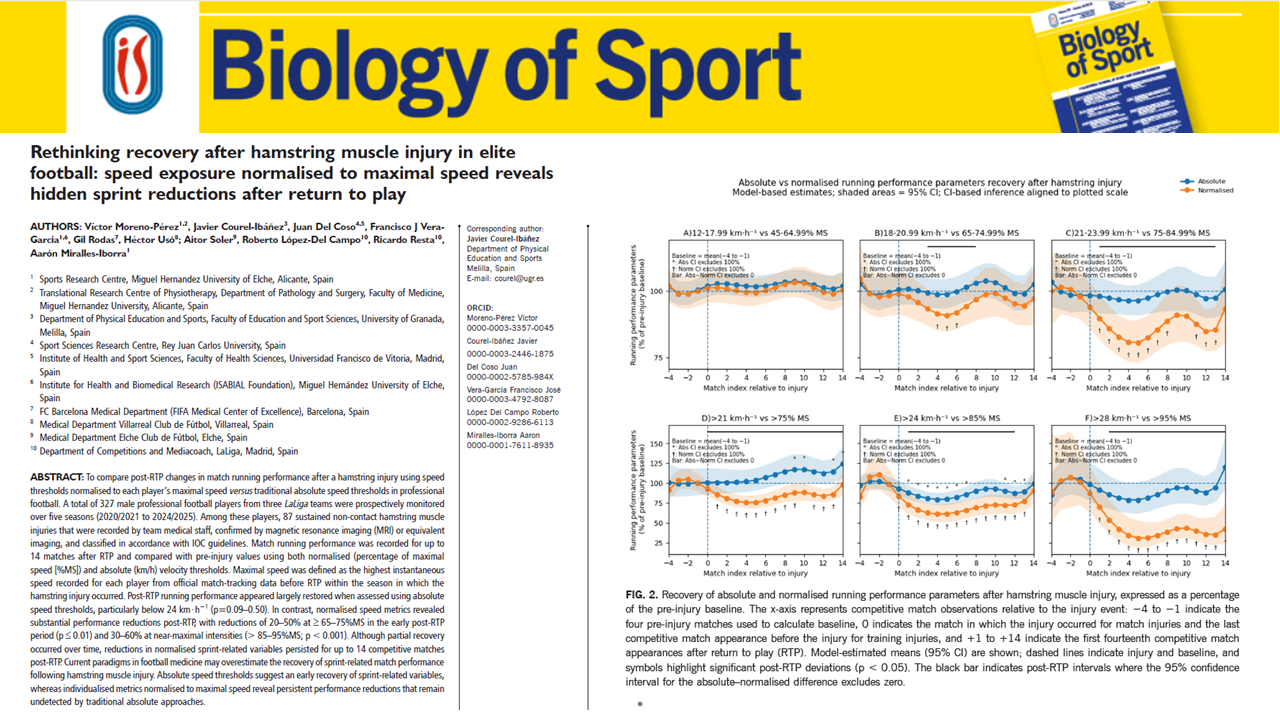
A player can return to competition after a hamstring injury, recover their usual running distances and still perform considerably fewer sprints near their maximum speed. The difference may simply depend on how we measure recovery.
This study monitored 327 professional LALIGA players from three clubs over five seasons (2020/21–2024/25). Among them, 87 sustained non-contact hamstring injuries, allowing researchers to compare their running performance before injury and across up to 14 matches after returning to play.
Using Mediacoach® tracking data, the researchers compared two approaches: traditional fixed speed thresholds, such as running above 21 or 24 km/h, and individualised thresholds based on each player’s pre-return maximum speed.
The findings reveal that traditional running metrics can make recovery appear more complete than it actually is when assessed through exposure to individual sprint intensities.
What the study found
When running performance was assessed using absolute speed thresholds, players appeared to recover relatively quickly. At speeds below 24 km/h, no clear differences were detected between their pre-injury and post-return performance.
However, the picture changed when running intensity was measured relative to each player’s maximum speed.
During the first five matches after returning, running exposure at higher individualised intensities was approximately 20–50% below pre-injury levels, with the greatest reductions occurring near maximum speed.
Although performance improved over subsequent matches, deficits generally remained around 10–30% during matches six to ten. At the highest intensities, reduced sprint exposure was still evident up to 14 matches after returning to competition.
This difference matters because the same absolute speed represents a different physical demand for different players.
Consider a footballer capable of reaching 35 km/h. Running at 25 km/h represents approximately 71% of their maximum speed. Although this effort may be classified as a sprint using a conventional threshold, it remains well below the player’s near-maximal capacity.
Consequently, recovering the distance covered above 25 km/h does not necessarily mean recovering the ability, or the opportunity, to perform near-maximal sprints.
What this means for coaches
Returning to play and returning to performance are not necessarily the same thing.
A player may complete competitive minutes, accumulate high-speed running distance and appear physically restored while still performing fewer actions above 85–95% of their pre-injury maximum speed.
For coaches and medical staff, this highlights the importance of monitoring sprint exposure relative to each player’s individual capacity, rather than relying exclusively on standard speed zones.
However, reduced sprint exposure does not automatically indicate incomplete physical recovery. Tactical responsibilities, match situations, playing time and deliberate workload restrictions may also explain why a player does not reach their highest speeds.
The study measured what players actually performed during matches, not their maximum physical capacity under controlled testing conditions. It also did not establish whether reduced sprint exposure increased reinjury risk.
Practical takeaways
After a hamstring injury, performance monitoring should combine absolute running distances with individualised speed thresholds, particularly exposure above 85% and 95% of the player’s pre-injury maximum speed.
Comparing these values with the player’s previous competitive profile can help identify whether near-maximal sprint demands have been progressively restored.
This also has implications for training. Returning to regular football practice and competitive matches does not guarantee sufficient exposure to maximum-speed running. Where appropriate, specific and progressively controlled sprint work may be needed alongside normal training and competition.
These decisions should integrate clinical assessment, strength testing, playing time, tactical context and other physical-load indicators, rather than depend on a single tracking metric.
Ultimately, the question is not only whether a player is running as much as before the injury, but whether they are once again exposed to the speeds their game demands.
Reference
Moreno-Pérez, V., Courel-Ibáñez, J., Del Coso, J., Vera-Garcia, F. J., Rodas, G., Usó, H., Soler, A., López-Del Campo, R., Resta, R., & Miralles-Iborra, A. (2027). Rethinking recovery after hamstring muscle injury in elite football: speed exposure normalised to maximal speed reveals hidden sprint reductions after return to play. Biology of Sport, 44, 75–84.
Full paper: https://doi.org/10.5114/biolsport.2027.164649