


08 Ago Hamstring Muscle Injury is Preceded by a Short Period of Higher Running Demands in Professional Football Players
Summary for coaches and performance staff
This LaLiga-supported study tracked 281 professional players from seven top-tier teams over three seasons to identify what really happens before a hamstring injury occurs in a match.
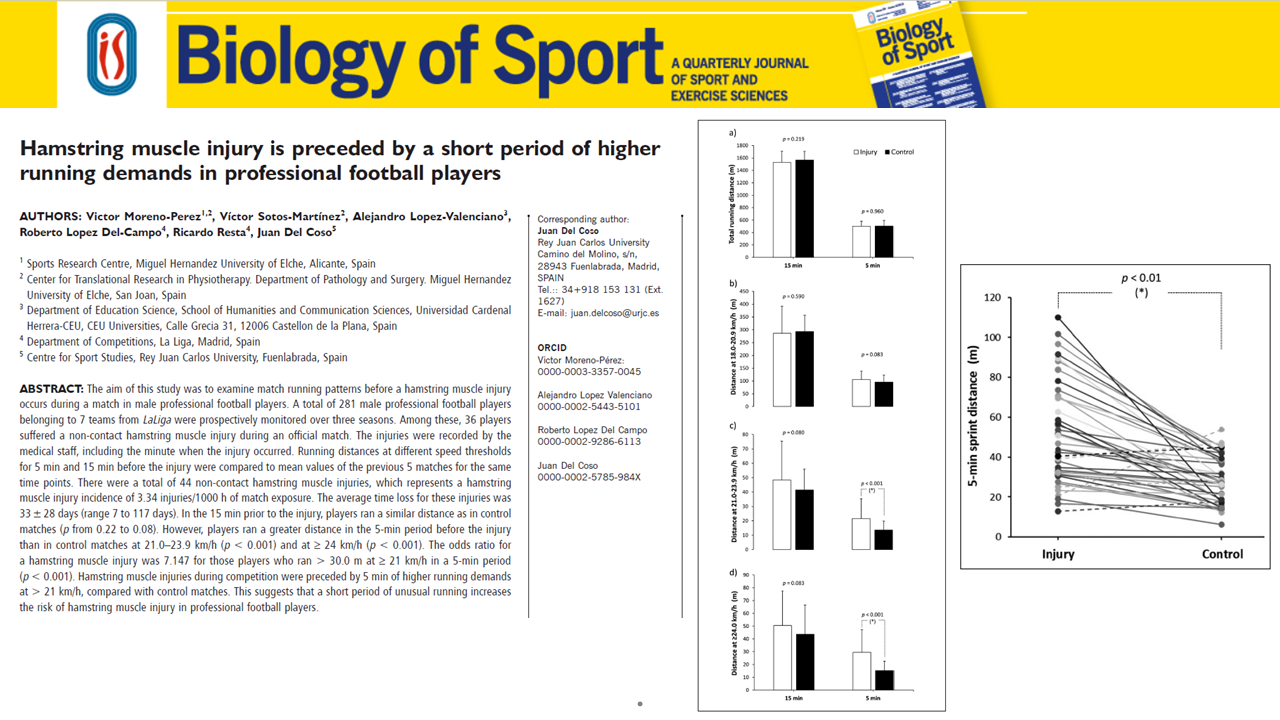
Across 44 non-contact hamstring injuries, the findings are clear: most of them are not random — they follow a brief surge of unusually intense running.
In the five minutes preceding injury, players covered significantly more distance above 21 km/h (both at sprinting and near-sprinting speeds) than they usually do in comparable match phases. Those who ran more than 30 meters above 21 km/h in five minutes had 7 times higher odds of suffering a hamstring injury.
In contrast, over a 15-minute window, no difference was found — meaning the risk spikes sharply only after short, sudden peaks in intensity.
Practical Applications for Coaches and Staff
- Monitor short-term load spikes, not just total match or weekly loads. Injury risk can rise within a five-minute window.
- Prepare players for sudden bursts under fatigue, especially late in each half when most injuries occur.
- Integrate sprint-based conditioning that reproduces match-like “5-minute overload” scenarios — preparing muscles, tendons, and the neuromuscular system to handle brief but extreme efforts safely.
- Fatigue magnifies risk: most hamstring injuries happen in the final 15 minutes of each half, when sprint mechanics deteriorate due to fatigue and reduced coordination.
- Prevention programs should combine eccentric strength training (e.g., Nordic exercises) with sprint exposure and deceleration control under realistic fatigue conditions.
In short: hamstring injuries don’t appear out of nowhere — they usually follow an abnormal, high-speed effort under fatigue. Recognizing and training for those moments is key to prevention.
Read the full paper: https://doi.org/10.5114/biolsport.2024.127387