


23 Sep Hamstring Return to Play: Can a Player Look Recovered While Still Being Underexposed to Sprinting?
A player returns from a hamstring injury.
His high-speed running metrics look normal. His sprint distance appears restored.
Yet he may still be performing substantially less running near his own maximal speed.
So, is he really back to performance?
The threshold changes the answer
Football commonly defines high-speed running through absolute thresholds such as 21, 24 or 28 km/h.
These cut-offs are useful, but they ignore individual capacity. Running at 24 km/h may represent a demanding sprint for one player and a relatively moderate effort for another.
This becomes critical after injury: recovering distance above a fixed threshold does not necessarily mean recovering exposure to the highest intensities of the player’s own speed spectrum.
What we found
Our new study, published in Biology of Sport, followed 87 male professional footballers with non-contact hamstring injuries from three LALIGA teams across five seasons.
We compared match running performance before injury and during the first 14 appearances after return to play, using both absolute and individualised speed thresholds.
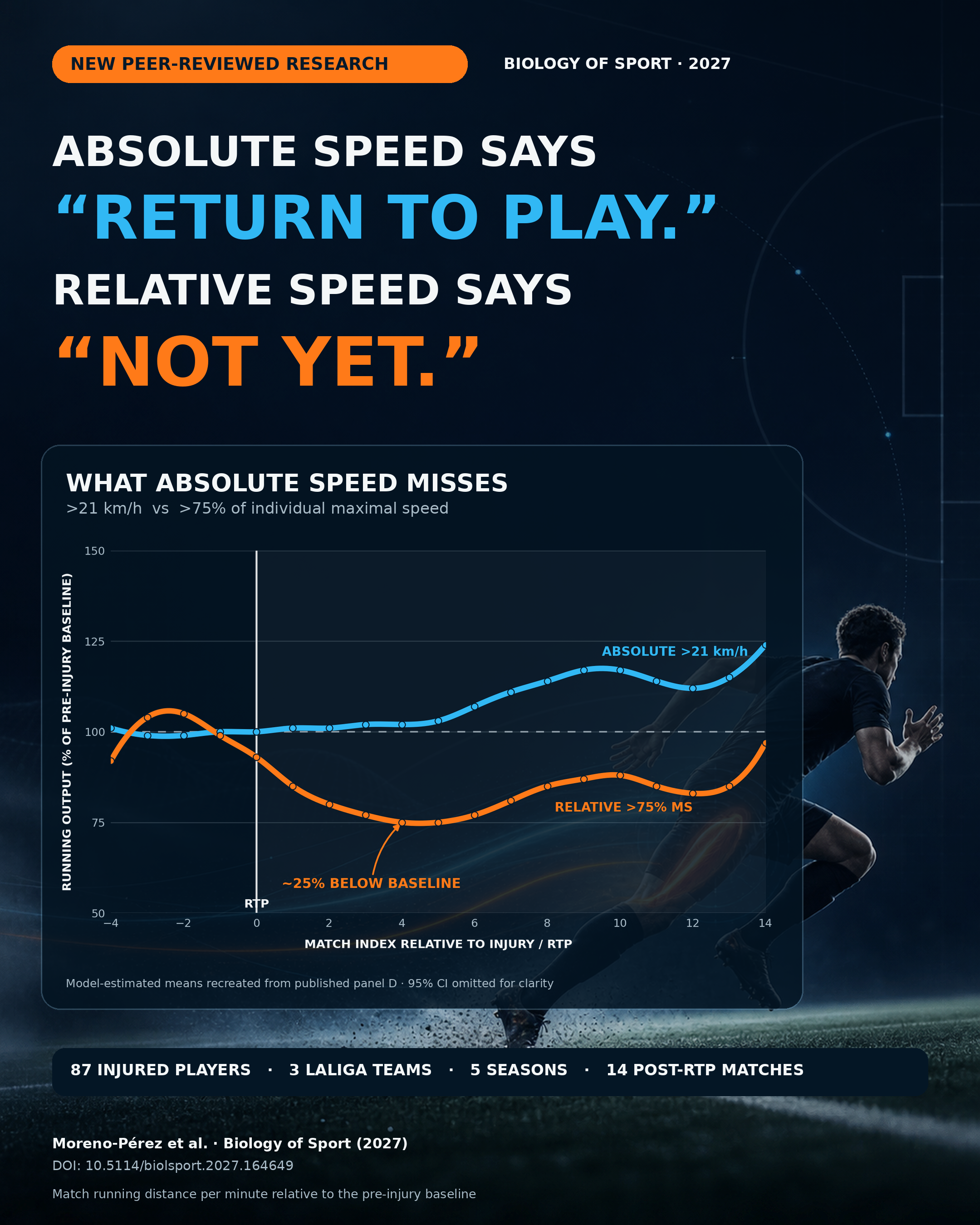
At lower intensities, both approaches produced similar recovery patterns.
The divergence appeared at high speed—approximately >21 km/h versus >75% of individual maximal speed—and became increasingly evident near maximal intensity.
Absolute thresholds suggested a relatively rapid recovery.
Individualised thresholds revealed reductions of up to 60% near maximal speed during the first matches, with deficits at the highest intensities persisting for up to 14 matches.
The same player could therefore look recovered in km/h while remaining clearly underexposed relative to his own maximal speed.
Why this matters
Near-maximal sprinting places particularly high forces and lengthening velocities on the hamstrings during late swing.
This does not mean that reduced sprint exposure causes reinjury—the study did not test that relationship. But it does mean that absolute thresholds may overlook the running intensities most relevant to restoring sprint performance and hamstring loading.
Returning to competition may not be enough. Structured exposure to near-maximal sprinting may still be required after return to play.
From data to practice
Absolute thresholds should not be abandoned. They remain valuable for benchmarking and comparing players.
But they should be complemented with speed expressed relative to each player’s maximum.
Practitioners should ask:
- Has the player regained exposure above 75% of maximal speed?
- Is he progressively reaching near-maximal intensity?
- Does the match context explain the reduced exposure?
Lower relative-speed output is a signal for further assessment, not proof of incomplete recovery. Tactical role, match state, playing time and deliberate load management can all influence sprint opportunities.
Individual thresholds also depend on the quality of the maximal-speed reference. In this study, it was obtained from official matches before return to play; if the player never reached his true maximum, the reference may be underestimated.
Return to play is not always return to performance
Medical clearance marks the return to competition. It does not necessarily mark the restoration of competitive sprint exposure.
The question is no longer only:
Has the player returned?
It is also:
Has the player returned to his own speed?
Moreno-Pérez V, Courel-Ibáñez J, Del Coso J, et al. Rethinking recovery after hamstring muscle injury in elite football: speed exposure normalised to maximal speed reveals hidden sprint reductions after return to play. Biology of Sport. 2027;44:75–84.