


03 May Hamstring Strain Injury Patterns in Spanish Professional Male Football (Soccer): A Systematic Video Analysis of 78 Match Injuries
Hamstring injuries are not random events. They follow patterns. Patterns that repeat across seasons, teams and tactical contexts.
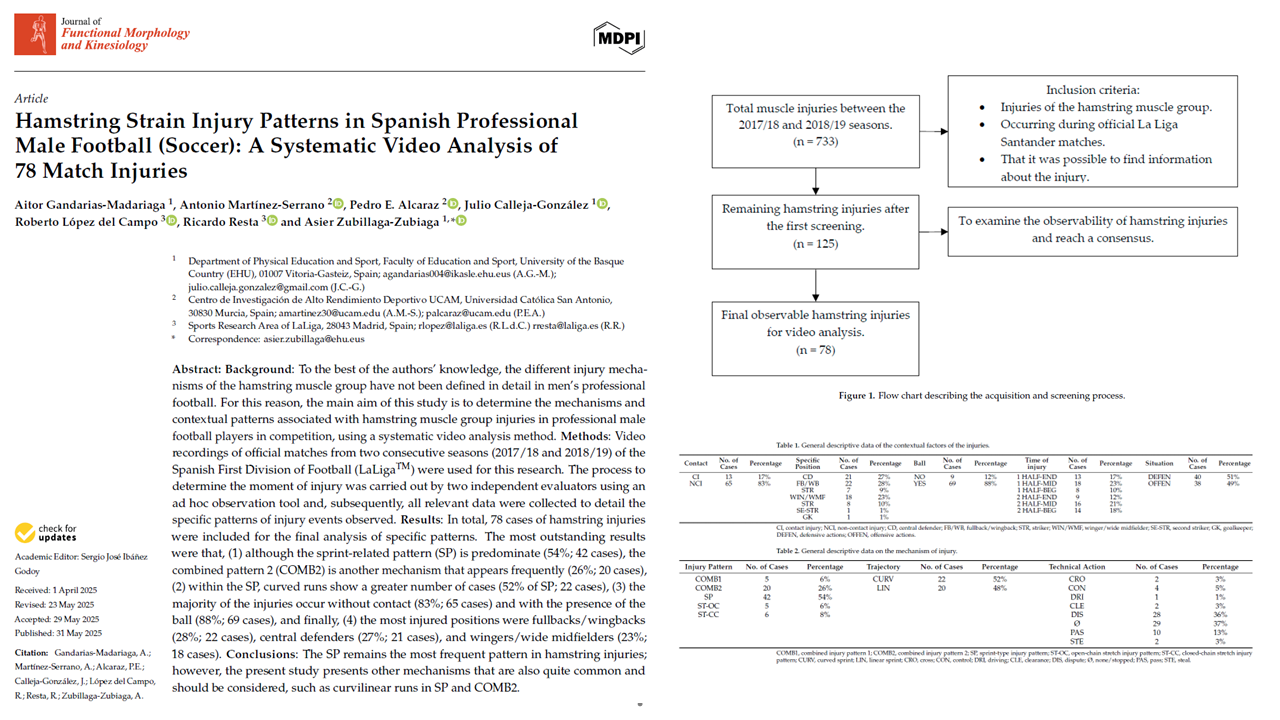
This study analysed 78 observable hamstring strain injuries that occurred during official LALIGA matches across two consecutive seasons. Using systematic video analysis, the objective was clear: to define how hamstring injuries really happen in elite male professional football.
The findings provide practical clarity for coaches, performance staff and medical departments.
Sprinting remains the primary mechanism. But it is not the only one.
The classic sprint pattern (SP) accounted for 54% of all cases. More than half of the injuries occurred during high-intensity running actions. This confirms what most practitioners already suspect: high-speed running remains the dominant context for hamstring strain injuries.
However, the story does not end there.
When combined patterns were included, 86% of all injuries had some direct relationship with sprinting. In other words, sprint exposure is almost always present before the injury occurs.
But not all sprint-related injuries are biomechanically identical.
The second most frequent mechanism was Combined Pattern 2 (COMB2), representing 26% of cases. This pattern deserves particular attention.
In COMB2, the injury does not necessarily occur at maximal sprint speed. It typically appears during rapid deceleration or braking after a high-intensity run, often combined with external disturbance such as contact or a contested action.
This shifts the preventive focus.
It is not enough to train maximum speed. Players must also be robust when stopping. They must tolerate braking forces, absorb ground reaction loads and manage perturbations while decelerating.
The ability to decelerate may be as important as the ability to accelerate.
Within the pure sprint pattern, another important detail emerged. Fifty-two percent of sprint-type injuries occurred during curvilinear runs rather than straight-line sprinting.
This is highly relevant.
Curved sprinting changes mechanics. The inner and outer legs behave differently. Hip rotators and hamstring activation patterns shift. Contact times and step characteristics adapt to centripetal force demands.
Yet many prevention programs still focus predominantly on linear sprint exposure.
If half of sprint-type hamstring injuries occur during curved trajectories, training must reflect that reality. Curvilinear sprint drills are not optional. They are specific.
Most injuries were non-contact. Eighty-three percent occurred without direct collision. But this does not mean they were simple.
In closed-chain and combined patterns, contact frequency increased, particularly during disputed actions. High-speed braking combined with external perturbation appears to increase mechanical stress.
Non-contact does not mean low complexity. It often means high neuromuscular demand under unstable conditions.
One distinctive contribution of this study is the inclusion of ball presence as a contextual variable.
In 88% of injuries, the ball was relevant to the action at the time of injury.
Football is not sprinting in isolation. It is sprinting while processing visual information, making tactical decisions, adjusting to opponents and interacting with a constantly changing environment.
Neurocognitive load matters.
The most frequent technical contexts at the time of injury were disputed actions, running without a specific technical gesture and passing actions.
This suggests that late-stage rehabilitation and prevention programs should integrate decision-making, external focus of attention and reactive components instead of purely mechanical drills.
Regarding playing positions, the most affected roles were fullbacks/wingbacks, central defenders and wingers.
The exposure of wide players is not surprising. Their role demands repeated high-speed runs, transitions and decelerations.
The incidence in central defenders, however, deserves attention. Although they may accumulate lower total distance than midfielders, they frequently perform isolated, high-intensity defensive sprints and reactive braking actions. If training does not replicate those exposures, match demands may exceed preparation.
The applied message for elite environments is clear.
Linear high-speed running must remain a cornerstone of hamstring prevention and rehabilitation.
But it is not sufficient.
Deceleration capacity must be deliberately trained. Curvilinear sprinting must be integrated. Tasks should include ball interaction and external attention demands. Positional profiles must guide load exposure strategies.
Hamstring injury prevention cannot rely only on eccentric strength exercises and straight-line sprint progressions.
It must reflect how injuries truly occur in competition.
The sprint pattern remains predominant. But braking, curved trajectories, contextual interaction with the ball and positional demands all shape how and when hamstring injuries happen.
In elite football, preparation must mirror reality.
Availability is performance.