


15 Nov How to Use Advanced Analytics to Identify and Enhance Your Team’s Strengths in LaLiga EA Sports

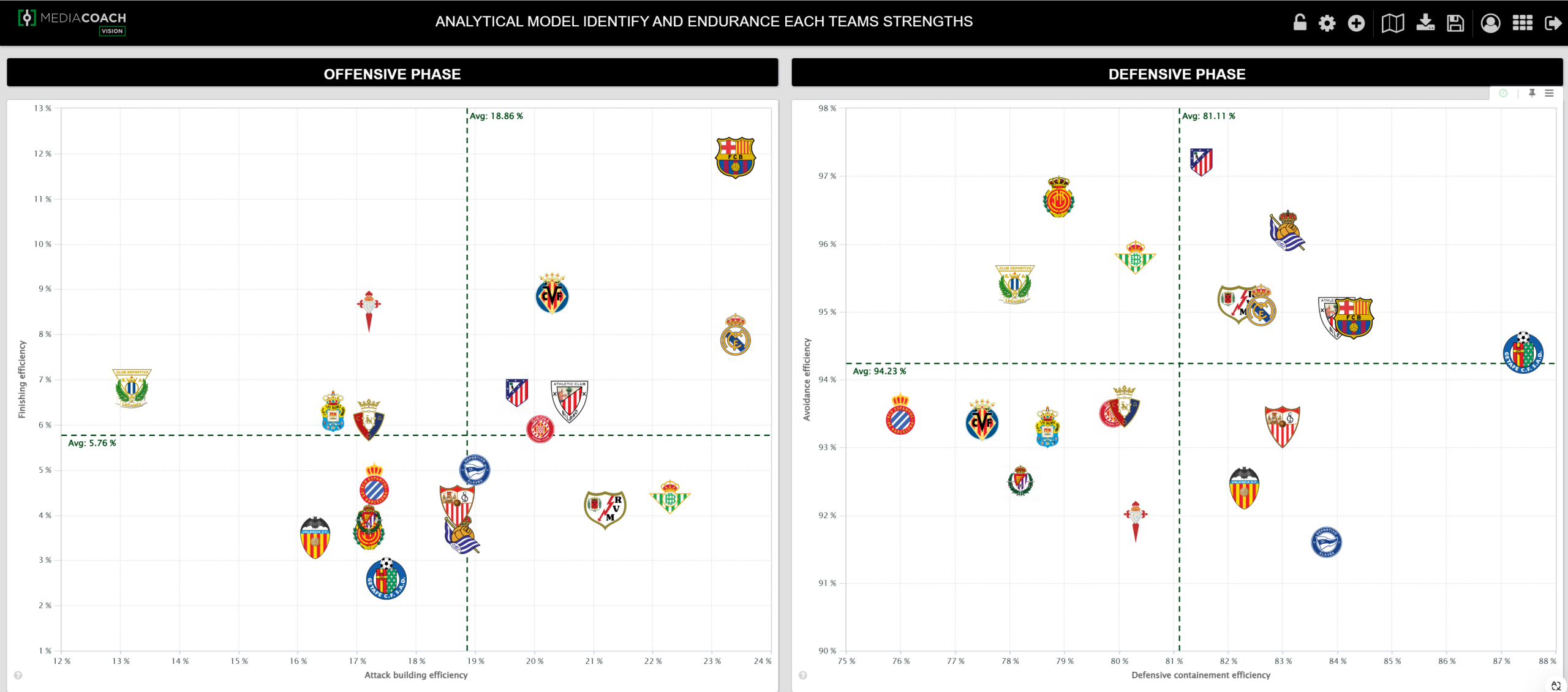
From LaLiga’s new Football Intelligence & Sports Analytics department, we have developed an analytical model that allows us to identify and enhance each team’s strengths in a practical and data-driven manner. For the 2024/25 LaLiga EA Sports season, up to matchday 14, we have used this model to analyze each club’s offensive and defensive performance, measuring their ability to create and convert opportunities, as well as to contain and neutralize opponents. This analytical approach focuses on key metrics such as Attacking Penetration (frequency of reaching the opponent’s box), Scoring Efficiency (effectiveness in converting those chances into goals), Preventing Opponent Penetration (ability to limit the opponent’s attacks), and Preventing Opponent Scoring (ability to prevent the opponent’s chances from turning into goals). The aim is to provide useful insights for coaches to improve their team’s performance and outperform their rivals.
Strengths Identified in Each Team up to Matchday 14
1. FC Barcelona (BAR)
Barcelona excels at pressing and maintaining pressure on their opponents’ area, as evidenced by their high Attacking Penetration (20.11%). This makes them a relentless attacking force that constantly generates opportunities. Practical Recommendation: Focus on maintaining possession-based play and rapid transitions to continue creating space.
2. Real Madrid (RMA)
Real Madrid stands out for their lethal Scoring Efficiency (8.1%), making them one of the most dangerous teams in the final third. Practical Recommendation: Work on maintaining the offensive rhythm and maximizing every opportunity to ensure high-quality finishing.
3. Atlético de Madrid (ATM)
Atlético de Madrid shines for their ability to Prevent Opponent Scoring (94.53%), creating a defensive wall that makes it difficult for opponents to convert chances. Practical Recommendation: Continue strengthening defensive organization and rapid transitions to capitalize on counterattacks.
4. Sevilla FC (SEV)
Sevilla displays excellent ability to Prevent Opponent Penetration (83.7%), making it challenging for opponents to create danger. Practical Recommendation: Maintain high pressure and defensive discipline to limit opponents’ attacking options.
5. Real Betis (BET)
Betis excels in Attacking Penetration (20.91%), creating a high volume of offensive opportunities. Practical Recommendation: Focus on improving Scoring Efficiency to increase the conversion rate of their chances and capitalize on their offensive output.
6. Real Sociedad (RSO)
Real Sociedad combines high Attacking Penetration (20.4%) with impressive Scoring Efficiency (7.1%). Practical Recommendation: Enhance offensive pressure and fine-tune finishing to maintain their goal-scoring effectiveness.
7. Villarreal CF (VIL)
Villarreal boasts excellent Scoring Efficiency (7.2%), making them extremely effective at converting chances. Practical Recommendation: Continue dynamic attacking movements and ensure every offensive player is ready to finish accurately.
8. Athletic Club (ATH)
Athletic excels at Preventing Opponent Scoring (94.02%). Practical Recommendation: Focus on maintaining strong defensive lines and effective retreat to preserve their defensive strength against attacks.
9. Deportivo Alavés (ALA)
Alavés maintains a good balance with Scoring Efficiency (6.13%) and strong defensive capabilities, including Preventing Opponent Penetration (82.78%). Practical Recommendation: Capitalize on quick transitions and work on maintaining solid block defense.
10. Valencia CF (VAL)
Valencia combines high Attacking Penetration (18.9%) with solid Scoring Efficiency (6.4%). Practical Recommendation: Maximize creativity in the final third to maintain and improve their offensive efficiency.
11. Rayo Vallecano (RAY)
Rayo demonstrates strength in Preventing Opponent Penetration (82.9%), making it difficult for opponents to enter their box. Practical Recommendation: Continue working on compact lines and quick transitions.
12. Getafe CF (GET)
Getafe has a standout ability to Prevent Opponent Scoring (94.1%), making them a tough team to beat. Practical Recommendation: Focus on generating offensive play to complement their strong defense.
13. Celta de Vigo (CEL)
Celta balances their game with good Preventing Opponent Penetration (81.3%) and Scoring Efficiency (5.2%). Practical Recommendation: Increase quality in the attacking area to improve their conversion rate.
14. Girona FC (GIR)
Girona shows high Attacking Penetration (19.7%) and strong Scoring Efficiency (6.9%). Practical Recommendation: Maintain offensive focus and improve decision-making in the final pass to maximize opportunities.
15. UD Las Palmas (LPA)
Las Palmas excels defensively with Preventing Opponent Penetration (83.5%) and Preventing Opponent Scoring (94.4%). Practical Recommendation: Prioritize defensive strength while exploring new offensive options.
16. Levante UD (LEV)
Levante combines good Attacking Penetration (18.3%) with Scoring Efficiency (6.1%). Practical Recommendation: Refine attacking movements to ensure higher goal conversion rates.
17. Mallorca (MLL)
Mallorca excels at Preventing Opponent Penetration (84.2%). Practical Recommendation: Maintain defensive order and capitalize on counterattacking opportunities.
18. CA Osasuna (OSA)
Osasuna displays a balanced approach with Attacking Penetration (17.1%) and Scoring Efficiency (5.3%), complemented by strong defensive capabilities. Practical Recommendation: Strengthen offensive capacity to better capitalize on opportunities.
19. Cádiz CF (CAD)
Cádiz is known for its Preventing Opponent Scoring (94.6%), which effectively protects its goal. Practical Recommendation: Focus on improving offensive output to complement their defensive solidity.
20. Almería (ALM)
Almería excels in Attacking Penetration and shows a good offensive balance. Practical Recommendation: Enhance Scoring Efficiency to convert more chances into goals.
Scientific Validation of the Model
Main Conclusion and Scientific Support for Each Test
1. Positive Correlation with Overall Performance (Analysis 1)
- Main Conclusion: Attacking Penetration and Scoring Efficiency metrics have strong positive correlations with points and goals scored, proving they are good indicators of offensive success.
- Scientific Support: Strong correlation shows these metrics consistently reflect the team’s offensive capacity.
2. Multiple Linear Regression (Analysis 2)
- Main Conclusion: Scoring Efficiency significantly impacts points obtained, confirming its relevance to success.
- Scientific Support: The high significance of Scoring Efficiency reinforces the importance of converting chances into goals.
3. Cross-Validation (Analysis 3)
- Main Conclusion: The model demonstrated a mean cross-validation score of 78.3%, showing good predictive power.
- Scientific Support: Robustness across different data subsets supports the applicability of the metrics.
4. Group Comparison (Analysis 4)
- Main Conclusion: High-performing teams have significantly higher values in Attacking Penetration and Scoring Efficiency.
- Scientific Support: The difference between groups validates that the metrics distinguish team success.
5. Predictive Power Throughout the Season (Analysis 5)
- Main Conclusion: Increases in Attacking Penetration and Scoring Efficiency are associated with improved point totals over the season.
- Scientific Support: The model demonstrates predictive capability, not just descriptive power.
6. Controlling for Confounding Factors (Analysis 6)
- Main Conclusion: When controlling for factors like goals conceded, Attacking Penetration and Scoring Efficiency metrics maintained their significant relationship with performance.
- Scientific Support: This confirms that the metrics are not merely coincidental but have a direct and significant impact, even when considering external factors.
7. Convergent and Discriminant Validity (Analysis 7)
- Main Conclusion: The metrics demonstrate good convergent validity by appropriately correlating with related metrics and good discriminant validity by not correlating with unrelated variables.
- Scientific Support: This ensures each metric captures a specific aspect of performance and reinforces their utility as analytical tools to enhance team performance.
This approach to advanced analytics allows coaches to identify and maximize their teams’ strengths, adjust tactics, and plan training sessions more accurately based on solid, validated data.