


01 Dic Impact of the FIFA World Cup Qatar 2022 on LaLiga Players’ Physical Performance: Unveiling Insights Into External Load Patterns
Did the Qatar 2022 World Cup damage LaLiga players’ physical performance?
The tournament was played in the middle of the season.
High temperatures.
Compressed schedules.
Extra time matches.
Travel.
Emotional and physical stress.
The expectation in many environments was clear: post-World Cup fatigue.
This study tested that assumption.
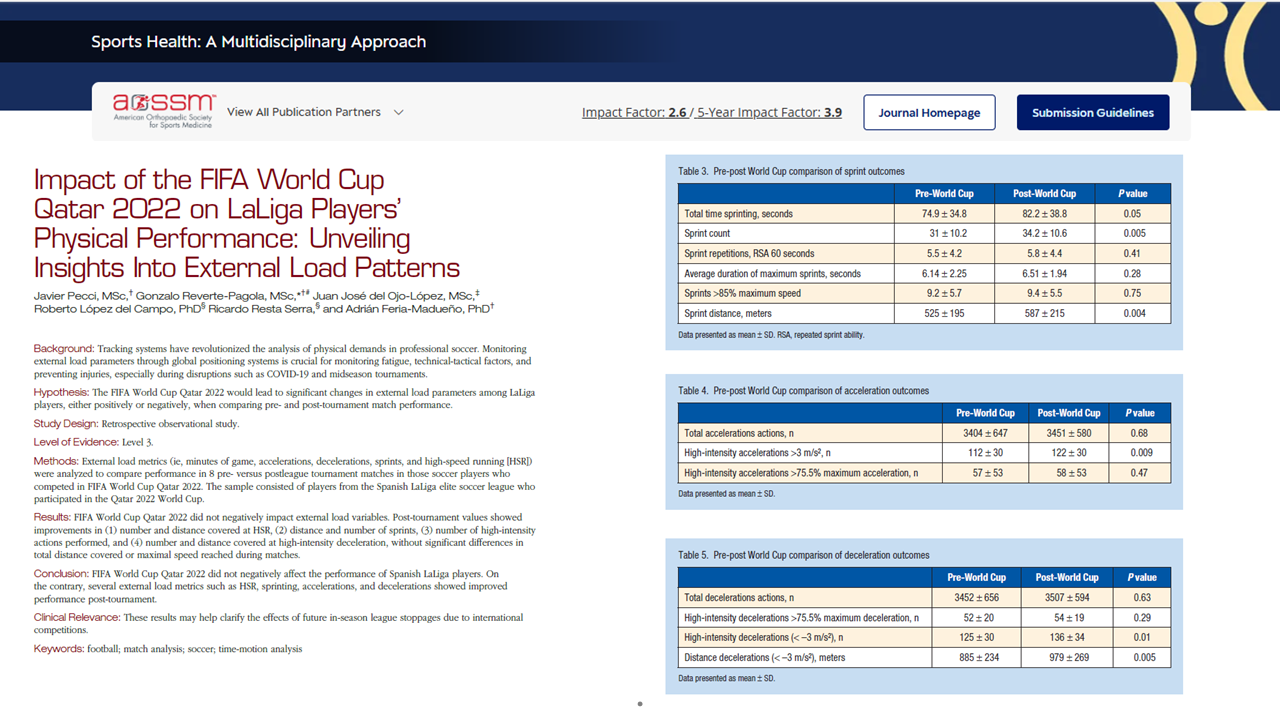
Using tracking data from LaLiga players who participated in the FIFA World Cup Qatar 2022, the authors compared external load metrics from 8 league matches before the tournament with 8 matches after returning to domestic competition.
A total of 57 LaLiga players were included (19 defenders, 28 midfielders, 10 forwards; mean age 24.6 years). Only matches where players competed for more than 60 minutes were analyzed to avoid substitute bias.
The results challenge the fatigue narrative.
Minutes played showed no significant differences before and after the World Cup.
Total distance covered did not change significantly.
Maximal speed did not change significantly.
In other words, the World Cup did not reduce baseline match output.
But something more interesting happened.
High-speed running (HSR) increased post-tournament.
Specifically:
– Total number of HSR actions increased
– Total HSR distance increased
– Total duration of HSR increased
Sprint performance also improved:
– Total sprint count increased
– Total sprint distance increased
Acceleration and deceleration profiles followed a similar pattern.
While total acceleration counts remained stable, high-intensity accelerations (>3 m/s²) increased.
High-intensity decelerations (< –3 m/s²) also increased, both in count and total distance.
These are not minor details.
High-speed running, sprinting, and high-intensity accelerations are strongly linked to decisive match actions and goal-scoring situations.
So what does this mean?
First, the World Cup did not impair LaLiga players’ physical performance.
Second, certain external load metrics actually improved after the tournament.
Why could this happen?
Several possible explanations emerge.
Players competing at the highest international level may have experienced:
– Peak competitive stimulus
– Optimized microcycle management during the tournament
– Enhanced neuromuscular readiness
– Psychological elevation and competitive rhythm
Additionally, the temporary interruption of domestic league play may have functioned as a recovery window for some players, particularly those eliminated earlier.
Importantly, maximal speed did not increase.
This suggests that players did not become “faster” in absolute terms.
Instead, they performed more high-intensity actions within matches.
This distinction matters.
Coaches should expect similar peak sprint capacity, but potentially higher frequency of repeated high-speed efforts post-tournament.
From a load management perspective, this is critical.
Increases in:
– High-speed running
– Sprint volume
– High-intensity accelerations
– High-intensity decelerations
mean increased neuromuscular load, especially on the posterior chain.
Hamstring injuries remain the most frequent non-contact injury in elite football.
Higher sprint and deceleration exposure requires proactive recovery strategies.
Another relevant finding concerns acceleration and deceleration patterns.
Post-World Cup increases in high-intensity decelerations (< –3 m/s²) are particularly important.
Decelerations are mechanically demanding and strongly associated with muscle damage and fatigue markers.
Therefore, although performance improved, fatigue risk management remains essential.
The study also highlights an important practical message.
Line-up decisions post-international tournaments should not assume physical decline.
Instead, players may be capable of higher high-intensity outputs.
Training microcycles after similar mid-season tournaments (e.g., African Cup of Nations, future winter World Cups) should consider:
– Monitoring HSR exposure
– Individualizing recovery
– Adjusting acceleration/deceleration load in training
– Tracking internal load responses alongside external metrics
One limitation acknowledged in the study is that only external load was analyzed. Internal load markers were not included.
Future research combining match load, training load and internal physiological responses would offer deeper insight.
But the central conclusion remains strong.
The FIFA World Cup Qatar 2022 did not negatively impact LaLiga players’ match running performance.
On the contrary, several high-intensity external load metrics improved.
In-season international tournaments may not be as disruptive as commonly feared.
Context, preparation and load management matter.
Fatigue is not inevitable.
Performance is adaptive.