


01 Feb Influence of competitive level and playing position on the physical and technical demands of professional men’s football
Are First Division players physically superior?
Or are they simply more technically efficient?
This study analysed 1,608 official matches across two full seasons (2021/22 and 2022/23) in the Spanish First and Second Divisions, including 1,050 professional players from 44 teams.
The objective was clear.
To determine how competitive level and playing position influence both physical and technical demands — and to differentiate those demands across phases of play (with and without possession).
The analysis combined TRACAB tracking data (physical metrics) and OPTA event data (technical actions), offering one of the most comprehensive position-specific comparisons between divisions to date.
The results show that the differences between divisions are not uniform.
They are positional.
They are phase-dependent.
And they are strongly linked to playing style.
High-intensity running and sprinting
First Division players covered greater distances at high speed (>21 km/h) and sprint speed (>24 km/h), particularly:
– Central midfielders (CM)
– Forwards (FW)
– Wide defenders (WD)
The most relevant differences appeared during possession phases.
First Division CM and FW covered significantly more high-speed running distance in possession (HSR-A) and sprint distance in possession (SPR-A).
Wide defenders in the First Division covered more high-speed running distance both in possession and without possession.
This suggests that higher competitive standard is associated with greater high-intensity involvement during attacking phases.
Interestingly, total distance (TD) did not show major differences between divisions.
The key discriminator was intensity, not volume.
Central defenders (CD) and wide midfielders (WM) did not show clear differences in physical demands between divisions.
Technical performance
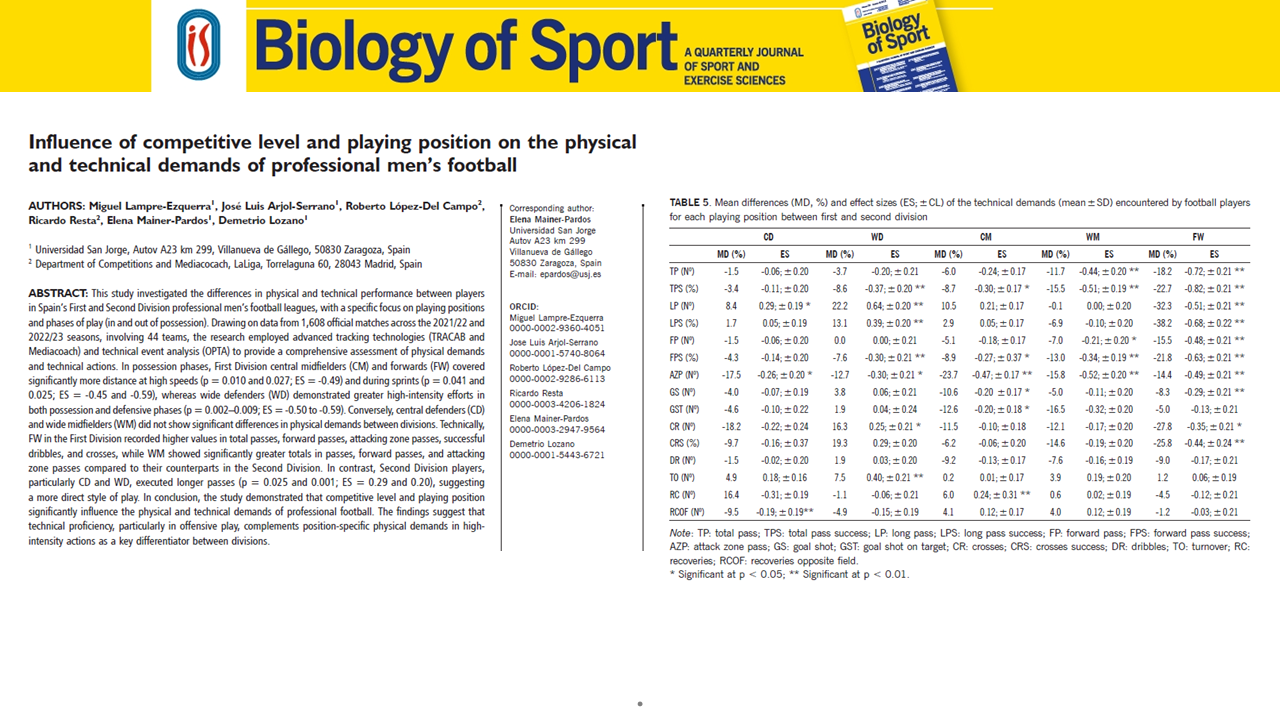
Where the differences become even clearer is in technical actions.
First Division players, especially forwards and wide midfielders, showed superior performance in:
– Total passes
– Forward passes
– Attacking zone passes
– Successful dribbles
– Crosses
– Goal shots
Forwards in the First Division had substantially higher offensive involvement compared to Second Division forwards.
In contrast, Second Division players — particularly central defenders and wide defenders — executed more long passes.
This suggests a more direct playing style in the Second Division.
First Division football appears more possession-oriented and structured in build-up phases.
Second Division football appears more direct and transitional.
Phase of play matters
When analysing possession vs non-possession phases, important patterns emerge.
First Division wide defenders showed greater high-speed running in defensive phases as well.
This likely reflects:
– Higher pressing intensity
– Faster defensive recovery after attacking involvement
– Tactical compactness and high defensive lines
Central midfielders in the First Division combined:
– Greater high-intensity running
– Greater involvement in ball progression
– Greater attacking technical contribution
This dual profile suggests that CM in higher divisions must combine physical capacity with technical decision-making efficiency.
Forwards in the First Division not only sprint more during attacking phases, but also participate more frequently in build-up and final-third actions.
Sprinting remains the most frequent action preceding goal situations.
Therefore, these high-intensity actions may be directly linked to competitive differentiation.
Style of play as mediator
The study suggests that playing style partly explains these differences.
Spanish First Division teams typically adopt more possession-based models.
Second Division teams tend toward more direct approaches, reflected in:
– Higher long pass frequency
– Fewer short combinations
– Less high-speed attacking runs
Thus, competitive level does not only influence physical output.
It shapes technical and tactical demands.
Key insight
The difference between divisions is not about running more.
It is about:
– Running at higher intensity during attacking phases
– Being more technically efficient in possession
– Combining positional physical profiles with offensive contribution
Physical performance alone does not define elite standard.
Technical proficiency, especially in offensive contexts, complements high-intensity actions as a key differentiator.
Practical implications
For coaches and performance staff:
- Conditioning must be position-specific.
WD, CM and FW require greater high-intensity capacity in higher divisions. - Technical development during possession phases is critical.
Passing accuracy, forward progression and attacking zone involvement distinguish higher-level players. - Recruitment and player promotion decisions should consider both:
– High-intensity involvement during possession
– Technical efficiency in build-up and final-third phases - Physical training must align with tactical model.
Possession-oriented teams require repeated high-intensity efforts during attacking phases.
In elite football, physical and technical demands are inseparable.
Competitive level amplifies the need for both.