


26 Nov Information integration and the latent consciousness of human groups
Can a football team think?
Not metaphorically. Not emotionally. But mathematically.
This study applies Integrated Information Theory (IIT) — a formal framework originally developed to quantify consciousness in the brain — to professional soccer teams.
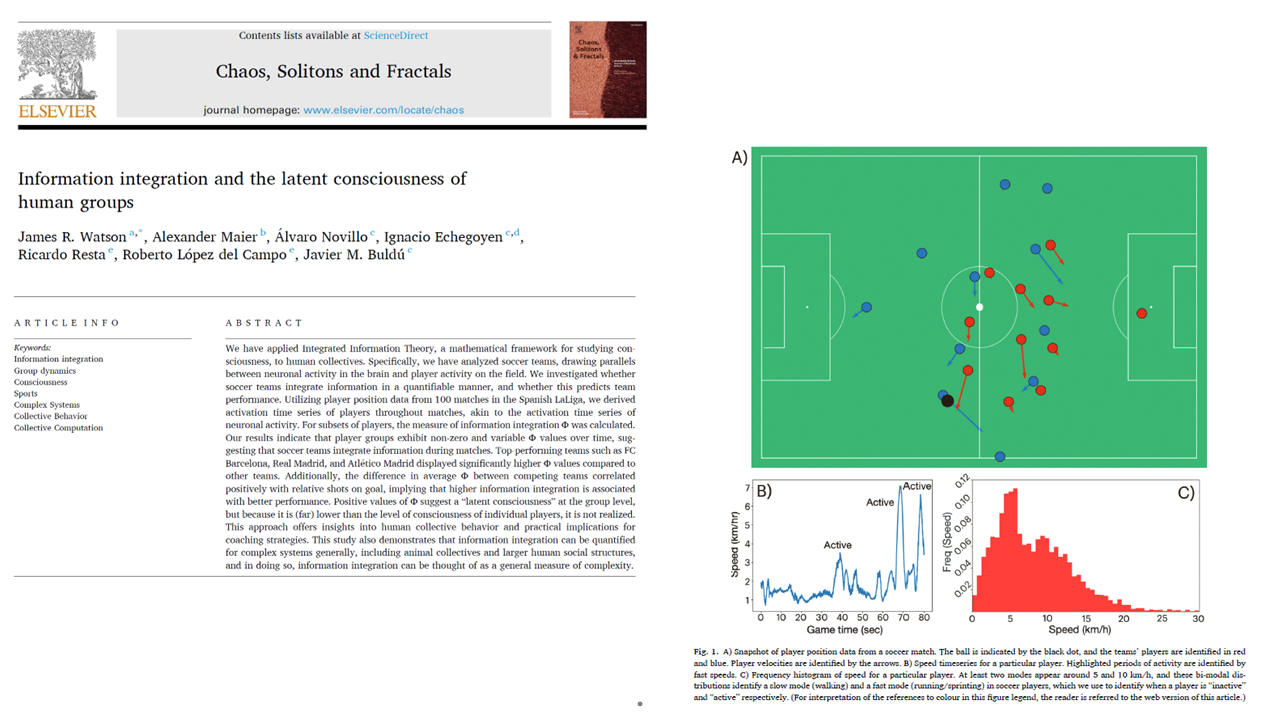
Using tracking data from 100 LaLiga matches (2018/2019 season), the authors transformed player positional data into activation time series, analogous to neuronal firing patterns. From these time series, they constructed transition probability matrices and computed Φ (Phi), the core IIT metric that quantifies information integration.
In simple terms:
Φ measures how much a system works as a whole rather than as a collection of independent parts.
And soccer teams, according to this study, do integrate information.
For subsets of players (pairs, trios and quartets), Φ values were consistently non-zero and variable over time. This indicates that player groups function as causally integrated systems during matches.
Importantly, higher Φ values were associated with better performance.
When comparing the three top teams of that season — FC Barcelona, Real Madrid and Atlético de Madrid — with all other teams, the top teams exhibited significantly higher Φ values.
The distribution of Φ for these elite teams was shifted upward relative to the rest of the league.
Performance correlation analysis showed:
– A positive relationship between average Φ and number of shots on goal
– A positive relationship between the difference in Φ between two teams and the difference in shots on goal
The correlations were modest but statistically significant.
This suggests that teams that integrate information more effectively generate more offensive pressure.
Shots on goal were chosen instead of goals as the performance metric because they provide a more sensitive measure of dominance. Goals are sparse events. Shots reflect sustained attacking capacity.
So what exactly is being measured?
The methodology followed several steps.
First, player speeds were computed from tracking data.
Second, speeds were binarized into “active” and “inactive” states using bimodal speed distributions (walking vs running/sprinting).
Third, transition probability matrices (TPMs) were constructed for combinations of players. These matrices describe how the collective activation state at time t transitions to time t+1.
Fourth, Φ was computed using the PyPhi toolbox, applying IIT’s formal causal framework.
Due to computational constraints, full 10-player systems were not analyzed. Instead:
– All possible player pairs (45 combinations per team) were evaluated
– All possible player trios (120 combinations) were evaluated
– Limited exploration of quartets was performed
A key result emerged.
Φ increases with group size.
Typical values were:
– Around 3 for player pairs
– Around 6–7 for trios
– Up to 80–100 for quartets
This scaling indicates that larger interacting groups integrate more information.
However, even these values remain far below what is estimated for human brains.
According to IIT’s Exclusion Principle, consciousness corresponds to the subsystem with maximal Φ. In humans, that subsystem is the brain — not the team.
Therefore, soccer teams exhibit what the authors call “latent consciousness.”
They integrate information as a system.
But they do not generate subjective experience.
This distinction matters.
The study does not claim that teams are conscious in a psychological sense.
It demonstrates that information integration — the mathematical foundation proposed by IIT — exists at the group level.
Another interesting finding relates to player combinations.
For trios, Φ distributions were bimodal.
Certain combinations of players generated much higher Φ values than others.
This likely reflects tactical linkages.
For example:
– A central midfielder and two forwards working in coordinated attacking patterns
– Defensive units moving in synchronized lines
These configurations produce stronger causal interdependence.
The null model analysis reinforces the robustness of results.
When one player’s activation time series was replaced with a random player from another match, correlations between Φ and performance disappeared.
This confirms that the observed relationships are not statistical artifacts.
From a practical football perspective, what does this mean?
Higher Φ reflects stronger causal coupling between players.
This could correspond to:
– Passing networks
– Coordinated pressing
– Positional rotations
– Set-play synchronization
– Tactical cohesion
In styles such as tiki-taka, where short, rapid interactions define the game, Φ may capture a meaningful aspect of performance.
However, not all tactical systems maximize Φ.
Direct play, long-ball strategies or counterattacking approaches may rely less on dense integration and more on transitional efficiency.
Therefore, Φ should not be interpreted as a universal indicator of superiority.
It measures collective integration — not necessarily effectiveness across all styles.
The broader implication extends beyond sport.
If human groups integrate information measurably, then Φ can be used as a general metric of collective complexity.
This framework could theoretically be applied to:
– Animal collectives
– Musical ensembles
– Corporate teams
– Social networks
– Large-scale societies
Soccer becomes a controlled laboratory for studying collective computation.
Ultimately, this research bridges neuroscience, complexity science and performance analysis.
It shows that teams are not just aggregations of individuals.
They are dynamic causal systems.
They compute.
They integrate.
They coordinate.
And the better they do so, the more dominant they become on the field.
Football is not only about physical output.
It is about collective information processing.