


13 Sep Injury Prevention in Professional Football: Insights and Solutions Based on Scientific Research and LALIGA Technology
Muscle injuries, particularly hamstring injuries, have been a constant concern in professional football. These injuries not only affect team performance but also have a significant impact on player health, match outcomes, and the costs associated with recovery. In this context, scientific research and the use of advanced technology have become essential tools to mitigate these risks.
Hamstring Injuries: A Growing Problem in Professional Football
According to a recent study published by LALIGA, hamstring injuries account for 24% of all reported injuries during a football season. These injuries are not only common but have also been on the rise in recent years, affecting player performance and causing prolonged absences. In fact, the incidence of these injuries has increased from 12% of all injuries in the 2001-2002 season to 24% in the 2021-2022 season. Players who suffer a hamstring injury typically miss an average of 13 days, although in more severe cases, recovery can take several weeks.
In football matches, the incidence of hamstring injuries is 10 times higher than in training sessions. Additionally, 18% of all recorded hamstring injuries are recurrent, underscoring the importance of proper recovery and prevention strategies.
The Link Between Accumulated Fatigue and Hamstring Injuries
One of the most revealing findings from the study is the connection between short periods of high-intensity running during matches and the risk of hamstring injuries. The research showed that, in the five minutes leading up to a hamstring injury, players ran significantly greater distances at speeds above 21 km/h compared to matches where no injuries occurred. In these cases, players covered 76% more distance at speeds between 21-24 km/h and 114% more distance at speeds over 24 km/h. This sudden increase in running intensity appears to be a clear trigger for these injuries.
This pattern suggests that when players face short bursts of high-intensity running during matches—especially in critical moments such as the final minutes of each half—they are more likely to sustain injuries. This is particularly evident during the last 15 minutes of each half, when accumulated fatigue begins to affect physical performance and neuromuscular coordination.
LALIGA’s Technological Solution: Mediacoach Live Pro
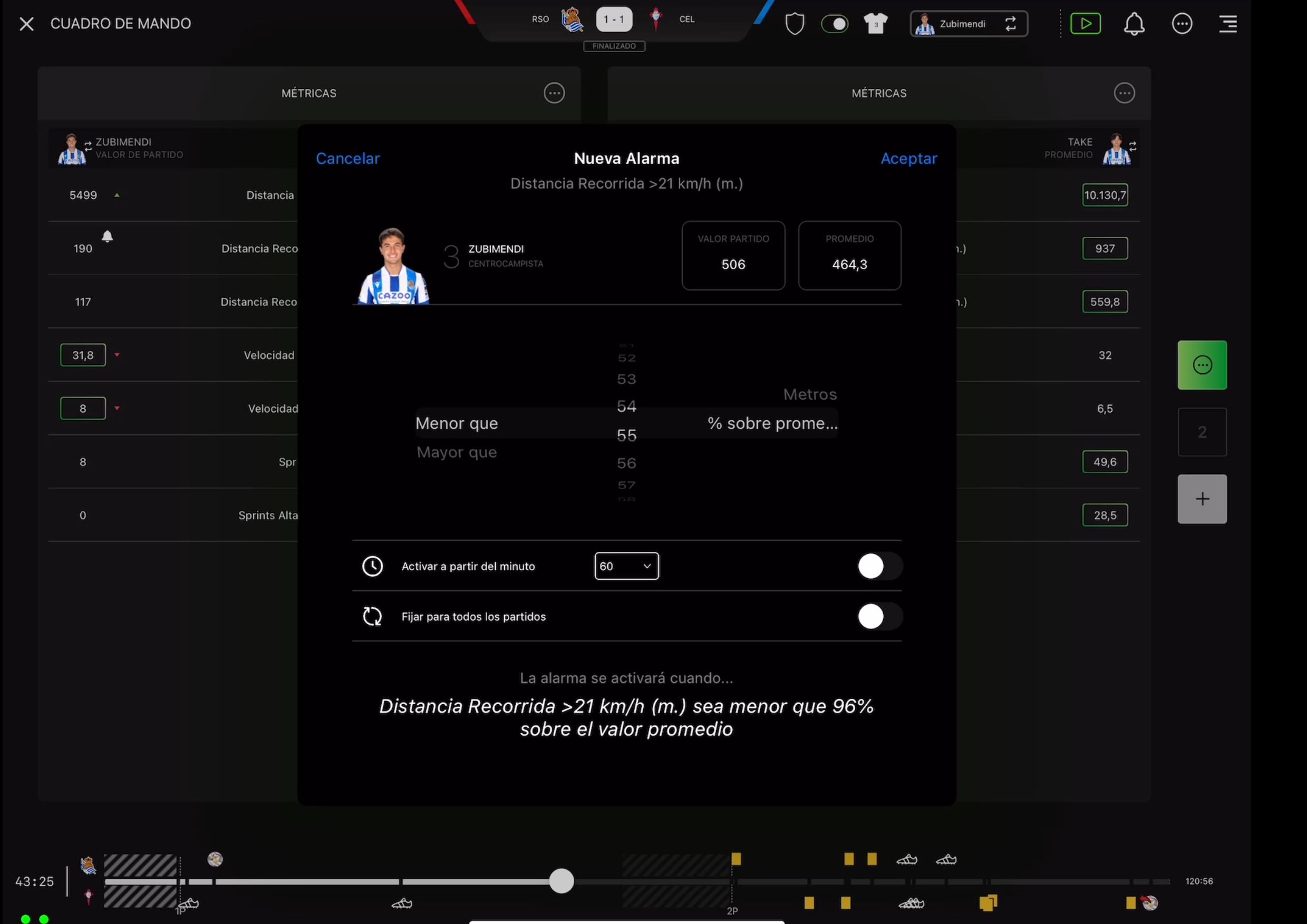
Based on these results, LALIGA has taken a significant step forward by implementing technological solutions to prevent injuries among its teams. Mediacoach Live Pro, an exclusive application available to the 42 clubs competing in LALIGA EA Sports and LALIGA Hypermotion, has been designed to monitor players’ physical and technical metrics in real-time during matches. This tool provides coaches and fitness trainers with key insights into player performance, enabling them to make real-time decisions to prevent potential injuries.
How does Mediacoach Live Pro work?
The app uses real-time data to alert fitness trainers when a player reaches 80% of their usual high-intensity efforts, measured primarily by the distance covered at high speed and the number of sprints. For example, if an alert is triggered in the 60th minute of a match, the fitness trainer can inform the coach that the player is nearing their typical effort limit. At this point, the coaching staff can consider a strategic substitution to prevent injury due to accumulated fatigue or overexertion.
This system is designed to help clubs manage player fatigue more efficiently, providing a competitive edge by preventing injuries that could jeopardize the team’s performance throughout the season. Backed by LALIGA’s scientific research, the tool is both valid and effective in practice.
Applying the Results to Training Planning
In addition to the real-time alerts during matches, coaches can use these findings to adjust their training plans. It is crucial to incorporate high-intensity exercises that simulate match demands, but with strict control over periods of fatigue. Training sessions should include short bursts of high-intensity running, similar to those experienced in matches, allowing players to adapt to these demands and reduce the risk of injury.
Another key aspect is managing the workload during the week leading up to a match. Teams must ensure that players do not enter matches with high levels of fatigue, as this increases the risk of muscle injuries.
Conclusion
Preventing injuries in professional football is a challenge that requires a combination of scientific research, advanced technology, and smart workload management for players. With the implementation of Mediacoach Live Pro’s alert system, LALIGA is at the forefront of injury prevention, helping its teams protect their players and enhance overall performance.
The results of this research, combined with the technological tools available, provide a clear path to preventing hamstring injuries, enabling coaches and fitness trainers to make data-driven decisions that can make the difference between winning and losing a match.
For more detailed insights, you can read the full study here: https://doi.org/10.5114/biolsport.2024.127387