


24 Abr The Jump That Makes the Difference: When Pressing Aggression Really Pays Off
Introduction
Pressing is one of the most defining defensive behaviors in modern football. But within pressing, not all actions are equal.
The “jump” — a player breaking structure to aggressively press the ball carrier — represents the most decisive and risky defensive action.
It raises a fundamental question:
Is it worth taking the risk of jumping to press?
Using full-season LALIGA data, we move beyond intuition and test one of football’s most common tactical beliefs.
From Volume to Effectiveness: Rethinking Pressing
Traditional analysis often focuses on:
- Number of pressures
- Ball recoveries
- Defensive activity
But this approach mixes very different contexts.
Instead, we isolate the jump and measure its true effectiveness:
Jump Success Rate
- 5 seconds → immediate disruption
- 10 seconds → sustained disruption
A jump is considered successful if the opponent’s possession ends within this time window.
Key Finding #1: It’s Not About How Many Jumps You Make
There is no meaningful relationship between jump volume and team performance.
However, when focusing on effectiveness:
- Jump success rate (10s) vs points → r = 0.56 (p < 0.01)
- Jump success rate (5s) vs points → r = 0.51 (p < 0.05)
Interpretation
Teams don’t succeed by pressing more — they succeed by pressing better.
Key Finding #2: Not All Jumps Are Created Equal
The context — specifically the defensive block — fundamentally changes the value of a jump.
High Block: Efficient but Not Differentiating
- Higher average success rates
- More favorable conditions
However:
- Low correlation with performance (r ≈ 0.20–0.25)
Interpretation
High block jumps are effective… but most teams can execute them.
Medium Block: The Real Competitive Edge
- More complex and less structured context
- Lower average efficiency
Yet:
- Success rate (10s) vs points → r = 0.58 (p < 0.01)
- Success rate (5s) vs points → r = 0.49 (p < 0.05)
Interpretation
This is where teams truly separate themselves.
Low Block: The Absence of the Jump
- Almost no jump actions recorded
This is not a limitation of the data — it is a tactical reality.
The risk of jumping near your own goal is so high that teams simply avoid it.
Top Performing Teams in Jump Effectiveness
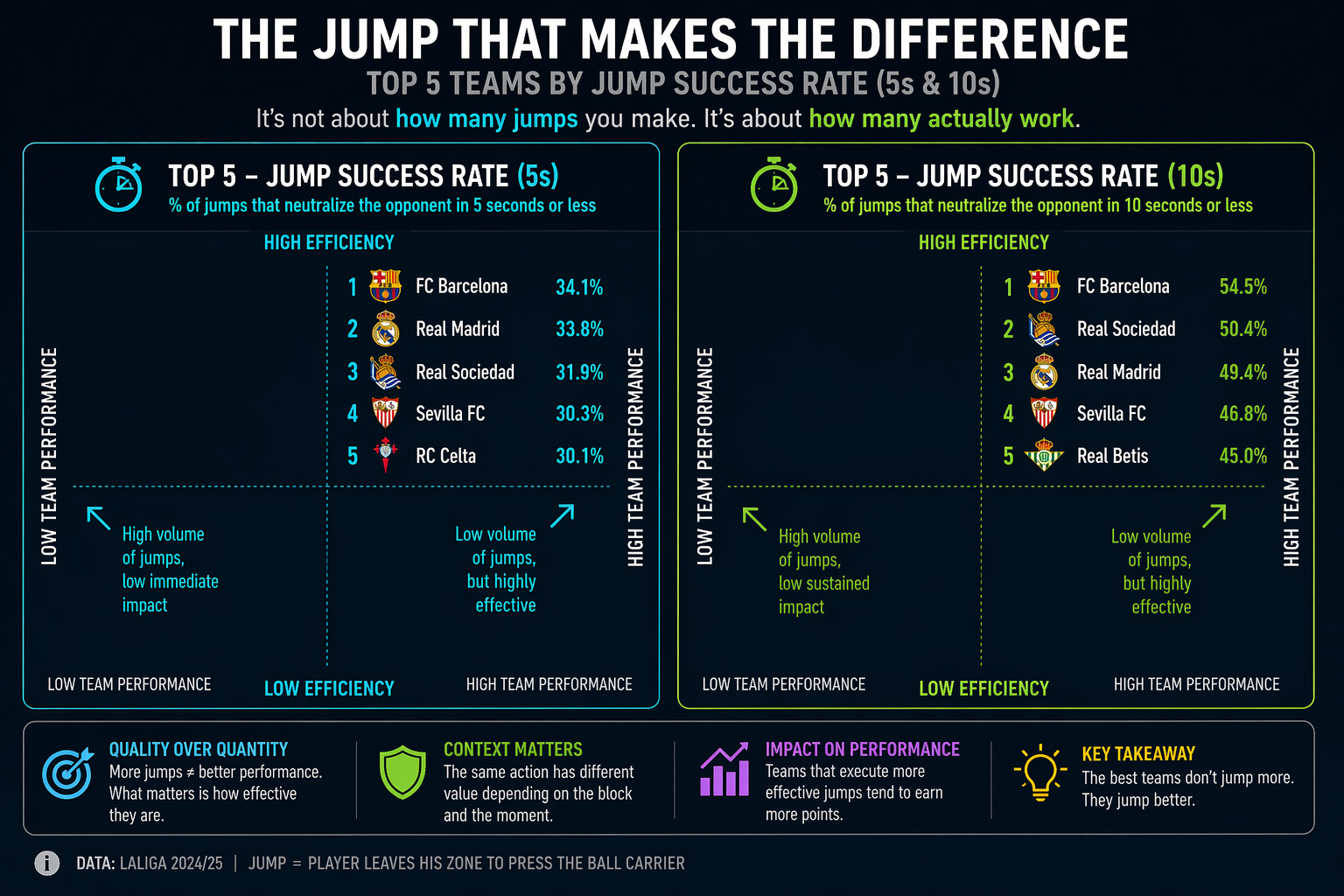
Jump Success Rate (10s)
- FC Barcelona → 54.5%
- Real Sociedad → 50.4%
- Real Madrid → 49.4%
- Sevilla FC → 46.8%
- Real Betis → 45.0%
Jump Success Rate (5s)
- FC Barcelona → 34.1%
- Real Madrid → 33.8%
- Real Sociedad → 31.9%
- Sevilla FC → 30.3%
- RC Celta → 30.1%
Key Insight: Immediate vs Sustained Impact
- 5s success → quality of the trigger
- 10s success → quality of the system
The best teams don’t just win the action — they win the sequence.
So… Is the Jump Worth It?
The answer is not binary.
✔ Yes — when executed in the right context
- High probability of disrupting possession
- Creates defensive advantage
❌ No — when poorly timed
- Especially in Medium Block
- Or near own goal
Key idea
The jump is not inherently valuable.
Its value depends entirely on when and where it is executed.
Practical Implications for Coaches
- Prioritize decision-making over intensity in Medium Block
- Train jumps as collective actions, not individual reactions
- Evaluate pressing by outcomes (5s / 10s), not by volume
What This Analysis Adds
This is not about discovering something new.
Coaches already:
- Avoid jumping in low block
- Look to press higher
What this analysis provides is:
- Quantification of tactical intuition
- Clear identification of where differences emerge
- A framework to evaluate pressing beyond volume
Final Takeaway
The jump is not a volume action — it is a quality action.
And in LALIGA, teams are not defined by what they do in favorable situations…
but by what they are capable of doing in the most demanding ones.
Closing Thought
The best teams don’t jump more.
They jump better — and, more importantly, at the right moment.